Many organizations adopt workforce monitoring platforms like Insightful. These tools surface productivity trends, track attendance, and map software utilization across departments.
However, solely monitoring hours worked leaves a critical blind spot. Work intelligence software records when employees work, but can’t defend corporate infrastructure against intellectual property exfiltration or compliance violations.
Because platforms in this category deliberately avoid content inspection, keystroke capture, or endpoint policy enforcement, they cannot stop an employee from copying customer databases to personal drives or pasting proprietary code into unvetted AI apps. Safeguarding a distributed business requires solutions that unite workforce analytics with proactive behavioral cybersecurity.
Quick verdict: What are the top Insightful alternatives for 2026?
- Best overall for DLP and insider threat detection: Teramind. Combines workforce productivity analytics with active data loss prevention (DLP), Optical Character Recognition (OCR), and real-time automated policy enforcement.
- Best for privacy-first team coaching: ActivTrak. Analyzes aggregate workload distribution and burnout risk without keystroke logging or screen surveillance.
- Best for mobile and field teams: Hubstaff. Unites GPS location tracking, geofenced job sites, and automated contractor payroll integration.
- Best for remote task accountability: Time Doctor. Uses task-based timers, daily workflow timelines, and gentle distraction nudges to keep distributed teams focused.
- Best for passive, automated tracking: DeskTime. Tracks app and website usage from system boot-up alongside shift scheduling.
- Best for agency client billing: Toggl. Delivers intuitive, user-controlled timers and client profitability reporting for consultancies and creative firms.
- Best for endpoint policy restrictions: InterGuard. Enforces strict hardware controls, website filtering, and USB blocking to lock down corporate devices.
Why do organizations look for Insightful alternatives?
Insightful (formerly Workpuls) provides clean dashboards and straightforward productivity reports, but this isn’t enough for some organizations. Those with greater compliance and security needs often look elsewhere.
These are the reasons why:
The add-on pricing reality
Insightful advertises an entry point of $8 per seat per month on an annual plan ($10 billed monthly) for its base Analytics tier.
However, configuring a functional employee monitoring environment quickly increases that baseline cost.
Crucial monitoring and security tools require separate subscriptions:
- Workspace Security: +$4/seat/month.
- Screen Recording: +$4/seat/month.
- On-Demand Screenshots: +$4/seat/month.
- Data Warehouse Integrations: +$0.50/seat/month.
Adding standard screen monitoring and security alerts drives the actual price to $20 per seat per month on an annual contract.
Furthermore, companies wanting Insightful’s People Intelligence features must upgrade to the "Insights" tier at $24 per seat per month. This mandates annual billing and a 50-seat minimum commitment ($14,400 annually), which excludes smaller teams that need deeper workforce insights.
Zero active Data Loss Prevention (DLP)
Insightful builds its architecture around a strict privacy-first logging model. By design, the platform doesn’t capture keystroke logs, webcam or microphone feeds, or message and document content.
While this architecture reassures privacy-conscious teams, it leaves enterprise IT and security departments without essential defenses. Foundational data-protection controls (including File Sharing Alerts, Printing Alerts, Policy Violations, and User-Based Risk Analysis) remain labeled as "Coming Soon".
Insightful alerts administrators when an employee launches an unapproved application, but it cannot inspect data in transit, scan clipboard transfers, or block an unauthorized upload of source code or customer records.
Restricted on-premise deployments
Organizations in healthcare, defense, and banking must comply with data sovereignty mandates that prohibit multi-tenant public cloud hosting. Insightful offers on-premises and private cloud hosting, but limits self-hosting strictly to its base Workforce Analytics tier at custom-scoped pricing.
Teams cannot deploy Insightful’s higher-tier People Intelligence or Process Intelligence modules on self-hosted infrastructure. This limitation forces security-conscious enterprises to either compromise internal hosting policies or forgo the platform’s advanced workflow optimization capabilities.
Passive visibility vs. active governance
Insightful acts as an observational tool rather than an active enforcement engine. The platform can flag Shadow AI adoption and application usage, showing managers which teams run tools like ChatGPT or unvetted web applications.
However, Insightful lacks the administrative mechanisms to enforce acceptable use policies in real-time. It reports unauthorized activity after the fact, but cannot block malicious domains, restrict removable USB storage devices, terminate risky sessions, or intercept sensitive corporate data before exfiltration occurs.
How do the leading Insightful competitors compare?
| Platform | Core Strength | Starting Price (Billed Annually) | Monitoring Mode | Threat & DLP Capabilities | Deployment |
|---|---|---|---|---|---|
| Insightful (Baseline) | Work intelligence & process analytics | $8/seat/mo (+ add-ons) | Visible & Stealth | Passive alerts only; no content inspection or active blocking | Cloud; On-Premise (Workforce Analytics tier only) |
| Teramind | Behavioral analytics, insider threat defense & DLP | Starts at $14/seat/mo (5-seat min; DLP tier at $32/seat/mo) | Visible & Stealth | Active: Real-time blocking, OCR, automated DLP policies | Cloud, On-Premise, Private Cloud |
| ActivTrak | Privacy-first workforce capacity trends | $10/worker/mo (Free tier up to 3 users) | Background / Visible | Anomaly detection alerts; no active data blocking | Cloud |
| Hubstaff | Mobile field teams, GPS & payroll integration | $4.99/user/mo (2-seat min; GPS is +$3.33/user/mo) | Visible (Stealth on Enterprise) | Minimal (Focus on payroll and fleet tracking) | Cloud |
| Time Doctor | Task timelines & BPO productivity | $6.67/user/mo (Monthly at $8) | Visible & Silent | Distraction warnings; basic activity metrics | Cloud |
| DeskTime | Fully automated background time tracking | $6.42/user/mo (Monthly at $7) | Automatic / Background | None (Productivity tracking only) | Cloud |
| Toggl Track | Invoicing & billable client projects | $9/user/mo (Free tier up to 3 users) | Visible only | None | Cloud |
| InterGuard | Endpoint policy restriction & web blocking | Custom quote only | Visible & Stealth | High: USB blocking, keyword screen capture, web filtering | Cloud & Hosted |
What are the strengths and limitations of the top Insightful alternatives?
1. Teramind
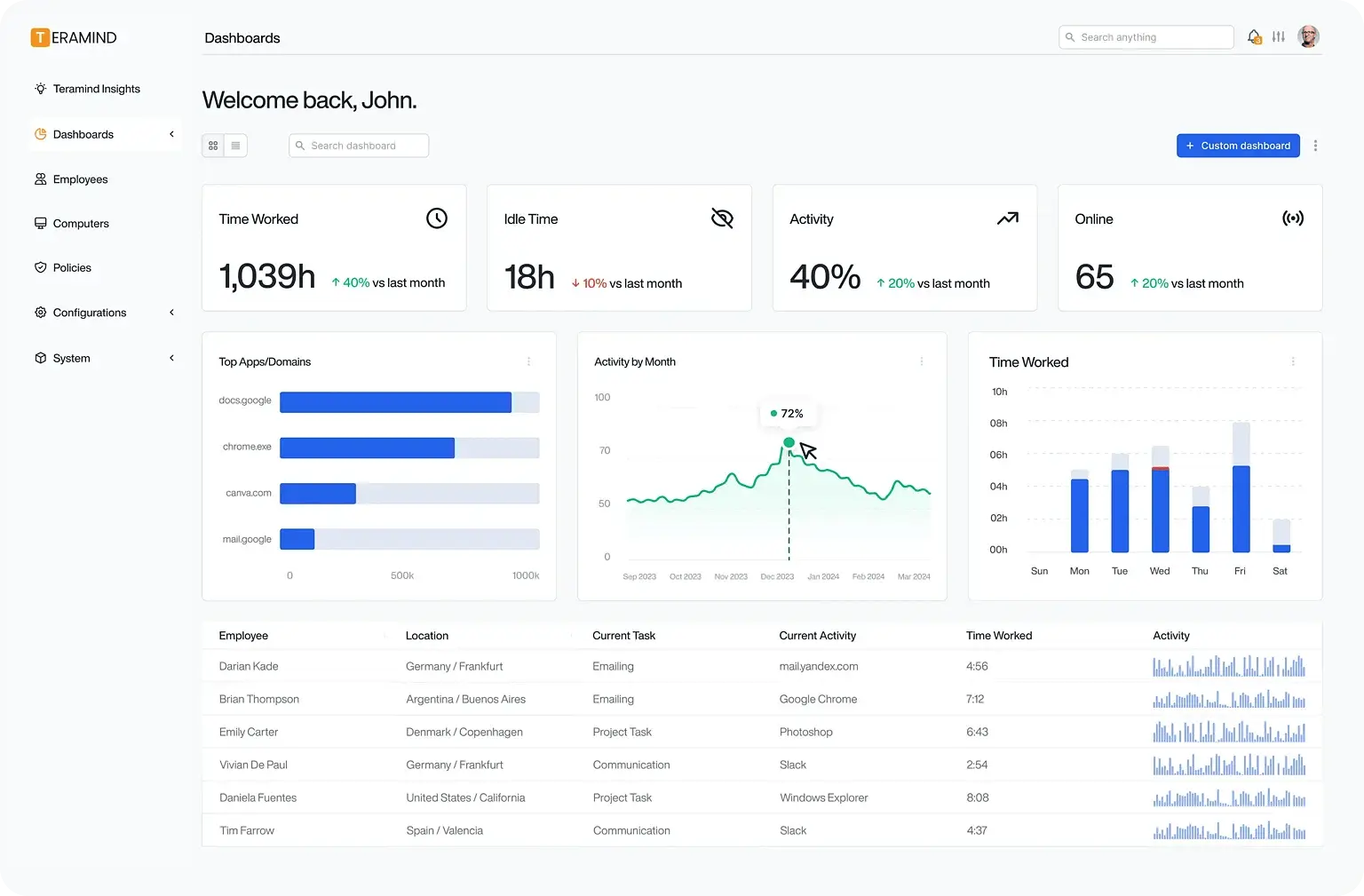
Teramind bridges the divide between workforce intelligence and endpoint cybersecurity.
Instead of treating employee monitoring and data protection as separate initiatives, Teramind combines workforce analytics, insider risk management, business process mining, and endpoint Data Loss Prevention (DLP) into a single agent. It gives leadership clear operational clarity while actively safeguarding intellectual property against leaks and exfiltration.
Key features
- 360-degree multi-channel monitoring: Tracks user activity across 15+ system channels, including applications, websites, file transfers, keystrokes, emails, instant messages, network connections, USB drives, printed documents, and terminal commands.
- Endpoint-centric generative AI and agentic governance: Extends visibility to employee AI usage, including browser extensions, agents, and web chatbots like ChatGPT, Claude, and Copilot. Teramind captures prompt-and-response transcripts while intercepting unauthorized data sharing.
- Patented real-time OCR: Indexes and extracts text directly from live screens, recorded sessions, and software applications. Teramind’s OCR engine allows administrators to search visual text and trigger automated policies based on on-screen data.
- Forensic video recording and playback: Captures evidentiary video recordings synchronized with activity logs. Teramind preserves a court-admissible chain of custody for legal and HR investigations.
- Automated Smart Rules and remote takeover: Executes direct actions the second a violation occurs, such as issuing real-time coaching warnings, blocking clipboard transfers, locking endpoints, or taking over remote desktops via RDP.
Strengths
- Active data protection: Moves beyond passive alerting by blocking unauthorized file uploads, clipboard transfers, and removable storage devices before data leaves the organization.
- Full deployment parity: Delivers identical features across SaaS cloud, on-premises, and private cloud (AWS and Microsoft Azure) environments.
- Dynamic privacy safeguards: Protects employee trust with selectable revealed or stealth monitoring modes, dynamic PII masking on recorded screens, custom tracking schedules, and zero-trust role-based access.
- Intelligent behavior baselining: Maps individual employee behavior over time to detect anomalous activity (such as bulk file compression or unusual command velocity) with minimal false positives.
Limitations
- Steeper learning curve: The depth of security, DLP, and forensic controls requires more upfront setup and administrative training than lightweight, single-purpose trackers.
- Over-engineered for simple time logging: Teams seeking only manual project stopwatches without endpoint security will find the toolset broader than necessary.
Verdict: Teramind vs. Insightful
Where Insightful flags that an employee accessed an unauthorized AI tool or cloud service after the fact, Teramind stops data exposure in real time.
Teramind inspects AI prompt content, prevents workers from pasting proprietary code or customer PII into external models, and blocks unauthorized document uploads. It can also terminate a session the moment a breach begins.
Read more → 10 Teramind Alternatives for Employee Monitoring
Pricing and deployment
- Starting price: $14 per seat/month on annual billing with a 5-seat minimum. Dedicated tiers are available for comprehensive User Activity Monitoring (UAM) and endpoint Data Loss Prevention (DLP).
- Deployment options: Cloud, on-premises, and private cloud (AWS/Azure) across Windows, macOS, Linux, and virtual desktop environments such as Citrix and VMware.
2. ActivTrak
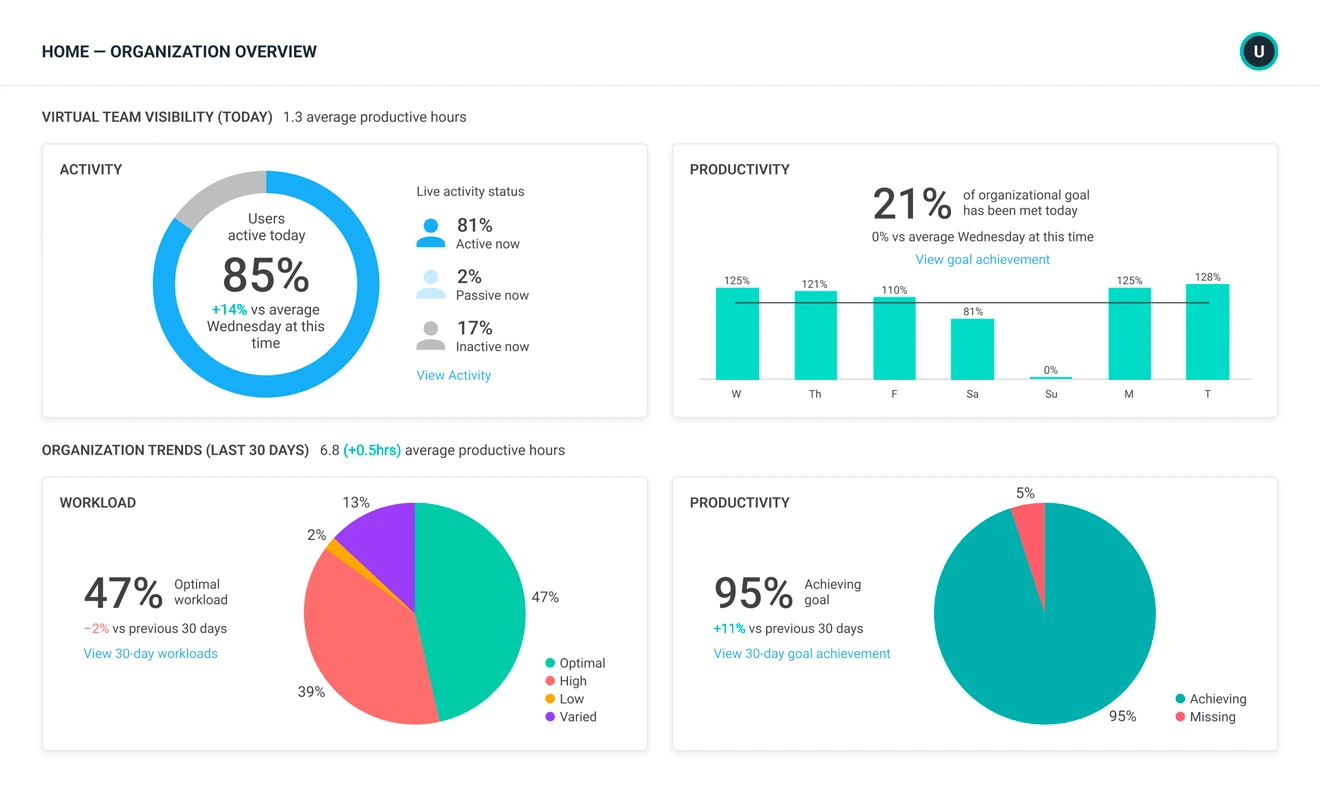
ActivTrak engineers its workforce analytics platform around capacity planning, employee well-being, and burnout prevention.
By transforming daily digital activity into high-level organizational trends, ActivTrak helps managers spot workflow friction, rebalance overloaded teams, and evaluate software adoption while protecting workplace trust.
Key features
- Workload balance and capacity planning: Surfaces real-time utilization metrics to identify overutilized employees at risk of burnout alongside underutilized capacity across departments.
- AI-powered productivity coaching: Uses conversational tools like Work Advisor to benchmark team efficiency. ActivTrak identifies coaching opportunities and recommends actionable workload adjustments.
- Technology and AI usage tracking: Measures application, website, and generative AI tool adoption (such as ChatGPT, Claude, and Gemini) to identify shadow tech and eliminate redundant software licenses.
- Automated activity alignment: Classifies digital work into productive, unproductive, and offline buckets without requiring manual employee timesheets.
Strengths
- Privacy-by-design architecture: Protects employee trust by excluding keystroke logging, email monitoring, webcam access, and continuous video recording.
- Executive-ready visualizations: Translates raw digital activity into boardroom-ready dashboards covering headcount modeling, operational capacity, and labor cost savings.
- Accessible entry tier: Offers a permanent free tier for up to three workers, giving small teams a risk-free trial of basic workforce visibility.
Limitations
- No active Data Loss Prevention (DLP): Operates strictly as an observability platform; it cannot scan file contents, block clipboard exfiltration, or restrict USB mass storage devices.
- Categorization calibration overhead: Pre-set productivity classifications often mislabel legitimate research or non-standard tools as unproductive. This requires ongoing administrative adjustments.
- Add-on pricing dependency: Essential capabilities (including on-demand screenshots, live screen views, conversational AI insights, and raw data export APIs) require separate add-on fees.
Verdict: ActivTrak vs. Insightful
If you value Insightful’s workforce planning analytics, ActivTrak serves a good alternative.
However, like Insightful, ActivTrak remains purely an observational engine: it flags compliance alarms after policy violations happen, but it cannot stop an employee from exfiltrating sensitive files in real-time.
Read more → ActivTrak vs. Insightful: Features, Pros, Cons & Pricing
Pricing and deployment
- Starting price: Free plan available for up to 3 workers. Paid tiers start at $7 per worker/month on annual billing with a 3-year commitment (or $10 per worker/month on a 1-year contract).
- Deployment options: Cloud (SaaS) only, supporting Windows and macOS endpoints.
3. Hubstaff
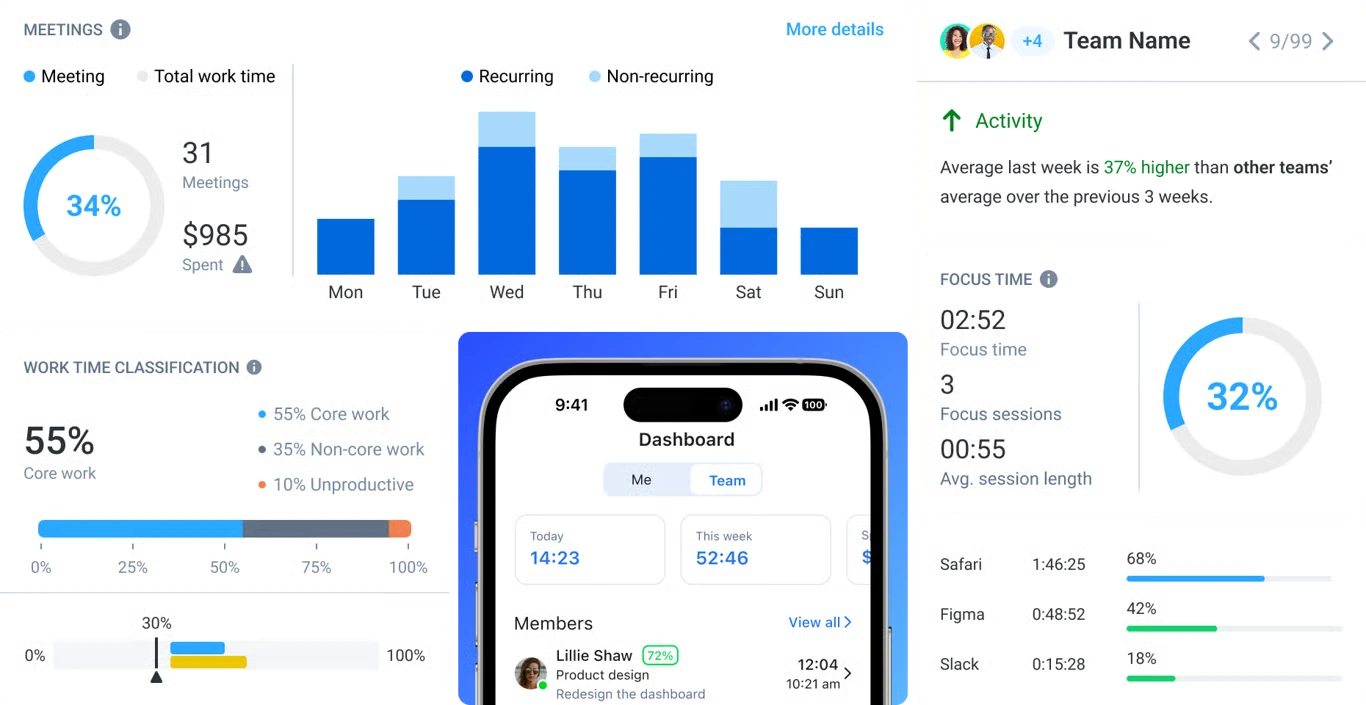
Hubstaff powers workforce management for distributed teams, field technicians, and remote contractors who need accurate work hours linked to payroll.
Rather than focusing on desktop analytics, Hubstaff bridges digital activity and physical job operations. It converts tracked hours into client invoices, project budgets, and global contractor payouts.
Key features
- Automated timesheets and invoicing: Converts tracked desktop and mobile work hours into verified timesheets and client-ready invoices without manual calculations.
- Mobile GPS and job-site geofencing: Tracks physical routes and uses automated geofencing to clock field workers in or out when they cross designated job-site boundaries.
- Integrated global payroll: Disburses payments directly to contractors and employees in local currencies through native integrations with PayPal, Wise, Gusto, and Bitwage.
- Productivity and idle time tracking: Calculates activity scores based on mouse movement and keystroke frequency (without keystroke logging), while automatically discarding idle time.
- Project budgeting and spend tracking: Sets strict project hour and monetary limits to prevent scope creep and protect margins.
Strengths
- Streamlined payroll automation: Eliminates administrative overhead by routing approved employee and contractor timesheets to international payroll runs.
- Cross-device usability: Runs lightweight, intuitive applications across Windows, macOS, Linux, iOS, Android, and web browser extensions.
- Worker-centric privacy controls: Builds workplace trust by allowing team members to view their own metrics, stop timers anytime, and request manual timesheet edits.
Limitations
- No Data Loss Prevention or threat blocking: Provides zero active mechanisms to intercept unauthorized file transfers, scan clipboard content, or block data exfiltration attempts.
- Core capabilities gated by add-ons: Requires additional monthly fees for essential operational features, including GPS location tracking ($3.33/seat/mo), productivity insights ($2.50/seat/mo), and background tracking ($2.50/seat/mo).
- Limited forensic depth: Lacks continuous session video playback, Optical Character Recognition (OCR) screen indexing, and system-level command governance.
Verdict: Hubstaff vs. Insightful
Insightful focuses on desk-bound process mining, SaaS utilization, and high-level workflow diagrams.
Hubstaff excels at operational execution for mobile workforces, field staff, and global contractor networks. If your primary need is to verify on-site arrival via GPS and pay international contractors accurately, Hubstaff provides a more cohesive solution.
Read more → Insightful vs. Hubstaff: Features, Pros, Cons & Pricing
Pricing and deployment
- Starting price: Paid plans start at $4.99 per seat/month on annual billing ($7 billed monthly) with a 2-seat minimum for the Starter plan.
- Deployment options: Cloud (SaaS) with native client support for Windows, macOS, Linux, iOS, Android, and Chrome.
4. Time Doctor
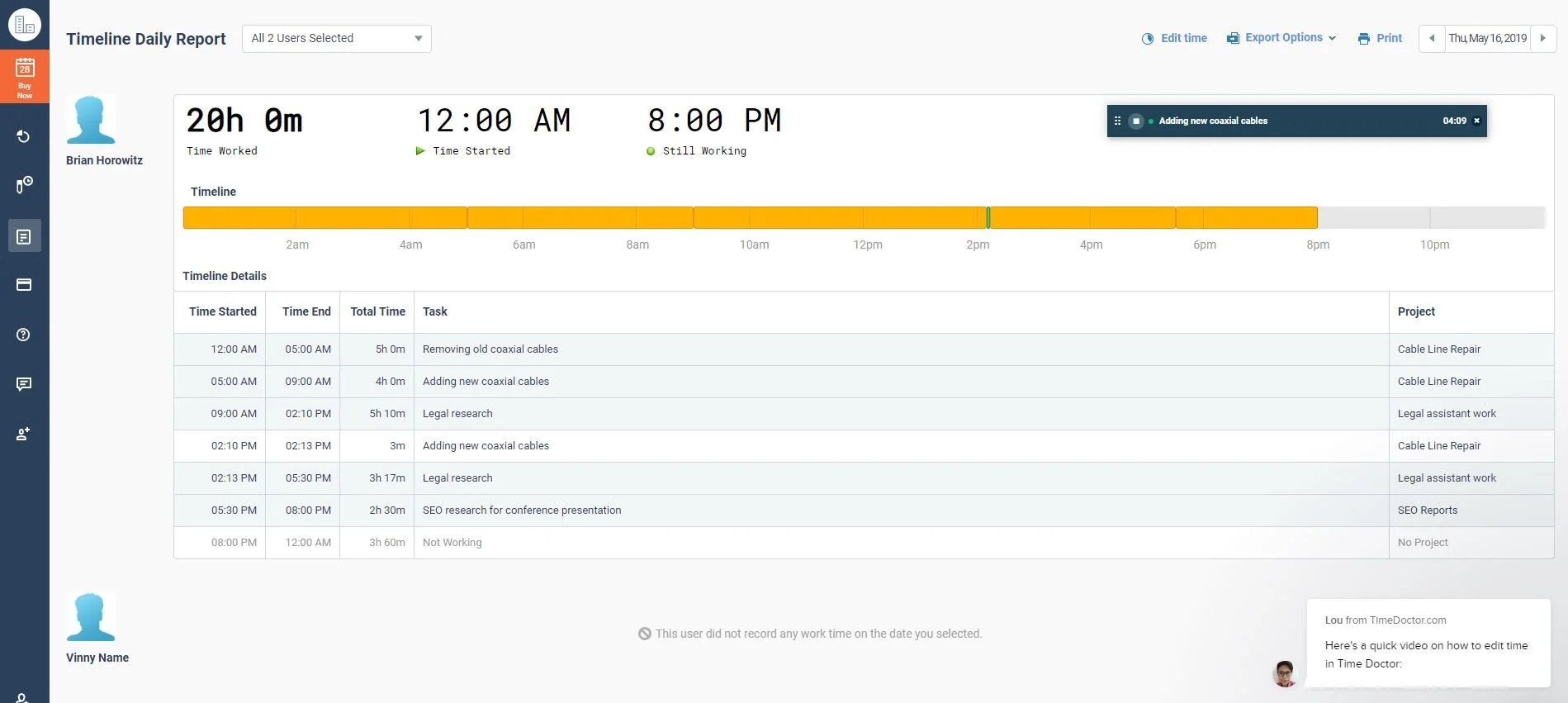
Time Doctor optimizes workforce productivity and accountability for business process outsourcing (BPO) firms, offshore staffing agencies, contact centers, and remote teams.
Rather than focusing on high-level process mining, Time Doctor ties daily digital activity to tangible client projects, individual tasks, and verifiable billable hours.
Key features
- Task-level time tracking: Allows employees to track time against specific projects and tasks via an interactive desktop widget.
- Timeline and workflow reports: Maps the exact sequence of a worker’s day, illustrating when they worked, which tasks they tackled, and when gaps occurred.
- Real-time distraction alerts: Surfaces automated pop-up nudges when team members stay idle on active timers or browse non-work-related websites.
- Work-life balance and burnout monitoring: Analyzes daily and weekly workloads to flag workers logging chronic overtime, working irregular hours, or exhibiting high risk of burnout.
- Benchmarks AI and meeting insights: Compares team productivity scores against external industry percentiles. Time Doctor calculates the true labor cost of internal meetings.
Strengths
- Audit-proof client invoicing: Validates billable contractor hours with transparent records, helping agencies and outsourcing firms eliminate client billing disputes.
- Focus-driven work culture: Empowers staff to manage their own productivity through clear personal analytics and gentle focus reminders.
- Extensive integration stack: Connects with over 60 project management, CRM, and accounting tools (such as Jira, Asana, Trello, and payroll platforms).
Limitations
- Fast-rising tiered costs: Essential management features (including website/app usage, shift scheduling, and payroll integration) require the Standard tier ($11.67/user/mo), while behavioral anomaly detection and Benchmarks AI demand the Premium tier ($16.70/user/mo).
- Dense user interface: The administrative reporting dashboard packs dozens of tabular reports into deep sub-menus. This creates a steeper learning curve for managers.
- No endpoint data protection: Provides no active DLP tools to block file transfers, inspect clipboard actions, or prevent unauthorized external uploads.
Verdict: Time Doctor vs. Insightful
Insightful concentrates on passive organizational observability and process mapping, while Time Doctor emphasizes active worker accountability and client billing verification.
For BPOs and offshore agencies, Time Doctor is the more useful option, as it provides the granular task timers, invoice exports, and distraction nudges that these companies prize.
Read more → Time Doctor vs. Insightful: Features, Pros, Cons & Pricing
Pricing and deployment
- Starting price: Paid plans start at $6.67 per user/month on annual billing ($8 month-to-month) for the Basic plan, which includes basic task tracking, timeline reports, and periodic screenshots.
- Deployment options: Cloud (SaaS) with dedicated desktop and mobile apps across Windows, macOS, Linux, Chrome OS, iOS, and Android. Custom private cloud hosting is available on the Enterprise tier.
5. DeskTime
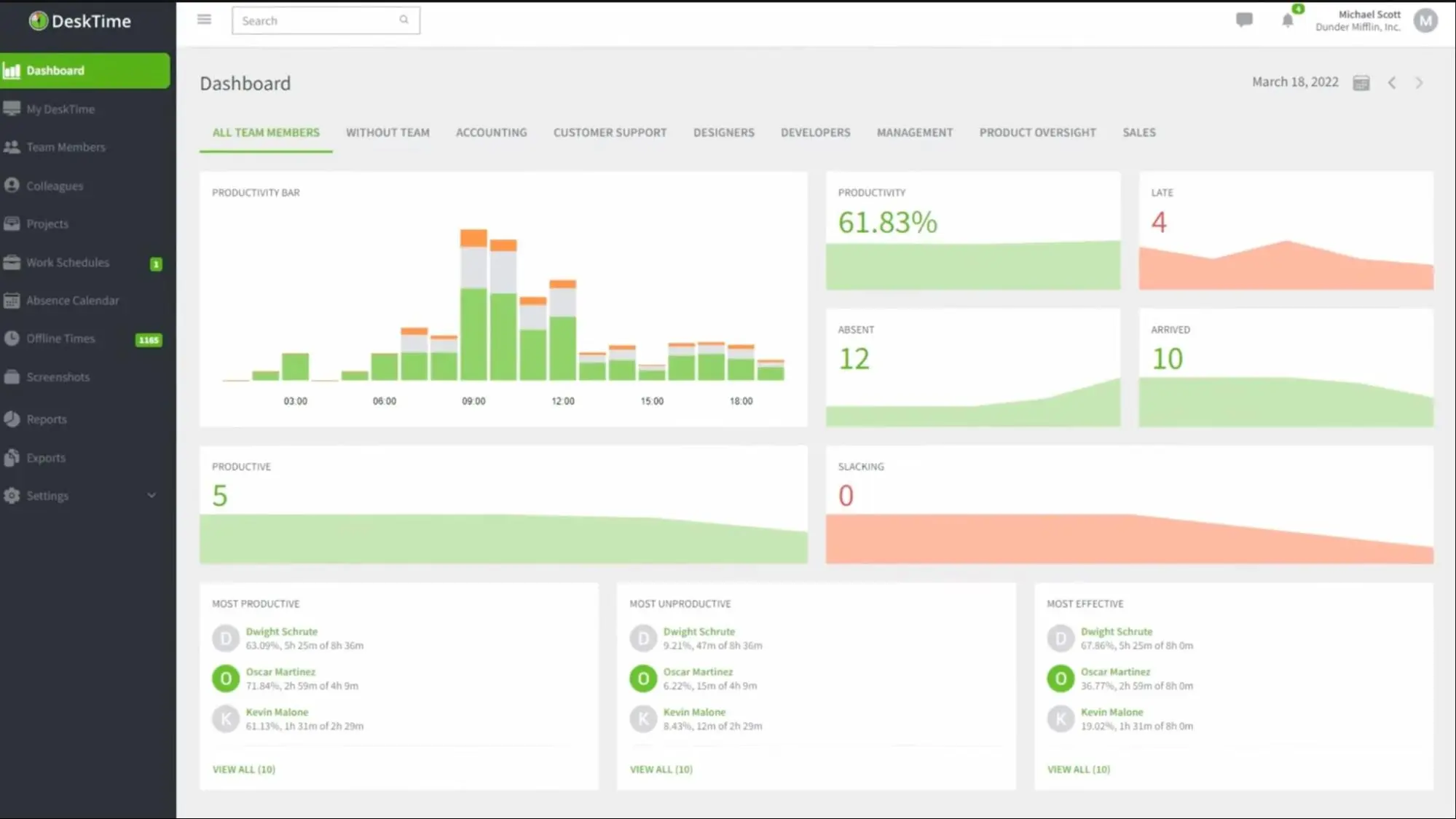
DeskTime delivers a set-it-and-forget-it automated time tracker that records employee activity in the background.
Instead of requiring workers to toggle timers or log hours manually, DeskTime launches automatically when the computer boots up. It tracks application use, URLs visited, and active versus idle time without interrupting employee workflows.
Key features
- Automatic boot-up time capture: Starts logging work hours the second an employee turns on their device. DeskTime detects idle downtime when users step away from their workstations.
- URL, app, and document title tracking: Categorizes web browsing and app use into productive, unproductive, or neutral buckets, while tracking specific document names and window titles.
- Integrated shift scheduling and absence calendar: Streamlines team availability, planned vacation days, sick leave, and custom work shifts into a unified scheduling dashboard.
- Pomodoro and break reminders: Encourages sustainable productivity rhythms using structured work-and-break cycles based on the 52/17 work method.
- Proof-of-work screen captures: Takes optional interval screenshots with automatic blurring capabilities. DeskTime verifies remote task progress without exposing confidential customer data.
Strengths
- Zero daily friction: Runs completely on autopilot in the background, removing the administrative burden of manual timesheets and forgotten start-and-stop timers.
- Clear productivity scoring: Calculates straightforward percentage-based productivity metrics that give managers and employees immediate visibility into daily focus levels.
- Built-in well-being tools: Features private time toggles for personal computing during off-hours, alongside proactive break reminders that prevent employee fatigue.
Limitations
- Shallow analytical depth: Lacks advanced organizational network analysis, multi-step process mining, and predictive workload modeling.
- No active threat prevention or DLP: Cannot inspect file transfers, restrict USB devices, detect prompt injections in generative AI, or block sensitive data leakage.
- Export and reporting lag: Generating and downloading extensive historical CSV reports can be slow across large team accounts.
Verdict: DeskTime vs. Insightful
Choose DeskTime if you want Insightful’s foundational attendance tracking, app logging, and URL tracking capabilities without paying for complex process intelligence or enterprise add-ons.
While Insightful pushes organizations toward higher-priced tiers with mandatory 50-seat minimums, DeskTime keeps time tracking simple, affordable, and completely automated for growing hybrid teams.
Read more → 13 DeskTime Alternatives for Productivity Tracking
Pricing and deployment
- Starting price: The Pro plan starts at $6.42 per user/month on annual billing ($7 month-to-month) for automatic time, app, and document tracking.
- Deployment options: Cloud (SaaS) architecture supporting desktop agents on Windows, macOS, and Linux, alongside companion mobile apps for iOS and Android.
6. Toggl
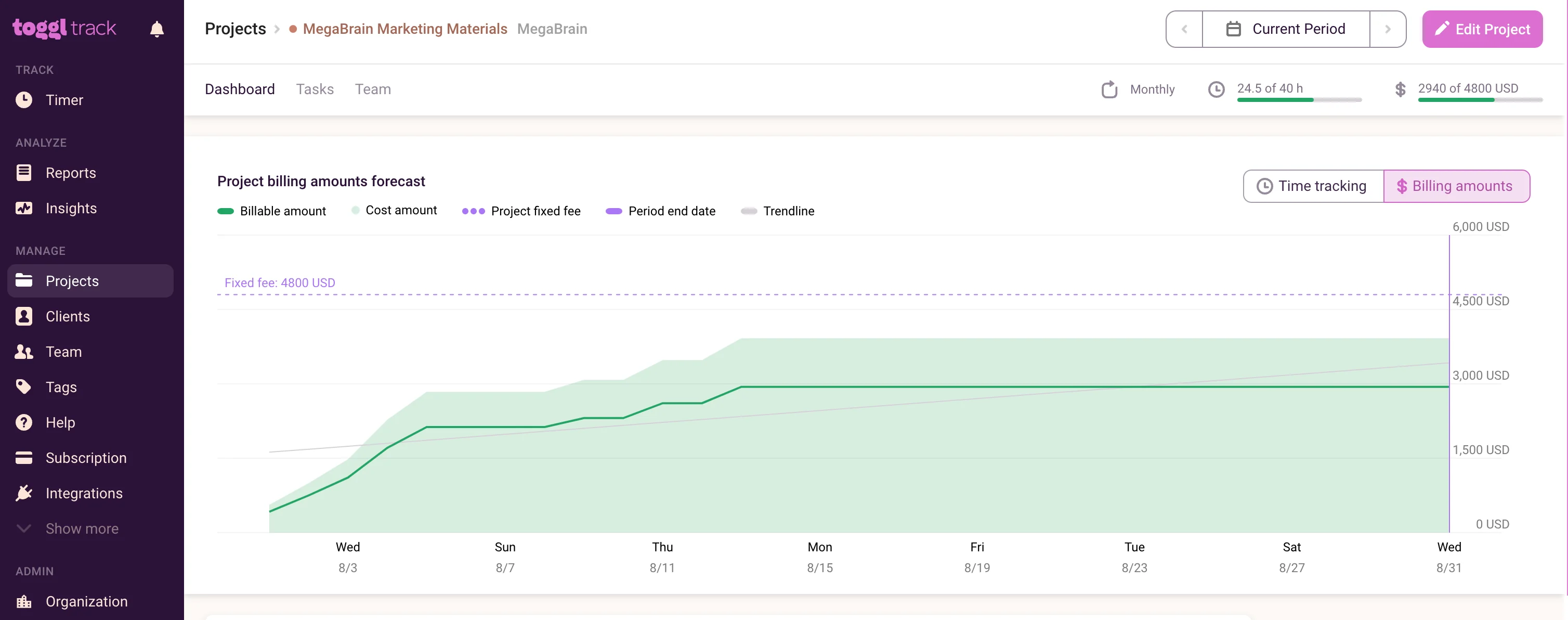
Toggl (formerly Toggl Track) reorients time tracking around team trust, project profitability, and capacity planning rather than digital surveillance.
Built specifically for creative agencies, consultancies, legal firms, and software teams, Toggl converts daily hours into transparent client invoices, project margin reports, and forward-looking workload forecasts.
Key features
- Flexible work and timer views: Lets employees capture work hours via a one-click stopwatch. They can view their work time via interactive Kanban boards, calendars, and timeline Gantt charts.
- Automated private activity timeline: Records desktop application and website usage locally and privately on the user's machine. Toggl allows the employee to review their day and decide which blocks to convert into logged project entries.
- Profitability and margin analytics: Combines billable rates and fixed-fee client budgets with internal labor costs. Toggl tracks gross profit and margin percentages across projects, clients, and individual contributors.
- Workload and capacity forecasting: Integrates scheduled assignments, paid time off (PTO), and public holidays to visualize team capacity and forecast delivery dates before teams take on new contracts.
- Toggl AI and Model Context Protocol (MCP): Connects workforce data to AI assistants via an MCP server and CLI. This allows teams to query budget overrun causes and create structured project tasks using plain-English prompts.
Strengths
- Deliberate anti-surveillance design: Builds high team adoption and trust by explicitly refusing to capture screenshots, log keystrokes, record webcams, or track physical GPS locations.
- Frictionless cross-platform experience: Delivers intuitive web, desktop, and mobile apps paired with browser extensions that embed direct timer buttons into tools like Jira, Asana, and GitHub.
- Accessible entry points: Offers a functional free tier for up to 3 users. Toggl is accessible for solo contractors and boutique agencies looking to track billable work without software overhead.
Limitations
- No background device verification: Because time tracking remains user-controlled, managers cannot independently audit idle minutes, active application windows, or background workstation activity.
- Zero Data Loss Prevention (DLP): Offers no administrative security controls to block malicious domains, inspect file movements, or protect intellectual property from exfiltration.
- Tier-restricted financial reporting: Unlocking essential business features (such as labor cost tracking, profitability reports, and timesheet approvals) requires an upgrade to the higher-tier Premium plan.
Verdict: Toggl vs. Insightful
Select Toggl if your agency or professional services firm views employee monitoring as incompatible with company culture.
While Insightful logs system-level attendance, application usage, and periodic screenshots, Toggl keeps time tracking entirely in the worker's hands. It directs administrative focus toward client profitability, accurate invoicing, and sustainable team capacity rather than endpoint monitoring.
Pricing and deployment
- Starting price: Free forever for up to 3 users with core time tracking, calendar integrations, and personal reporting. Paid plans start at $9 per user/month on annual billing ($12 month-to-month) for the Starter tier.
- Deployment options: Cloud (SaaS) architecture with native applications for Windows, macOS, iOS, Android, and browser extensions for Google Chrome and Mozilla Firefox.
7. InterGuard
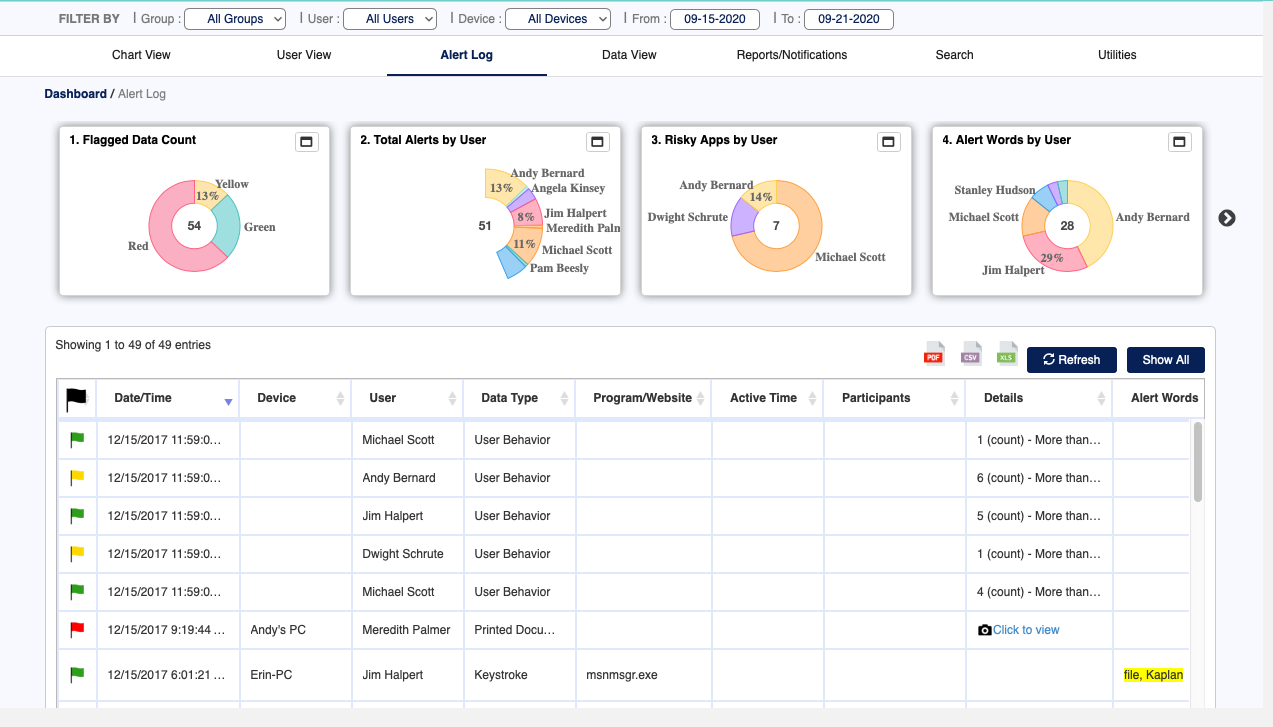
InterGuard approaches employee monitoring from a strict data security and compliance perspective.
Rather than operating as a lightweight project tracker, InterGuard functions as an endpoint security engine that protects internal corporate data, enforces acceptable use policies, and records digital evidence across remote and office-based workstations.
Key features
- Real-time application and web filtering: Blocks employee access to risky websites, unapproved applications, and personal webmail accounts both on and off the corporate network.
- Endpoint Data Loss Prevention (DLP): Prevents unauthorized data transfers by restricting USB mass storage devices, halting suspicious email attachments, blocking web form uploads, and tracking printed documents.
- Keyword-triggered alerts and visual evidence: Triggers automated email alerts, continuous video playback, and targeted desktop screenshots the second an employee types pre-defined alert terms or engages in suspicious behavior.
- Remote endpoint lockdown and data retrieval: Enables administrators to remotely lock down a compromised device, retrieve proprietary files, or delete confidential assets from lost or stolen laptops.
- Keystroke and file activity tracking: Records all document interactions (including file creations, modifications, and deletions) alongside comprehensive keystroke logging across all desktop apps.
Strengths
- Proactive security enforcement: Actively stops restricted behaviors at the endpoint (such as terminating unapproved programs or blocking USB transfers), rather than generating passive notifications after data leaves the organization.
- Continuous off-network coverage: Enforces acceptable-use policies, web filtering, and activity recording even when laptops disconnect from the corporate VPN or local network.
- Broad environment support: Deploys across Windows, macOS, Chromebook, Android, iOS, and virtualized desktop environments like Citrix and VMware.
Limitations
- Dense legacy interface: The administrative dashboard displays a dense layout with complex sub-menus, creating a steeper learning curve than modern SaaS tools.
- Resource-intensive agent: Continuous background logging, keystroke recording, and real-time endpoint inspection can demand more CPU and memory resources on older machines.
- High surveillance friction: Granular surveillance features, such as keystroke logging and continuous video captures, can damage employee morale if implemented without transparent corporate policies.
Verdict: InterGuard vs. Insightful
Insightful notifies managers when an employee opens an unsanctioned application or visits an unapproved domain, while InterGuard enforces hard endpoint blocks to instantly stop the activity.
Teams that prioritize general workforce efficiency and process optimization will find Insightful more user-friendly. However, organizations handling sensitive intellectual property that require active USB blocking, keyword-triggered screen recording, and remote device lockdown will benefit from InterGuard’s security-first architecture.
Pricing and deployment
- Starting price: InterGuard does not publish its pricing online; organizations must contact its sales team to schedule a demo and receive a custom quote based on chosen modules (such as Employee Monitoring, DLP, Web Filtering, or Endpoint Lockdown), user volume, and billing cadence (monthly or annual).
- Deployment options: Cloud-hosted SaaS, on-premises, or private cloud, with agent support for Windows, macOS, Chromebook, iOS, Android, and virtual environments like Citrix.
Buyer’s decision framework: Which alternative fits your team?
Choosing the right employee monitoring software depends entirely on the operational problem you need to solve.
Use this framework to narrow down your top Insightful alternative:
“I need active data loss prevention and real-time security enforcement.”
- Teramind: Select Teramind for full behavioral analytics, active DLP, OCR search, and instant automated blocking against unauthorized data exfiltration.
- InterGuard: Select InterGuard for hardware restrictions (such as blocking USB mass storage devices) and strict website filtering.
“I need privacy-first capacity planning and burnout prevention.”
- ActivTrak: Select ActivTrak to analyze aggregate workforce trends and receive productivity coaching without capturing keystrokes or on-screen content.
“I need GPS tracking and automated contractor payroll.”
- Hubstaff: Select Hubstaff if you manage field personnel and need mobile route tracking tied directly to multi-currency contractor payouts.
“I need direct task accountability and distraction alerts.”
- Time Doctor: Select Time Doctor to provide distributed BPO workers with task-level time logging and gentle idle reminders.
“I need effortless background tracking with zero interaction.”
- DeskTime: Select DeskTime for automatic tracking upon computer startup combined with straightforward shift management.
“I need client billing and agency project tracking.”
- Toggl: Select Toggl for autonomous, trust-focused manual time tracking tailored for billable client work.
FAQs
What is the best free alternative to Insightful?
ActivTrak offers a free tier for up to 3 users, which includes foundational workforce productivity dashboards.
Toggl (formerly Toggl Track) also provides a free plan for up to 3 users focused on manual project time tracking.
Does Insightful offer on-premise deployment?
Insightful provides on-premises and private cloud hosting, but limits self-hosting strictly to its base Workforce Analytics product at custom-scoped pricing.
For organizations that require fully self-hosted behavioral security, DLP, and analytics, Teramind offers on-premises and private cloud options.
How does Insightful's pricing compare when you include security and screen capture?
While Insightful's entry-level Analytics plan starts at $8/seat/month (annual), essential monitoring capabilities require add-ons: Workspace Security ($4/seat/mo), Screen Recording ($4/seat/mo), and On-Demand Screenshots ($4/seat/mo). This brings the total cost to $20/seat/month.
Which Insightful alternative provides active Data Loss Prevention (DLP)?
Teramind is the primary alternative that offers active DLP. It provides real-time content inspection, AI usage control, automated file-transfer blocking, and OCR.
Insightful doesn’t collect document or message content, and its file-sharing and printing alerts are listed as "Coming Soon".
Can employees detect when Insightful or alternative software is running?
Yes, depending on the configuration.
Tools like Toggl operate exclusively in visible mode. Solutions like Teramind, InterGuard, and Insightful can be deployed in visible mode (with an interactive tray icon and task timer) or in silent stealth mode for threat audits and forensic investigations.
