
AI usage is invisible to most security tools. Network monitoring sees HTTPS traffic. Endpoint detection sees browser activity. CASB platforms see cloud application access. None of them sees what employees type into AI prompts or upload to AI services through web forms.
This invisibility creates a problem. Organizations can’t prove they didn’t expose customer data through AI because they can’t see the data that employees shared. Regulatory compliance frameworks require demonstrating appropriate controls.
Enterprise AI DLP makes AI usage visible and auditable. These ten platforms reveal the data that flows to AI services, enforce policies preventing data breaches, and generate the compliance documentation that proves governance works.
What Are Enterprise AI Data Loss Prevention Tools?
Enterprise AI data loss prevention tools are security solutions that monitor, detect, and block sensitive data exposure through generative AI services.
They identify when employees share regulated information, confidential business data, or proprietary content with external AI platforms (e.g., ChatGPT, Claude, Gemini), safeguarding data from leaving organizational control.
Generative AI DLP addresses three problems that traditional DLP doesn’t:
- Data exposure through AI prompts.
- Uploads to third-party AI sites.
- Conversational interfaces where employees interact with external AI.
They also operate at various points (the browser level, network layer, and endpoint) to inspect the data that employees send to AI tools and enforce policies that block sensitive information before transmission.
How Did We Select the Best Enterprise AI DLP Solutions?
We handpicked the tools on this list based on how effectively they address the security risks posed by generative AI and autonomous AI agents in enterprise environments.
This was our criteria:
Visibility Into AI Interactions
We prioritized platforms that provide deep visibility into how employees interact with AI tools. This includes monitoring prompts and responses, browser-based AI usage, coding assistants, and autonomous agent activity.
We believe that without this level of visibility, organizations cannot accurately detect shadow AI usage or sensitive data exposure.
Real-time Detection and Policy Enforcement
Monitoring is just one half of enterprise data protection. The other half is proactive defence.
So to build our list, we focused on solutions capable of inspecting AI interactions in real-time and blocking risky behavior before sensitive information is leaked.
Coverage Across AI Tools and Environments
Enterprise AI usage is fragmented across many different tools. Some of the most common are ChatGPT, Gemini, Copilot, Claude, coding assistants, browser extensions, and embedded AI features inside SaaS apps.
As such, we selected tools that provide broad coverage across cloud, endpoint, browser, and AI application layers.
Enterprise Data Protection and Policy Controls
We evaluated how effectively each platform protects the most sensitive data, such as PII, intellectual property, source code, credentials, and regulated data types.
Strong policy engines, contextual classification, and granular enforcement capabilities were key factors in our selection process.
AI Governance and Shadow AI Detection
A major consideration was whether the platform could help organizations govern AI usage at scale.
This includes detecting unauthorized AI applications, identifying risky user behavior, and giving security teams centralized oversight into where AI is being used across the business.
Integration With Enterprise Security Ecosystems
Enterprise AI DLP tools need to work alongside existing security infrastructure.
We favored solutions that integrate well with identity providers, SIEMs, endpoint tools, CASBs, browsers, and broader security operations workflows.
Scalability for Enterprise Environments
Finally, we looked at whether the platform could realistically operate in large enterprise environments with distributed teams, complex compliance requirements, and high volumes of AI interactions.
Scalability, operational visibility, and manageability were important factors throughout our evaluation.
What Are the Best AI Enterprise DLP Tools?
1. Teramind
Teramind is an endpoint-level AI data loss prevention tool. It provides comprehensive monitoring of employee interactions with AI across all applications and channels.
The platform captures:
- What employees type into AI prompts.
- The files they upload to AI services.
- What AI generates in response.
- What employees do with AI-generated content.
This endpoint approach ensures visibility into AI usage regardless of how employees access the tools (e.g., via browser-based services, desktop apps, mobile apps, or renamed executables).
For example, if an employee attempts to upload confidential documents to Claude or share proprietary code with AI coding assistants, Teramind intercepts the data at the endpoint to prevent exposure before it leaves the device.
Key Features
See Teramind's AI governance platform in action → Take a self-guided product tour
- Complete AI Agent Monitoring: Distinguishes between human work and artificial intelligence, captures prompts and responses, creates forensic audit trails, prevents shadow AI, and secures data used by AI agents.
- Behavioral Analytics: Tracks clipboard activity, outbound transfers, prompt submissions, and risky behavioral patterns to detect when confidential data is being exposed to AI systems. Also scores activities from no risk to critical.
- Smart Rules and Automated Alerts: Security teams can configure enforcement rules around AI tool access, unauthorized agents, or abnormal command execution patterns.
- Live View and Historical Playback: Gives security teams the ability to observe activity in real-time and review past sessions.
- OCR and Keystroke Logging: OCR detects sensitive content that appears on screen or inside images, while keystroke logging captures typed activity that may not be visible through file or network monitoring alone.
Best For
Regulated or data-sensitive industries such as financial services, healthcare, legal, manufacturing, BPOs, and government contractors.
It's also a good choice for enterprises with distributed teams where sensitive data moves across endpoints, SaaS apps, browsers, remote desktops, and AI tools.
What Teramind Users Say
“Its intuitive interface and comprehensive monitoring capabilities make it easy to track and analyze user activity effectively. The real-time alerts and detailed reports help quickly identify risks and ensure compliance, enhancing overall security."
"The biggest upside of using Teramind - improved visibility into employee actions, proactive threat detection and streamlined investigation process that save time and reduce security gaps. What I like best about Teramind - the support team, especially the developers and their manager.” → Read Full Review
Pricing
Teramind offers three main, tiered employee monitoring and data loss prevention plans starting at $15/seat/month (Starter), $30/seat/month (UAM), and $35/seat/month (DLP) for cloud-based services, with annual discounts and a 5-seat minimum.
It also provides customized Enterprise plans. Click here to book a demo and speak to sales.
2. Cyberhaven
See this list of Cyberhaven alternatives →
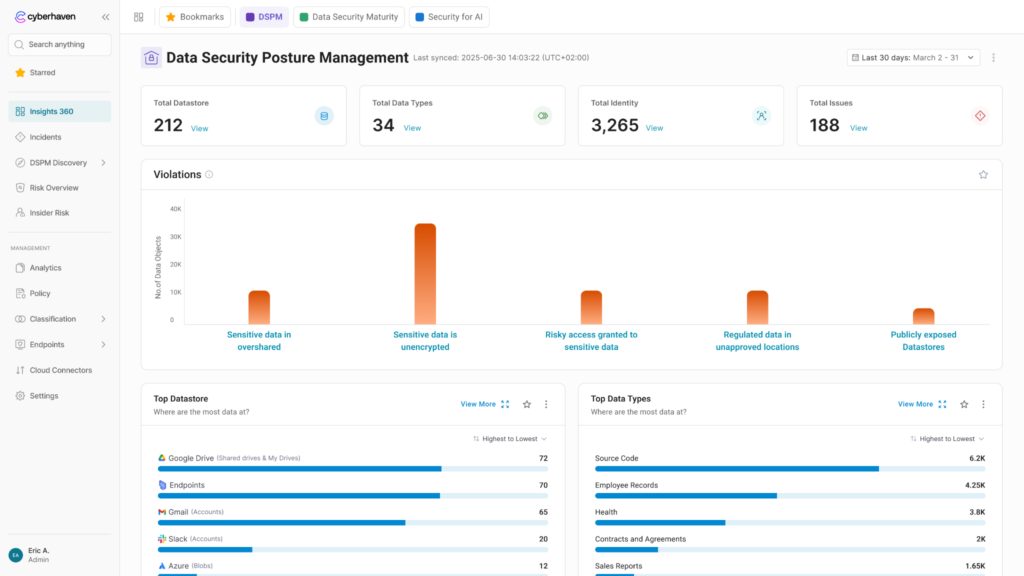
Cyberhaven is built around a different DLP idea than others on this list. It uses data lineage tracking to monitor where sensitive information originates and follows it throughout its lifecycle as employees copy, paste, modify, and share it with AI tools.
Cyberhaven also captures subtle unauthorized data movement that other DLP tools miss. Like when employees screenshot confidential information and upload the image to AI, or extract data from one application and feed it to AI through another. Cyberhaven tracks all these multi-step data flows.
In addition, it combines DSPM, DLP, insider risk management, and AI security into its solution for protecting data across endpoints, cloud, SaaS, on-prem systems, and AI tools.
Key Features
- Security for AI: Provides visibility into enterprise AI adoption, monitors how sensitive data moves into generative AI platforms, and applies risk-based controls to prevent sensitive information leakage into external AI environments.
- AI Risk IQ: Evaluates and scores over 700 AI applications and agents based on their potential risk to an organization.
- Shadow AI Discovery: Identifies AI tools being used across a business, including standalone LLM apps, embedded AI features inside SaaS tools, browser-based copilots, and unsanctioned AI services.
Best For
Security teams investigating how sensitive data reached AI services during an incident response.
Its data lineage capabilities provide forensic trails showing the complete path from data creation to AI exposure.
What Cyberhaven Users Say
“Cyberhaven has user-controlled override functions that work on email, web, USB, and peripheral data transfers to keep availability “always on” in my enterprise, provides an impression of comprehensive oversight to deter would-be insiders, and a lightweight feel that has virtually no user-experience for those who are always doing the right thing.” → Read Full Review
Pricing
Cyberhaven doesn't publicly disclose its pricing. You must contact its sales team via a form on its website.
3. Microsoft Purview
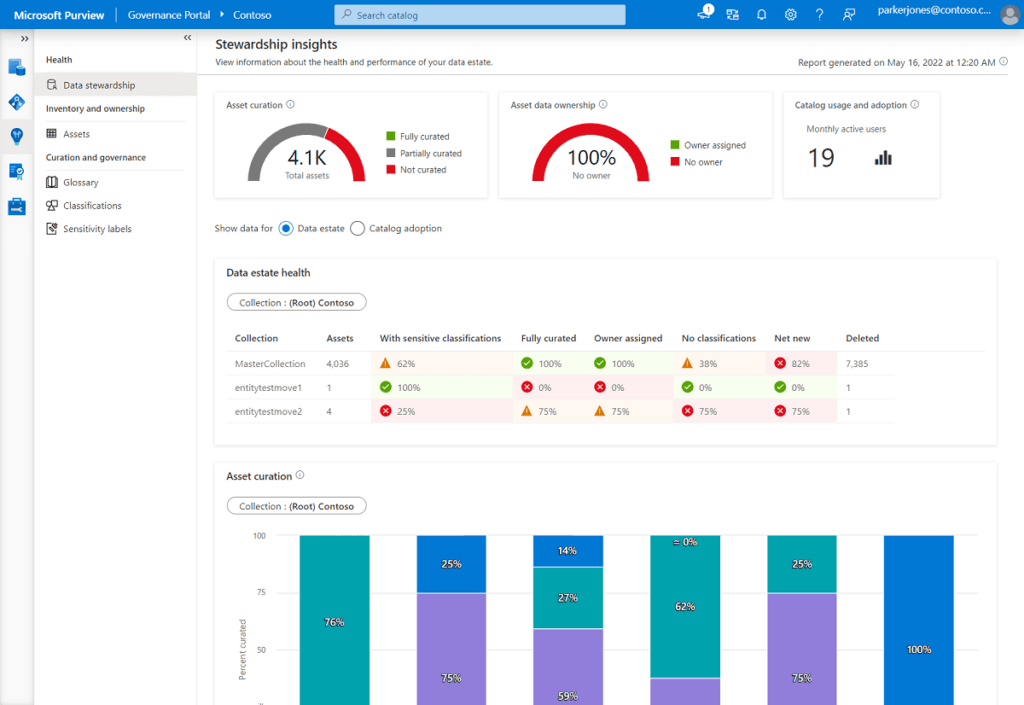
Purview is Microsoft’s cloud-native framework for identifying, monitoring, and protecting sensitive information across the Microsoft 365 ecosystem. It governs how employees use Microsoft Copilot and external AI services while working within Outlook, Teams, Word, Excel, SharePoint, and other Microsoft applications.
This deep integration with Microsoft’s identity, data classification, and security infrastructure allows organizations to enforce consistent data protection policies across their entire Microsoft stack.
Key Features
- Data Security Posture Management for AI (DSPM for AI): Offers visibility into how AI applications, copilots, and AI agents interact with enterprise data across Microsoft and third-party environments.
- Microsoft Purview Information Protection: Enables organizations to classify, label, and protect sensitive data across documents, emails, SaaS environments, and AI systems. These sensitivity labels carry forward into AI interactions, allowing organizations to apply the same policies even when data is processed through copilots or AI agents.
- Insider Risk Management: Correlates user activity, AI interactions, access behavior, and policy violations to identify potential insider threats tied to generative AI workflows.
Best For
Companies requiring governance over the data that Microsoft Copilot can access.
Purview provides the controls ensuring Copilot delivers employee productivity benefits without creating compliance violations or unauthorized data exposure.
What Microsoft Purview Users Say
“It is critical that Purview delivers data protection across multi-cloud and multi-platform environments. That is the number one reason that people are adopting hybrid and best-of-the-breed approaches.” → Read Full Review
Pricing
Microsoft Purview pricing is structured around a mix of monthly user subscriptions for compliance suites and pay-as-you-go, consumption-based models for data governance.
The Microsoft Purview Suite typically starts at $12.00 per user/month, while specialized governance, scanning, and AI protection features are billed based on data volume, usage, and assets managed.
4. Nightfall AI
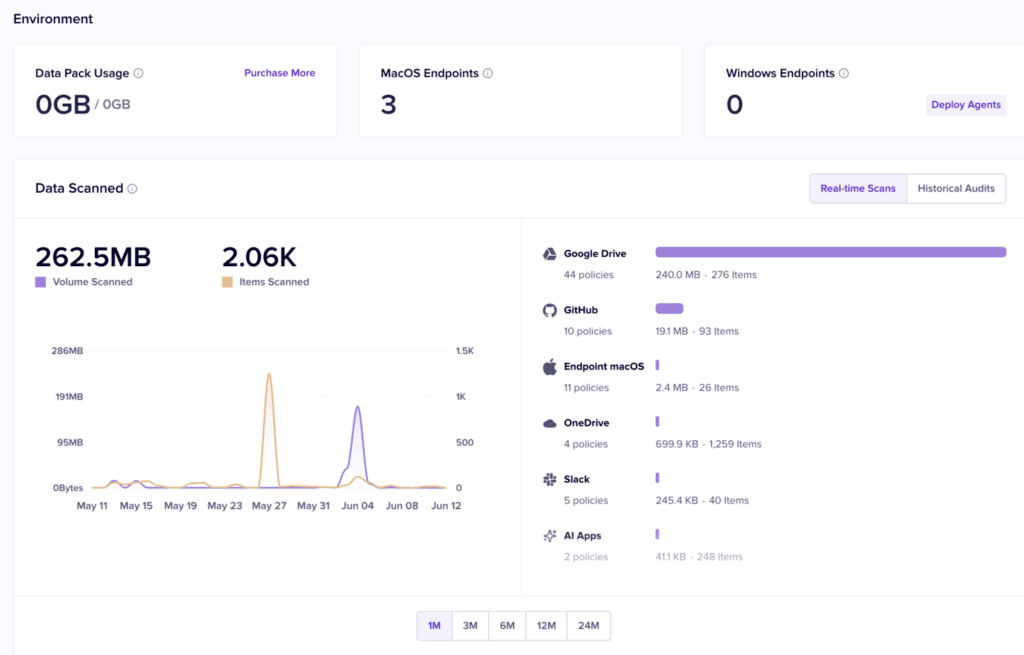
Nightfall AI specializes in cloud application DLP with native integrations across SaaS platforms. It embeds directly into Slack, Microsoft Teams, Google Drive, GitHub, Jira, Confluence, and dozens of other cloud applications, monitoring AI usage as it happens within these collaboration environments.
For example, it can detect when Slack messages contain prompts to AI bots, or flag when GitHub code gets uploaded to AI assistants.
Nightfall leans heavily on AI-based detection models, LLM-powered classifiers, computer vision, and contextual analysis. It helps detect sensitive data such as PII, PHI, PCI, credentials, and confidential business information.
Key Features
- Nightfall for ChatGPT: A browser plugin solution that can detect 100+ sensitive data types before they're submitted to ChatGPT.
- Shadow AI Visibility: Monitors generative AI usage across enterprise environments and helps identify unsanctioned AI adoption.
- Nyx Copilot: Autonomous, agentic DLP analyst that can investigate data breaches, tune policies, and analyze risks.
Best For
Enterprise companies needing automated DLP response at scale.
Organizations with thousands of employees use Nightfall’s automated remediation to handle routine incidents while escalating high-risk scenarios.
What Nightfall AI Users Say
“I find Nightfall AI incredibly valuable in helping my organization detect potential exfiltration of sensitive or confidential data in real-time. This capability is crucial for safeguarding our data.” → Read Full Review
Pricing
Nightfall offers three plans, all with custom pricing: Data Detection Response (DDR), Data Exfiltration Prevention (DEX), and Nightfall Complete.
5. Forcepoint
See this list of Forcepoint alternatives and competitors →
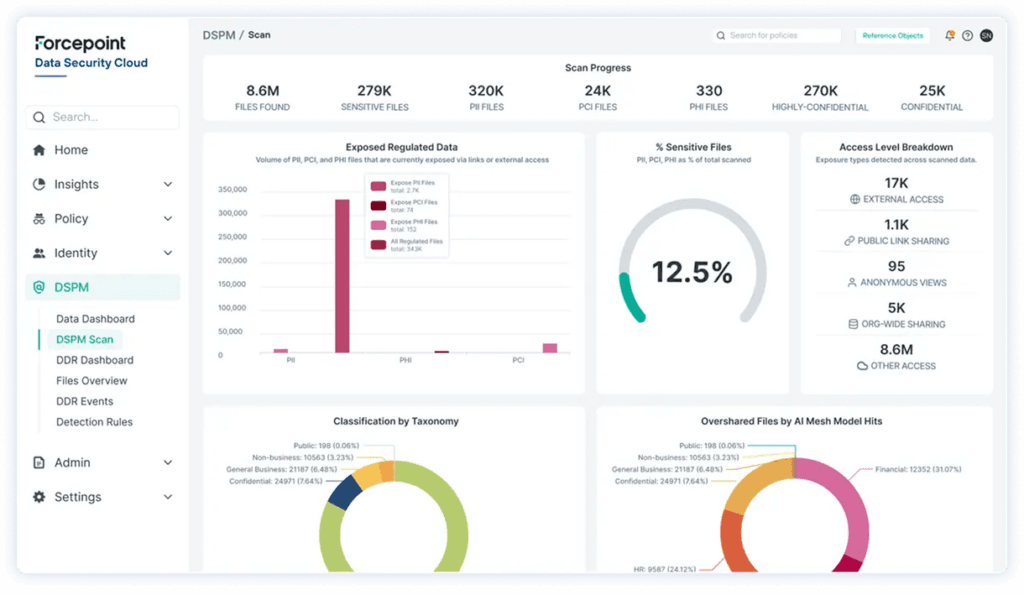
Forcepoint is a unified data security platform built for environments where sensitive information moves constantly across cloud apps, endpoints, browsers, SaaS platforms, and generative AI systems.
It combines DLP, DSPM, CASB, DDR (Data Detection and Response), behavioral analytics, and AI governance into a single architecture called the Forcepoint Data Security Cloud.
Forcepoint provides visibility into shadow AI adoption, monitors interactions with generative AI tools, blocks risky uploads and prompts, and applies contextual controls around how sensitive data interacts with LLMs and copilots.
Key Features
- ARIA (Adaptive Risk Intelligence Assistant): Analyzes signals across a business to surface insights, identify protection gaps, and activate enforcement using natural language.
- Prebuilt Classifiers: Includes a large library of more than 1,800 pre-built classifiers and policy templates spanning 90+ countries and 160+ regions. It also supports Exact Data Matching (EDM) and OCR, extending protection across structured and unstructured data, including files that employees may share with AI tools.
- AI Mesh: Uses small language models (SLM) and contextual AI classifiers to improve classification accuracy across structured and unstructured data.
Best For
Organizations with complex network environments requiring DLP enforcement across on-premises data centers, cloud infrastructure, remote offices, and distributed workforces.
What Forcepoint Users Say
“Forcepoint ONE is great because it puts all your security tools in one place, making it easier to protect users, data, and apps no matter where people work. It’s simple to manage and helps stop threats before they cause problems.” → Read Full Review
Pricing
Visit the Forcepoint website to complete a form and get accurate pricing.
6. Concentric AI
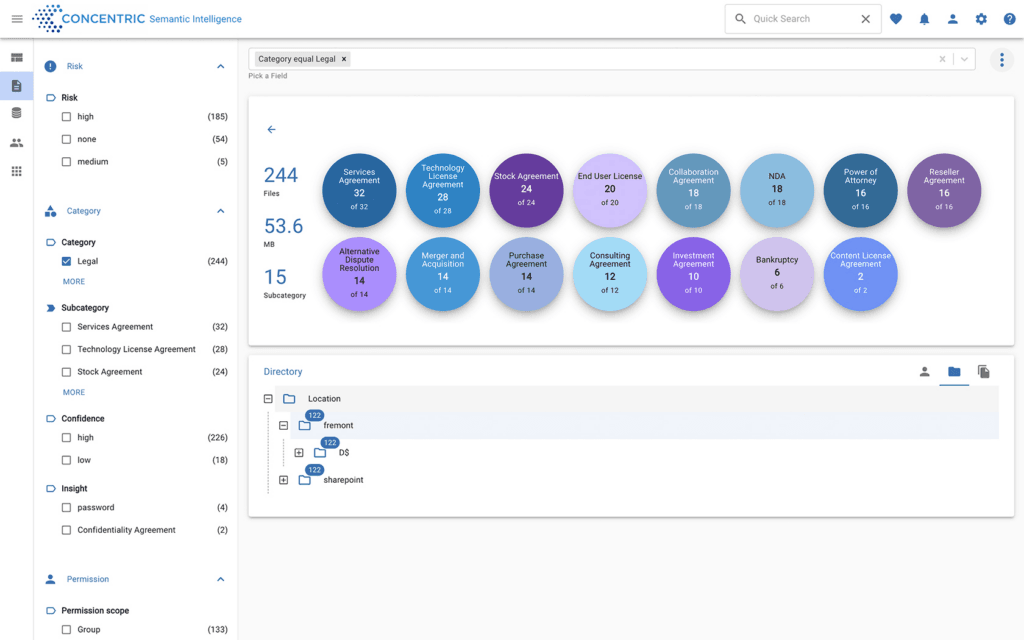
Concentric AI is a data security governance platform built around Semantic Intelligence, its context-aware AI engine for discovering, classifying, governing, and protecting sensitive data.
It uses machine learning to understand the meaning and business context of data across structured and unstructured environments. That makes it useful for finding sensitive information such as business plans, source code, financial records, and other high-value intellectual property.
Once discovered and classified, the platform tracks this data through its lifecycle, sending alerts when employees copy it to AI tools, share it with external services, or upload it to AI platforms.
Key Features
- Risk Distance Analysis: Evaluates how exposed sensitive data is based on access patterns, permissions, location, user behavior, and external sharing activity.
- Centralized Remediation and Access Governance: Identifies overshared data, excessive permissions, AI-related exposure risks, and governance gaps. It then automates remediation actions across cloud and SaaS environments.
- Microsoft Copilot Data Security: Tracks Copilot interactions so teams can see what data employees are sharing, with which users, and when.
Best For
Enterprises with unstructured data sprawl across multiple cloud platforms, file shares, and collaboration tools.
What Concentric AI Users Say
“Concentric leverages AI/LLM for its classification of structured and unstructured data across just about any data store currently in use by any given company, and it does so with a very high degree of fidelity/accuracy, w/out any agents.” → Read Full Review
Pricing
Concentric AI gates its pricing behind a form. Visit its website to contact the sales team.
7. Netskope
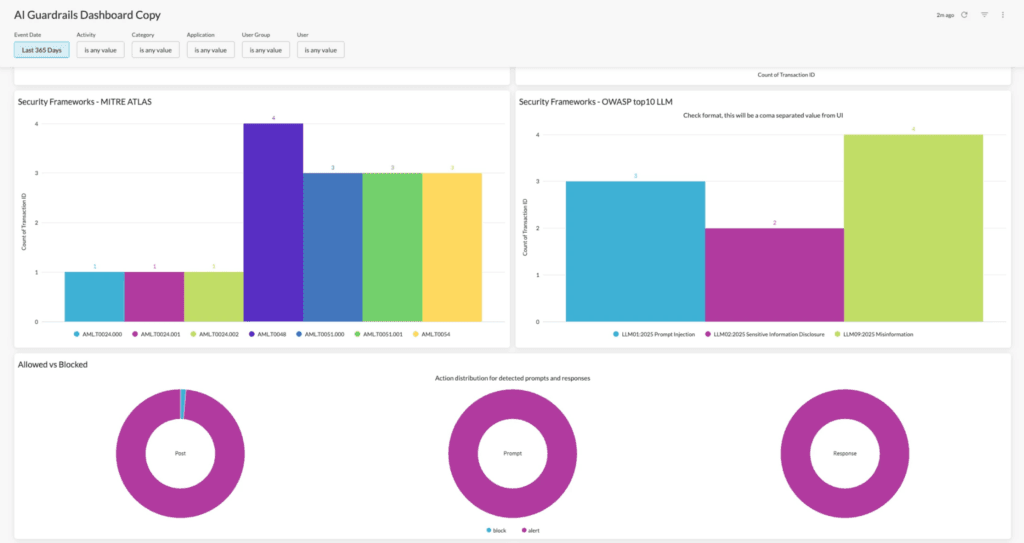
Netskope is a cloud security and Security Service Edge (SSE) platform with data protection built into the traffic path.
Its inline architecture puts Netskope between users and AI services, decrypting and inspecting HTTPS web traffic to understand the data that employees share with AI tools.
It also offers instance deception capabilities that distinguish between different versions of the same AI service. For example, it can recognize when employees use enterprise ChatGPT with appropriate data protection versus personal ChatGPT accounts lacking business safeguards.
Key Features
- Comprehensive Data Classifiers and File Type Coverage: Provides a catalog of 3,000+ data classifiers and supports 1,800+ file types to identify and protect critical data.
- SaaS Security Posture Management (SSPM): Assesses risk exposure, detects misconfigurations, and remediates SaaS app security issues.
- Endpoint DLP: Netskope extends data protection to user devices and can inspect activity such as transfers through USB, printers, Bluetooth, and local device channels.
Best For
Teams already investing in SASE, SSE, CASB, SWG, or zero trust.
Netskope’s value comes from sitting in the data path and applying AI-aware DLP across the places people work.
What Netskope Users Say
“What I like best about Netskope One Platform is the level of visibility and control it provides across web, cloud, and private application traffic from a single console.” → Read Full Review
Pricing
Netskope offers numerous pricing packages, all based on different products. Visit its website to review options and request a quote.
8. LayerX
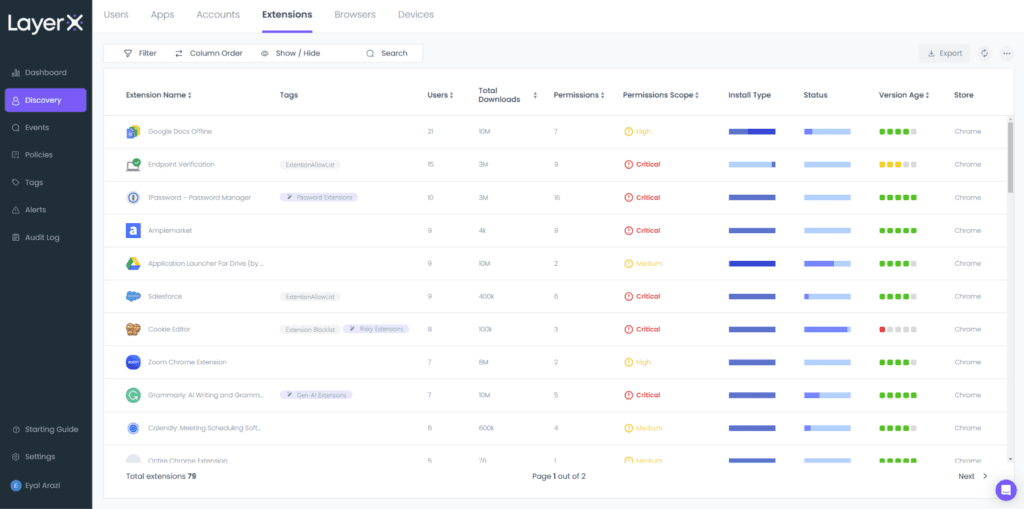
LayerX is a lightweight browser extension that transforms standard browsers like Chrome and Edge into governed workspaces where AI interactions, SaaS activity, identities, and sensitive data movement can all be monitored and controlled in real-time.
It intercepts AI usage at the source before it’s even sent or encrypted. For example, it can analyze content pasted into Gemini before it reaches Google’s servers.
LayerX’s contextual DLP engine also deserves a mention. It can detect and block risky AI use, such as when an employee uploads a proprietary codebase into ChatGPT.
Key Features
- Shadow AI Discovery: Discovers sanctioned and unsanctioned AI tools across browsers, SaaS applications, IDEs, desktop AI apps, and AI browser extensions.
- AI Usage Control (AIUC): Centralizes visibility over how employees use AI tools, monitors risky AI behavior patterns, and applies granular enforcement policies around AI interactions.
- Browser Extension Security: Analyzes installed extensions and evaluates data risk posture. LayerX can restrict or block extensions that cause data leakage, credential theft, or malicious AI behavior risks.
Best For
Remote or distributed teams that want security controls across existing browsers without forcing major user-experience changes.
What LayerX Users Say
“LayerX integrates smoothly into our digital workplace environment. Employees can continue using their preferred browsers while the platform quietly applies security controls in the background.” → Read Full Review
Pricing
LayerX's pricing isn't made public. Visit its website to book a demo.
9. Proofpoint
See how Teramind compares to Proofpoint →
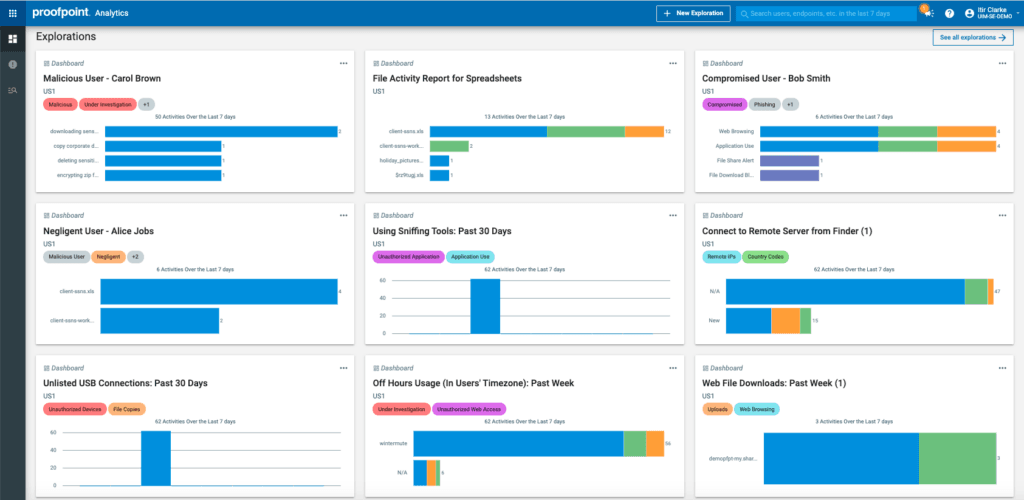
Proofpoint takes a different approach compared to the others we've reviewed for our list. Namely, it views data loss as a human behavior problem.
Its data security stack brings together Proofpoint DLP, DLP Transform, DSPM, insider threat management, endpoint visibility, browser-based GenAI controls, and user education. These capabilities help companies understand who is putting sensitive data at risk, what data is being exposed, which channels are involved, and whether the behavior is careless, risky, or potentially malicious.
Proofpoint’s DLP also works across managed and unmanaged endpoints and cloud, with visibility into user activities such as web uploads, USB copies, website and app usage, and GenAI prompts.
Key Features
- ZenGuide: AI-powered, adaptive security awareness platform designed to reduce human risk by delivering personalized training, phishing simulations, and actionable insights.
- ZenWeb: Enables monitoring of prompt submissions, browser-based AI activity, uploads, clipboard actions, and AI website interactions directly inside browser sessions.
- Very Attacked People (VAP): Identifies users within an organization who are most frequently targeted by advanced email threats.
Best For
Regulated or data-sensitive organizations that want to allow GenAI adoption while reducing careless data exposure.
Proofpoint offers a mature, human-centric approach, particularly when it comes to coaching employees to engage in safer AI interactions.
What Proofpoint Users Say
“I love how Proofpoint Enterprise DLP uses smart AI to focus on people and their behaviors, protecting data across email, cloud apps, and endpoints.” → Read Full Review
Pricing
Proofpoint only offers custom pricing; you must submit a form on its website to get a quote.
10. Zscaler
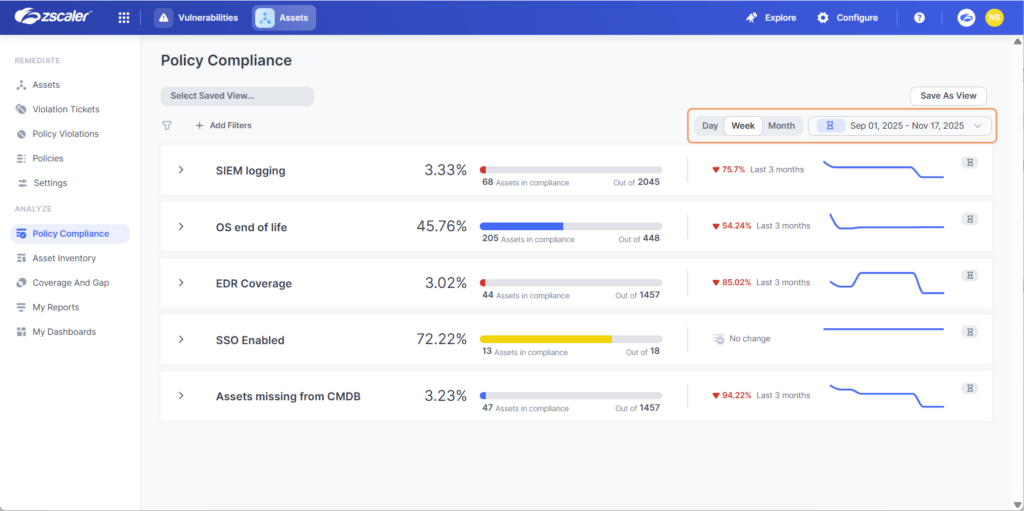
Zscaler is a zero-trust security platform that protects users, apps, workloads, and data through its cloud-native Zero Trust Exchange (ZTE).
Its advantage is that it sits inline across user traffic, web access, SaaS usage, cloud apps, and GenAI interactions. This means Zscaler can inspect and control AI-related data movement as it happens.
This allows organizations to monitor prompts submitted into AI systems, block sensitive information before it reaches external LLMs, and apply adaptive controls dynamically across browser sessions and cloud traffic.
Key Features
- Zscaler Zero Trust Browser: Adds browser-level governance for AI interactions. Security teams can isolate risky AI sessions, restrict copy/paste behavior, block downloads, and inspect browser-based AI activity.
- Autonomous Workflow Protection: Applies zero-trust controls and AI-specific protections to reduce the risk of autonomous AI misuse, lateral movement, and unauthorized system access.
- Smart Input Prompt Blocking: Allows Zscaler to block risky prompt submissions when they contain high-risk data or violate policies.
Best For
Organizations that want to apply zero-trust principles to AI usage.
Zscaler’s identity-centric, context-aware detection aligns AI governance with a broader zero-trust strategy.
What Zscaler Users Say
“Its simple, powerful and packed with amazing backend features like security posture management across multiple clouds like Google, AWS or Azure; Secure app to app communication and individual identity based microsegmentaion.” → Read Full Review
Pricing
Zscaler offers different platform bundles and add-on packages. Visit its website for more information.
How Do the Best Enterprise Data Security Tools Compare?
| Vendor | Primary Approach | Standout Features | Best For | Pricing Model |
|---|---|---|---|---|
| Teramind | Endpoint agent with full session capture | Live view & session playback; OCR & keystroke logging; complete AI agent monitoring; behavioral risk scoring (none → critical); smart rules & automated alerts | Regulated industries (finance, healthcare, legal, gov), BPOs, distributed teams with sensitive endpoint activity | Starts at $15/seat/mo (Starter), $30 (UAM), $35 (DLP); Enterprise custom |
| Cyberhaven | Data lineage tracking across the full data lifecycle | Tracks multi-step data flows (screenshot → AI upload); AI Risk IQ scores 700+ AI apps; shadow AI discovery across SaaS, browser, & LLM apps | Incident response teams needing forensic trails of exactly how data reached an AI service | Custom pricing |
| Microsoft Purview | Native Microsoft 365 governance layer | DSPM for AI across Copilot & third-party tools; sensitivity labels that persist into AI interactions; insider risk correlation across M365 signals | Microsoft-first orgs deploying Copilot that need governance without adding a new vendor | From $12/user/mo for compliance suite; AI protection features billed by usage |
| Nightfall AI | Cloud-native DLP with 100+ AI detection models | Browser plugin redacts ChatGPT prompts in real time; 95% precision across SaaS; Nyx agentic DLP copilot for autonomous incident investigation; 100+ sensitive data classifiers | Large enterprises managing AI use at scale across dozens of SaaS platforms with automated remediation | Custom pricing (DDR, DEX, or Complete plans) |
| Forcepoint | Unified data security cloud (DLP, DSPM, CASB, & DDR) | ARIA AI assistant surfaces protection gaps in natural language; 1,800+ prebuilt classifiers for 90+ countries; AI Mesh uses SLMs for context-aware classification | Complex on-prem, cloud, & remote environments needing a single enforcement architecture | Custom pricing |
| Concentric AI | Deep learning-powered data discovery & classification | Semantic Intelligence classifies unstructured data (IP, source code, financials); risk distance analysis; Microsoft Copilot data tracking; automated remediation for overshared data | Enterprises with years of unstructured data sprawl across multi-cloud file shares & SaaS tools | Custom pricing |
| Netskope | Inline HTTPS inspection at cloud scale (SSE / SASE) | 3,000+ data classifiers; 1,800+ file types; instance deception (personal vs enterprise ChatGPT); SSPM; endpoint DLP for USB, Bluetooth, printers | Teams investing in SASE / zero trust that need AI-aware DLP built into the data path | Custom pricing |
| LayerX | Browser-native interception before data is transmitted | Contextual DLP (debugging help vs full codebase upload); shadow AI discovery across browsers, IDEs, & extensions; AIUC centralized AI usage governance; extension risk scoring | Remote / distributed teams wanting browser-level controls without deploying agents or disrupting UX | Custom pricing |
| Proofpoint | Human behavior-focused DLP across endpoint & cloud | ZenGuide adaptive security training with phishing simulations; ZenWeb browser-level GenAI prompt monitoring; VAP (Very Attacked People) identification; managed & unmanaged endpoint coverage | Orgs wanting to allow GenAI while reducing careless exposure through coaching & behavior change | Custom pricing |
| Zscaler | Zero Trust Exchange with inline inspection across all user traffic | Zero Trust Browser with session isolation, copy/paste control; autonomous workflow protection for AI agent lateral movement; smart input prompt blocking for sensitive data | Organizations building or extending a zero-trust architecture that want AI governance integrated into that strategy | Custom pricing |
The tools split cleanly into three camps based on where they enforce policy:
- Endpoint Agents: Teramind and Proofpoint give the deepest forensic detail but require deployment.
- Inline/Network Tools: Netskope, Zscaler, and Forcepoint work without touching endpoints but add latency and infrastructure.
- Browser-based Tools: LayerX and Nightfall’s plugin are the lightest lift, but only cover browser-accessible AI.
For enterprise buyers, we’ve seen that the most important differentiator is usually the compliance use case.
For this, we recommend Teramind for AI insider threat monitoring and audit trails, Purview for Microsoft-centric orgs, Cyberhaven for incident response forensics, and Nightfall for SaaS-heavy environments at scale.
What Should You Look for in an Enterprise AI Data Loss Prevention Tool?
Real-time Prompt and Response Inspection
An enterprise AI DLP tool should inspect what users send into AI tools and what those tools return.
This includes prompts, file uploads, copied text, generated responses, AI summaries, and outputs from copilots or AI agents.
Inline Blocking, Redaction, and User Warnings
Your preferred solution should be able to act when sensitive data is about to be shared with an AI system. At minimum, look for blocking, redaction, warning, quarantine, justification prompts, and policy-based allow/deny controls.
For example, if an employee pastes customer PII into ChatGPT, the tool shouldn't simply log the event for later. It should block the prompt, redact the sensitive fields, warn the user, or require a business justification depending on your policy.
Data Access Governance Before AI Exposure Happens
Look for capabilities like DSPM, access governance, oversharing detection, permissions analysis, sensitivity labeling, and remediation workflows.
If a confidential SharePoint folder is broadly accessible, Copilot may surface that content to users who technically have access but shouldn't. AI DLP should help you fix those upstream data exposure problems before they become major incidents.
Browser, Endpoint, SaaS, Cloud, and Email Coverage
AI data loss can happen via many channels, so the tool should protect more than one surface.
Look for coverage across browsers, endpoints, SaaS apps, cloud storage, email, collaboration tools, developer environments, and AI applications.
Audit Trails and Investigation-ready Evidence
AI compliance is vital, especially with new laws such as the EU AI Act coming into play. To this end, the tool should create clear activity records.
Security and compliance teams need to know who used the AI tool, what data was involved, when the data was shared, which app or account was used, what policy was triggered, and what action was taken.
Integration With Your Existing Security Stack
The solution should integrate cleanly with SIEMs, identity providers, SSE/SASE platforms, CASBs, endpoint tools, and existing security workflows.
AI DLP only works long-term if it scales operationally across distributed users, large datasets, and multiple AI environments.
Support for AI Agents and Autonomous Workflows
The best AI DLP tools should be prepared for more than human prompts.
Enterprises are moving toward copilots, coding agents, support agents, workflow agents, and autonomous systems. These create a new layer of risk, as they can access data, call APIs, generate outputs, and take actions without human oversight.
Why is Teramind an Ideal Data Loss Prevention (DLP) Tool?
See how Teramind compares to other AI DLP tools → Explore an interactive product demo
There's no need to choose between browser monitoring, network inspection, or endpoint detection; with Teramind, you get all three via a unified platform that tracks AI usage regardless of how employees access it.
Here’s what Teramind offers:
- See All AI Usage as It Happens: Behavioral detection identifies shadow AI regardless of how employees access it. Teramind discovers AI usage across browsers, desktop applications, and endpoints.
- Prove Compliance With Audit-ready Logs: Teramind delivers complete records of AI interactions showing what employees sent, what was blocked, what AI generated, and what happened next. Gather evidence that meets HIPAA, GDPR, PCI DSS, and financial services requirements.
- Detect AI Agents Operating at Machine Speed: Teramind can detect and secure superhuman AI activity, such as autonomous systems executing hundreds of operations per minute.
- Work Across Platforms Without Gaps: Consistent monitoring and enforcement on Windows, macOS, and Linux. Employees can’t evade governance by switching operating systems or using personal devices.
- Capture Visual Evidence With Screen Recording: See exactly what employees saw when using AI tools and what they did with its content.
Most organizations deploy multiple specialized tools trying to cover different AI usage patterns. One for browsers, another for network traffic, a third for cloud applications.
Teramind provides complete AI DLP governance in one platform, monitoring everything, blocking what matters, and documenting it all for compliance.
FAQs
What is the Difference Between Traditional DLP and AI-powered DLP?
Traditional DLP mainly protects data across known channels like email, endpoints, cloud storage, USB, and web uploads.
AI-powered DLP adds visibility into AI-specific workflows, including prompts, responses, file uploads to AI tools, copilots, AI agents, and shadow AI apps.
How Do Enterprise AI DLP Tools Prevent Data Leaks Into ChatGPT or Claude?
They inspect prompts, pasted text, uploaded files, screenshots, and browser activity before the data reaches the AI tool.
If sensitive information is detected, the Claude or ChatGPT monitoring platform can block, redact, warn, or restrict the interaction based on policy.
Can AI DLP Tools Detect Sensitive Information in Screenshots or Video Calls?
Yes, some platforms can, but not all.
Tools like Teramind with OCR and computer vision capabilities can identify sensitive information inside screenshots, screen recordings, images, and shared video content.
What Are the Biggest Data Protection Threat Vectors?
The biggest risks are:
- Employees pasting sensitive data into AI prompts.
- Employees uploading confidential files to AI systems.
- Employees using unauthorized or shadow AI tools.
- Employees using AI-powered browser extensions.
- Developers using AI tools to generate or manipulate code.
- Autonomous AI agents interacting with internal systems.
Is an AI DLP Tool Required for EU AI Act Compliance?
Not directly. The EU AI Act does not say every company must buy an AI DLP tool.
But if your organization uses high-risk AI systems or handles sensitive data with AI, AI DLP can help support required controls such as AI insider risk management, incident logging, human oversight, and misuse prevention.
How Does AI DLP Reduce False Positives Compared to Legacy Systems?
AI DLP uses context, behavior, data lineage, semantic classification, exact data matching, and AI-based detectors instead of relying only on keywords or regex.
That helps it understand whether a data movement is risky, rather than flagging every pattern that looks sensitive.
How Do I Identify Shadow AI Usage Within My Organization?
Start by monitoring browser activity, SaaS app usage, endpoint activity, network traffic, AI domains, browser extensions, and login patterns across personal and corporate AI accounts.
A good AI DLP monitor should reveal which AI tools employees use, who uses them, what data they share, and whether the tools are approved.
What Should I Look for When Evaluating an AI DLP Vendor’s Own Security?
Check whether the vendor has:
- Strong encryption.
- Access controls.
- Audit logs.
- Data retention policies.
- Tenant isolation.
- Compliance certifications.
- Secure model usage policies.
- Clear documentation on whether customer data is used to train AI models.
Also, ask how the vendor secures prompts, files, logs, and detection metadata.
Can These Tools Protect Data Across Hybrid and Multi-cloud Environments?
Yes, but coverage varies by vendor. Some tools are strongest in Microsoft 365, some in browsers, some on endpoints, some across SaaS and cloud apps, and some across SASE/SSE traffic.
For hybrid and multi-cloud environments, prioritize tools with cloud, endpoint, SaaS, browser, API, and identity integrations.
