
Insider Threat Detection Software for User Risk Monitoring and Data Protection
Teramind combines privacy-first insider threat monitoring with intelligent user and entity behavior analytics (UEBA), providing full visibility into human operations and agentic AI across your organization.
Why Insider Threats Are Difficult to Detect
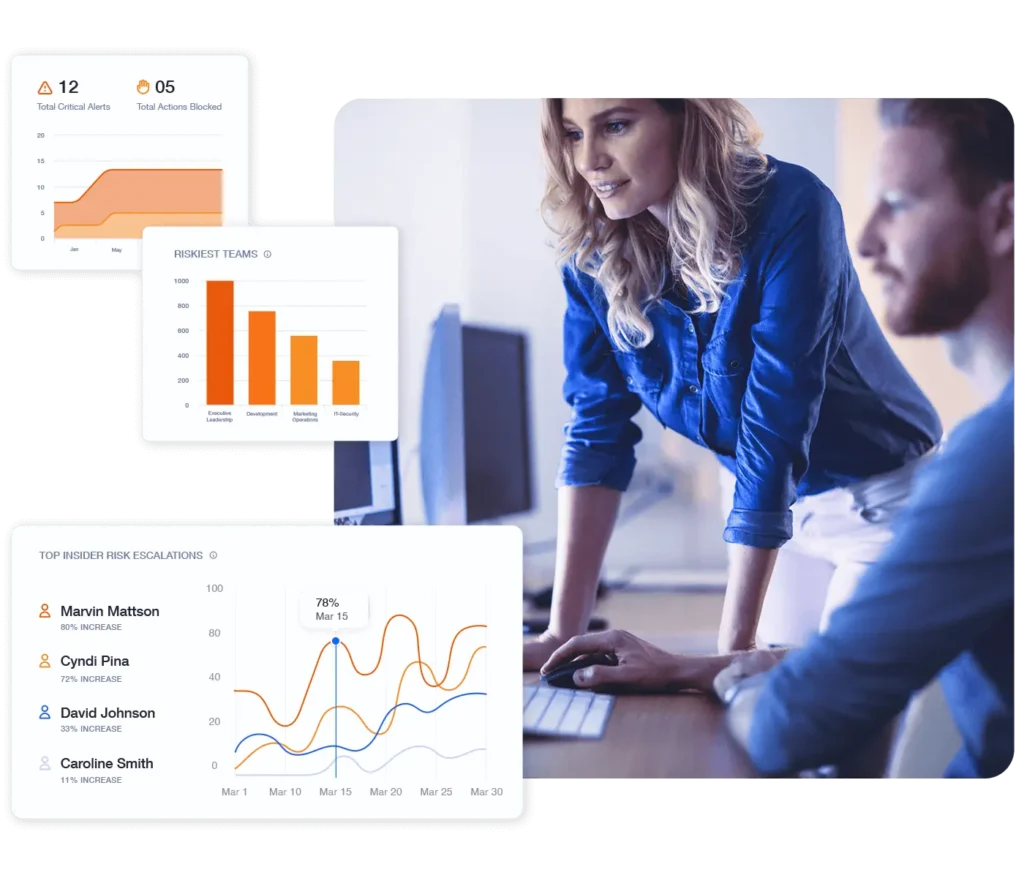
Insider threats are difficult to identify because they originate inside your company. Unlike external attacks that must breach a perimeter, compromised insiders, malicious actors, or unmonitored automated accounts use authorized credentials to operate undetected.
Several key factors contribute to this detection gap:
- Legitimate Access: Employees, contractors, and AI agents already have authorized access to systems and files. Their presence in sensitive environments rarely triggers standard perimeter alarms.
- Need for Baselines: Without sophisticated behavior monitoring, risky behavior often mimics normal day-to-day operations. Establishing baselines is essential to distinguish between productive work and subtle threat indicators.
- Non-Human & Agentic AI Risks: The proliferation of autonomous AI agents, API integrations, and non-human identities operating at speed creates new visibility gaps alongside traditional user activity.
- Diverse Exfiltration Channels: Data exfiltration can occur through a vast array of channels, including email, USB drives, cloud uploads, printing, screenshots, personal applications, and unauthorized AI tools.
- Expanded Workforce Risk: Remote teams and third-party contractors often operate outside traditional network boundaries, introducing elevated risk exposure.
- Lack of User Context: Traditional security tools monitor systems but fail to capture human and non-human intent, missing the context required to perform accurate risk assessments.
How Teramind Insider Threat Detection Works
Teramind provides a privacy-first platform designed to help security, legal, and HR teams maintain a secure, compliant, and defensible digital environment. By monitoring endpoints, Teramind offers contextual visibility into risk without compromising employee privacy.
Gathers high-fidelity activity logs while enforcing strict privacy safeguards, including Role-Based Access Controls (RBAC), end-to-end data masking for PII/PHI, and full compliance alignment with GDPR, HIPAA, and SOC 2.
Monitors actions taken by human employees as well as non-human identities and agentic AI tools executing tasks on the endpoint.
Establishes behavioral baselines for users, peer groups, and system entities to automatically spot suspicious deviations.
Assigns dynamic risk scores to incidents using machine learning models so security teams can focus on urgent threats.
Employs customizable rule engines to proactively block unauthorized uploads, risky file access, or suspicious data movement in real-time.
Delivers audit-ready forensic evidence through session replays, OCR keyword indexing, and detailed activity timelines, backed by strict access control governance.
Teramind Insider Threat Monitoring Use Cases
Teramind provides versatile security monitoring tailored to the operational, legal, and risk requirements of modern enterprises.
Here are the platform’s main use cases:
Stop Unauthorized Data Exfiltration
Prevent IP theft and sensitive data exposure across key channels by automatically blocking:
- Uploads of confidential files to unauthorized cloud storage or personal web applications.
- Data transfers to unauthorized USB drives or external storage media.
- Unauthorized printing or screen capturing of restricted documents.
- Exfiltration via personal email, messaging platforms, or unauthorized AI tools.
Detect Workplace Toxicity and Safety Risks
Maintain a legal, safe, and compliant work environment by detecting harmful insider behaviors:
- Identify patterns of workplace harassment, abusive language, or bullying in business communication channels.
- Detect policy violations involving non-inclusive behavior or improper distribution of toxic material before it impacts company culture or introduces legal liability.
Prevent Insider Sabotage and Financial Fraud
Protect core infrastructure, financial accounts, and proprietary code bases from deliberate internal damage:
- Detect unauthorized system configuration changes, registry modifications, or back-door creations by dissatisfied insiders.
- Stop malicious code deletion, repository purging, or unauthorized database altering.
- Flag anomalous financial interactions, unauthorized ledger changes, or fraudulent transaction attempts.
Monitor Privileged Users and Admin Accounts
Protect your critical infrastructure by establishing strict oversight for users with administrative privileges or elevated permissions.
Secure Non-Human Identities and Agentic AI Tools
Gain visibility into autonomous AI agents, endpoint scripts, and automated service accounts to ensure non-human entities operate strictly within assigned parameters.
Oversee Contractors and Distributed Teams
Maintain visibility into external third parties and remote workforces to ensure system access remains within contractual and security guidelines.
Investigate Incidents with Defensible Evidence
Accelerate incident response using immutable audit logs and visual evidence. Quickly establish intent, verify scope, and support HR or legal proceedings.
What to Look for in Insider Threat Detection Tools
| Capability | Why It Matters | How Teramind Supports It |
|---|---|---|
| Privacy-First Governance | Avoids "Big Brother" concerns from HR/Legal while remaining compliant | Provides robust RBAC, PII data masking, and HIPAA/GDPR compliance tools |
| Agentic AI & Entity Monitoring | Covers risks from non-human identities and autonomous software agents | Tracks both human users and non-human endpoint identities at operational speed |
| User & Entity Behavior Analytics (UEBA) | Detects subtle deviations from baseline behavior across systems | Leverages machine learning to model baseline behavior and flag anomalous activity |
| Dynamic Risk Scoring | Prioritizes security alerts based on actual risk context | Automatically assigns risk scores to prioritize urgent threats for security operations |
| DLP Controls | Prevents intellectual property theft and data leaks in real time | Enforces file, email, cloud upload, USB, and print control policies |
| Defensible Forensics | Provides clear proof for legal, HR, and compliance reviews | Features session replay, OCR text search, and indexed activity logs with access auditing |
| System Integrations | Fits into existing security ecosystems to simplify workflows | Integrates natively with SIEM, EDR, ITSM, and ticketing platforms |
Teramind vs. Other Insider Threat Tools
| Feature Category | Teramind | Proofpoint ITM | DTEX | Mimecast Incydr |
|---|---|---|---|---|
| Privacy & Governance | Granular RBAC, PII masking, GDPR/HIPAA controls | Role-based permissions, dual-login session playback | Privacy-by-design, default pseudonymization | Basic privacy & identity masking controls |
| Human & Non-Human Monitoring | Monitors human users, AI agents & non-human endpoint identities | Focuses primarily on human identity tracking | Endpoint telemetry & metadata focus | Data movement & user departure focus |
| UEBA & Anomaly Detection | Advanced machine learning across apps, entities & behaviors | Rule-based & behavioral risk scoring | Comprehensive metadata-driven behavior analysis | Exfiltration-focused risk indicators & scoring |
| Real-Time Policy Enforcement | Instant blocking & customizable response actions across all channels | Native blocking, user prompts & process termination | Targeted containment actions via integrations | Automated micro-trainings, targeted blocking |
| Forensic Evidence & OCR | Full session recording with indexed OCR & visual timelines | Full video session replay, lacks native OCR text search | Metadata timelines; lacks visual replay capabilities | File event timelines; no OCR or visual capture |
| Ecosystem Integrations | Direct SIEM, EDR & ticketing integrations (Splunk, Sentinel, etc.) | Standard SIEM & CASB integrations | Standard SIEM & SOAR integrations | Standard SIEM & email security integrations |
Where Teramind is Strongest
Teramind distinguishes itself as a comprehensive leader in insider threat protection through several key strengths:
- Privacy-First Architecture: Teramind balances security oversight with privacy governance. Features like selective masking, customizable recording rules, and Role-Based Access Controls (RBAC) ensure that HR and Legal guidelines are fully met.
- Unified Human & Non-Human Telemetry: Extends coverage beyond traditional user activity to include non-human identities, automated scripts, and agentic AI tools executing operations on endpoints.
- Proactive Response Capabilities: Moves past passive monitoring by delivering automated, real-time enforcement actions to stop exfiltration, sabotage, or malicious activity immediately.
- High-Fidelity Forensics: Provides searchable visual timelines and OCR text extraction, transforming raw system events into clear, context-rich evidence for swift resolution.
How Teramind Complements DLP, SIEM, and EDR
Teramind adds context, user intent, and privacy-governed visual evidence to complete your security stack.
- DLP (Data Loss Prevention): Traditional DLP tools identify sensitive files based on static content rules but lack intent context. Teramind supplies behavioral history and visual evidence to reveal why data is moving and whether the action is legitimate.
- SIEM (Security Information and Event Management): SIEMs ingest logs from infrastructure devices. Teramind enriches SIEM dashboards with identity-linked behavioral telemetry, helping analysts isolate high-risk actions faster.
- EDR (Endpoint Detection and Response): EDR protects endpoints against malware, exploits, and external threats. Teramind focuses on the human or non-human entity operating the device, helping teams differentiate between valid user actions, insider threats, and compromised accounts.
How to Compare Insider Threat Detection Vendors
When evaluating insider threat management platforms, consider the following technical and operational criteria:
- Privacy & Governance Controls: Ensure the vendor supports configurable Role-Based Access Control (RBAC), data obfuscation/masking for PII, and compliance features alignment (GDPR, HIPAA) to satisfy internal Legal and HR requirements.
- Coverage for Non-Human Identities: Verify whether the tool can monitor autonomous AI agents, endpoint automations, and service accounts alongside human operations.
- Behavioral Analytics Depth: Assess the solution’s ability to establish individual and peer-group baselines to reduce false positive alerts.
- Enforcement Flexibility: Determine whether the solution offers customizable automated blocking across multiple vectors (USB, web uploads, print, apps) or relies solely on passive alerting.
- Forensic & Investigation Capabilities: Confirm the software provides indexed visual evidence (such as session replay or OCR search) to streamline post-incident investigation.
- Ecosystem Integration: Validate how effectively telemetry can be exported to your existing SIEM, SOAR, or EDR tools.
Try Platform
With a Live Demo
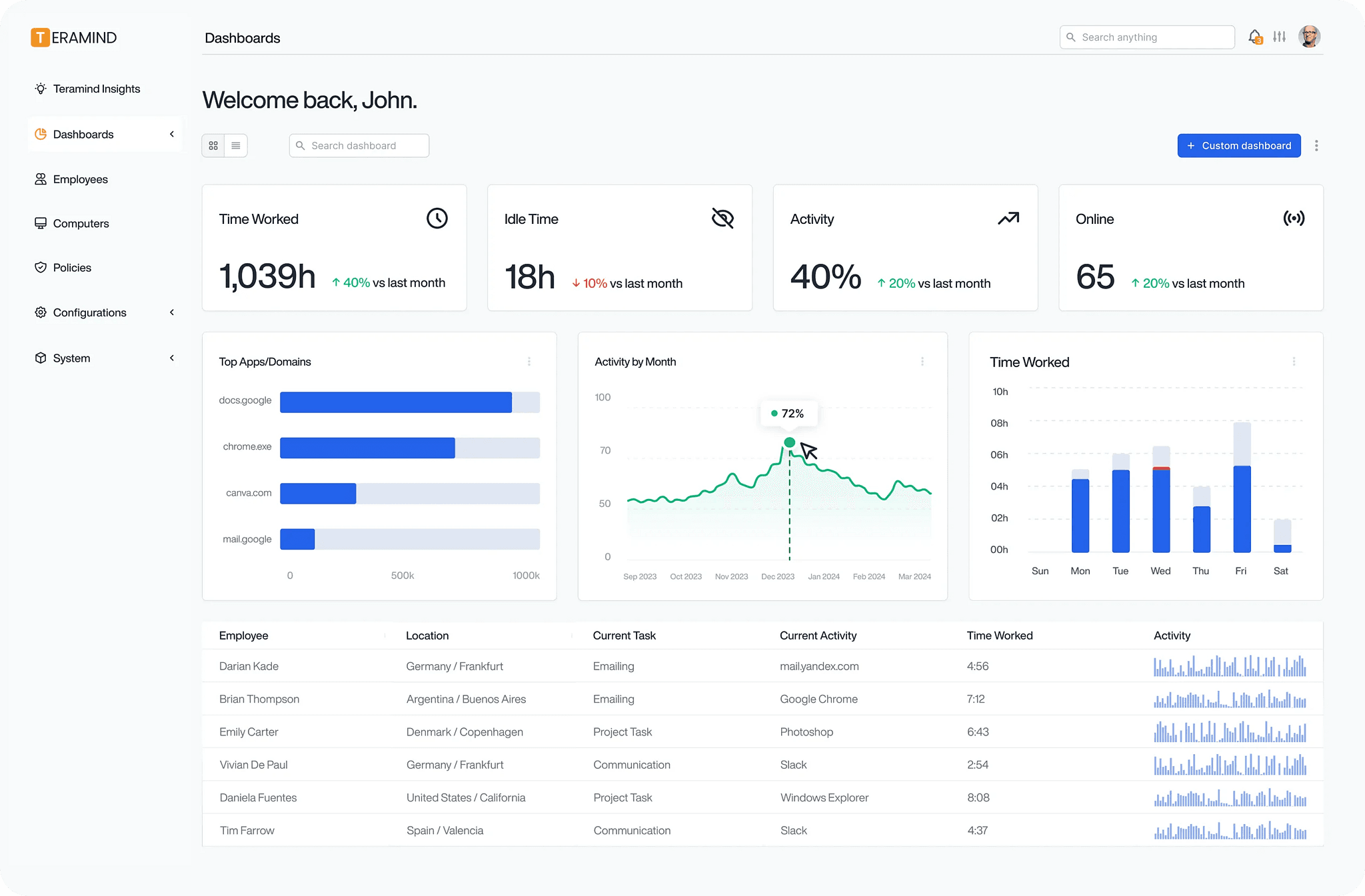
Interact with a live deployment of Teramind to see how it works.
FAQs
What is insider threat detection software?
Insider threat detection software is a specialized security solution designed to identify, monitor, and mitigate risks originating from within a business.
Unlike traditional perimeter defenses, insider threat software focuses on the actions of individuals who already have legitimate access to company systems and data.
These tools are essential for protecting against a wide range of insider risks:
- Malicious Insiders: Individuals who intentionally steal data or sabotage systems for personal gain or harm.
- Negligent Employees: Staff members who cause accidental data leaks due to poor security practices or simple human error.
- Compromised Accounts: External attackers who have successfully hijacked legitimate user credentials to bypass standard security filters.
- Contractors and Third Parties: External entities who may have unmonitored access to sensitive information, increasing the potential attack surface.
- Privileged Users: Administrators or users with high-level access whose actions — if compromised or malicious — can have the most significant impact on an organization.
What are insider threat detection tools?
These are technology platforms that provide visibility into endpoint and user behavior.
The best tools combine data collection, user behavior analytics (UBA), and automated response capabilities to secure sensitive information.
What is the difference between insider threat detection, monitoring, and management?
- Detection: Identifying anomalous patterns or threats using behavioral analytics and machine learning models.
- Monitoring: Gaining visibility into user and system activity across endpoints, applications, and networks.
- Management: The holistic program encompassing governance, cross-functional working groups, policies, technical controls, incident response workflows, and employee training.
What features should the best insider threat detection software include?
Top-tier solutions should include:
- Granular user activity monitoring.
- Advanced UEBA and anomaly detection.
- Dynamic risk scoring to prioritize alerts.
- Forensic investigation tools like session replay and OCR.
- Automated policy enforcement and blocking.
- Seamless integrations with SIEM, EDR, and project management tools.
How does insider threat risk scoring work?
Risk scoring automatically evaluates user activity based on behavioral patterns, data sensitivity, and access history.
Incidents are assigned a severity level (e.g., Low to Critical), which allows security teams to focus on the most urgent threats.
How does UEBA help detect insider threats?
UEBA (User and Entity Behavior Analytics) establishes baselines for "normal" user activity.
Then, it uses machine learning to identify deviations from these baselines that may signal malicious intent, compromised credentials, or policy violations.
How can teams reduce false positives in insider threat detection?
Teams can reduce false positives by continuously tuning policies based on observed behavior and organizational context.
High-fidelity alerts that combine user intent and activity history significantly improve detection accuracy.
How does insider threat software prevent data exfiltration?
These tools monitor common exfiltration channels like email, USB drives, cloud uploads, printing, and personal apps.
When a policy violation occurs, the software can automatically block the action in real-time, preventing the data from leaving the organization.
How does insider threat detection work with DLP, SIEM, and EDR?
Teramind complements these tools by providing the missing human context:
- DLP: Adds user intent and behavioral history to content-based data protection.
- SIEM: Feeds high-fidelity behavioral data into the log system for better incident management.
- EDR: Focuses on the person operating the machine, differentiating between malicious actors and legitimate users.
How do you build an insider threat management program?
Establishing a mature insider threat program requires a structured operational foundation before deploying technology:
- Establish a Cross-Functional Insider Threat Working Group (ITWG): Bring together key stakeholders across HR, Legal, IT, Information Security, and Compliance to define governance, align on employee privacy boundaries, and maintain leadership oversight.
- Identify High-Value Assets (HVAs): Map out your organization's most critical data, intellectual property, core financial systems, and infrastructure to define priority protection zones.
- Define Clear Policies: Document standards for acceptable data handling, system usage, and acceptable software usage across employees, contractors, and third parties.
- Conduct Regular Risk Assessments: Periodically evaluate high-risk roles, elevated permissions, and system access levels.
- Enforce Least Privilege Access: Restrict access rights to only what is strictly required for an individual’s or service account’s current job role.
- Deploy Privacy-First Telemetry & UEBA: Implement monitoring tools to track behavioral baselines across endpoints and applications safely.
- Establish Automated Escalation Workflows: Define standard operating procedures for reviewing, triaging, and escalating suspicious alerts.
- Investigate Incidents with Defensible Evidence: Use comprehensive activity logs and visual evidence to resolve incidents while maintaining legal integrity.
- Refine & Tune Detection Rules: Continually optimize detection models to minimize false positives and adjust for shifting business processes.
- Train Staff and Promote Awareness: Conduct continuous security awareness training to help employees avoid accidental data exposure or negligent mistakes.
What are the most common insider threat indicators?
Common indicators include:
- Anomalous login times.
- Unexpected access to sensitive files.
- Unauthorized use of USB devices.
- Mass data transfers.
- Attempts to circumvent security policies.
What industries need insider threat detection software most?
While all organizations face risk, industries that handle sensitive intellectual property, high-volume customer data, or regulated information — such as finance, healthcare, government, and technology — have the most critical need for robust insider threat detection.
How does Teramind protect employee privacy?
Teramind is built around privacy-first governance. It allows organizations to configure Role-Based Access Controls (RBAC), obscure sensitive PII/PHI using automated data masking, limit monitoring exclusively to corporate systems, and align fully with global privacy frameworks like the GDPR and HIPAA.
Can Teramind monitor non-human identities and AI agents?
Yes. Teramind tracks activity executed by both human users and non-human identities — including autonomous AI agents, command-line scripts, and endpoint service accounts — to ensure all operations adhere to corporate security policies.