
AI adoption has accelerated faster than most organizations’ ability to manage it. Security and compliance teams are now responsible for overseeing machine learning models, large language models (LLMs), agentic AI systems, and shadow AI — often with frameworks and processes that weren’t built for any of it. The gap between deploying AI and governing it responsibly is where risk lives.
AI governance tools exist to close that gap. They give organizations visibility into how AI systems behave, where they’re being used, and whether they meet regulatory and ethical standards. This guide covers what to look for in a governance platform and reviews the seven best options available today.
What Should You Look for in an AI Governance Solution?
Not all AI governance tools address the same problems. Some focus on model documentation and compliance reporting. Others prioritize real-time monitoring of how employees use AI. The best platforms can do a mix of both.
Here are the seven capabilities that matter most.
Full-Spectrum Prompt and Response Logging
As employees move between sanctioned tools like Copilot and unsanctioned ones, the paper trail disappears.
A governance tool needs to capture the full conversation — what the employee asked and what the AI answered — to identify AI data leakage or toxic outputs before they become a compliance problem.
The Teramind Edge
- Teramind logs full conversation threads across ChatGPT, Gemini, Claude Code, and Copilot.
- Those logs are indexed and searchable, making compliance audits for IP protection fast and reliable.
Autonomous Agent (Agentic AI) Oversight
By late 2026, many “insiders” are expected to be autonomous agents performing tasks across systems. Visibility into what an agent does isn’t enough; you need visibility into what it’s planning.
If an agent initiates a multi-step process to “reorganize a database,” the sub-tasks it creates along the way matter just as much as the final action.
The Teramind Edge
- Teramind provides full transcripts of agent activity, logging planning, and execution steps.
- With this info, data security teams can distinguish legitimate automation from a hallucination or a prompt injection attack.
Behavioral Shadow AI Discovery
Employees are adept at hiding unauthorized AI tool usage — renaming browser windows, using custom wrappers, or routing traffic through unfamiliar domains.
Relying on a blocklist of known URLs is no longer sufficient. A governance tool needs to identify AI usage based on how an application behaves on the endpoint, not just what it’s called.
The Teramind Edge
- Teramind uses behavioral fingerprinting to detect Shadow AI based on execution patterns
- It provides zero-day visibility into new AI tools the moment they touch your network.
Visual Evidence and High-Frequency OCR
Data exfiltration through generative AI often happens visually. An employee reads a sensitive code snippet rendered in a browser-only AI chat, or an AI generates a chart containing confidential data.
Standard logs miss this entirely. A governance tool needs to see what the user sees.
The Teramind Edge
- Teramind’s real-time OCR reads AI output directly from the screen.
- If an LLM suggests a way to bypass a security control, the text is identified, and an alert is triggered immediately — no file download required.
Automated Regulatory Alignment
With the EU AI Act now in full effect, manual compliance checks are too slow and too error-prone.
An AI governance tool should automatically map AI activity to specific regulatory requirements — covering transparency obligations, data residency rules, and high-risk use case monitoring — without requiring compliance teams to do it by hand.
The Teramind Edge
- Teramind generates continuous audit trails and real-time reporting.
- This shows your AI risk posture across all covered regulatory frameworks, such as the GDPR.
AI-Driven Alert Prioritization
Governance at scale generates noise. Thousands of low-risk alerts can bury the one high-risk breach that actually matters.
An effective AI governance platform needs to surface patterns, grouping small, repeated violations into coherent incident stories rather than flooding analysts with individual events.
The Teramind Edge
- Teramind’s Insights interface uses AI to consolidate related alerts.
- Instead of 50 separate copy/paste flags, security teams see one story: “User X is systematically moving IP into an unauthorized LLM.”
Predictive Risk Scoring
Good AI governance isn’t just about blocking bad behavior; it’s about identifying who is likely to engage in it before they do.
Correlating employee AI usage patterns with behavioral signals like sentiment shifts and productivity changes gives governance teams the ability to intervene early.
The Teramind Edge
- Teramind’s brAIn Engine correlates AI usage with sentiment analysis and productivity shifts.
- If a disengaged employee starts asking an LLM how to encrypt local files for backup, the system flags it as a high-intent risk before the encryption starts.
What AI Governance Tools Should You Consider?
| Tool | Best For | Core Approach | Key Differentiator |
|---|---|---|---|
| Teramind | AI security and shadow AI governance | Monitors AI usage at the endpoint and application level in real time | Only tool combining insider threat detection with agentic AI and shadow AI governance |
| Credo AI | Policy-driven enterprise AI governance | Maps AI initiatives to regulatory frameworks and internal governance policies | Strong policy management with automated compliance scoring |
| Monitaur | Model risk management and audit readiness | Documents the full AI lifecycle with structured governance records | Purpose-built for regulated industries requiring detailed audit trails |
| Fiddler AI | Model monitoring and explainability | Tracks model drift, performance degradation, and fairness metrics post-deployment | Deep explainability layer that makes model behavior interpretable to non-technical stakeholders |
| IBM watsonx.governance | Enterprise risk management, compliance, and MLOps lifecycle governance | Tracks foundation models and ML assets from initial request through live production | Automated metadata capture via AI Factsheets integrated with enterprise risk consoles |
| Holistic AI | Enterprise AI risk management | Audits AI systems against global regulatory frameworks | Broad regulatory coverage with quantified risk scoring across the AI lifecycle |
| OneTrust AI Governance | Enterprise risk management, privacy, and global compliance councils | Translates complex policy frameworks into active runtime controls and guardrails | Programmatic control plane that actively enforces “policy recipes” and agent boundaries at runtime |
1. Teramind
While most AI governance platforms focus on data classification and regulatory compliance, Teramind monitors how AI tools are actually being used across the organization — by employees, contractors, and automated agents — in real-time.
This makes Teramind particularly relevant for organizations dealing with Shadow AI. Employees regularly adopt unsanctioned AI tools that never appear in any formal AI inventory.
Teramind’s behavioral fingerprinting identifies these tools based on how they behave on the network and endpoint, not just whether their URLs appear on a blocklist. It also logs prompt and response activity across sanctioned AI tools like ChatGPT, Gemini, and Copilot, creating audit trails that compliance teams can actually use.
Key Features
See Teramind’s AI governance features in one place → Take a self-guided product tour
- Detects Shadow AI usage through behavioral fingerprinting, identifying unsanctioned tools even when renamed or hidden.
- Logs full conversation threads across major AI tools for audit trails and forensic investigation.
- Monitors agentic AI behavior, flagging velocity anomalies and superhuman execution patterns.
- Applies continuous monitoring to user activity across AI tools and cloud environments.
- Generates screen recordings of real user behavior for forensic investigations.
Use Cases
- Identifying Shadow AI adoption before it creates regulatory exposure or data governance gaps.
- Monitoring how employees interact with generative AI tools to detect unauthorized sharing of sensitive data.
- Supporting enterprise AI governance programs with audit-ready logs of AI tool usage across business units.
Best For
Teramind is the right choice for organizations that need to govern AI at the security layer, not just the model layer.
For security and compliance teams trying to get visibility into how AI tools are being used across a workforce, it fills a gap that traditional AI governance platforms don’t address.
2. Credo AI
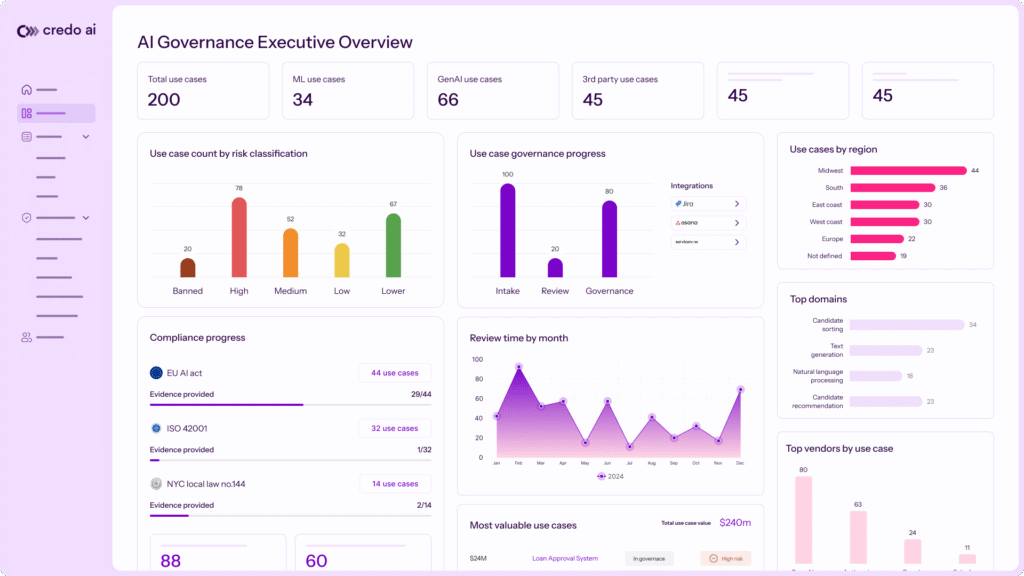
Credo AI is one of the more established names in enterprise AI governance. Its platform is built around policy management, helping organizations define governance policies, map them to regulatory frameworks like the EU AI Act and NIST AI RMF, and track compliance across AI initiatives throughout the organization.
What makes Credo AI practical for large organizations is its ability to work across business units. Different teams can register their AI systems, document their use cases, and receive automated compliance scoring based on the governance policies the organization has defined. This makes it easier to maintain a centralized AI inventory while still giving individual teams the flexibility to move at their own pace.
Key Features
- Automated policy enforcement that maps AI systems to internal governance policies and external regulatory frameworks.
- AI inventory management that registers and tracks AI tools and models across the organization.
- Compliance scoring that evaluates each AI initiative against applicable regulatory requirements.
- Risk tiering workflows that document AI-specific risks at each stage of the AI lifecycle.
- Audit trails that record governance decisions and policy assessments for regulatory reporting.
Use Cases
- Managing AI governance across large enterprises with multiple business units and diverse AI projects.
- Documenting compliance with the EU AI Act, NIST AI RMF, and GDPR.
- Building structured governance frameworks for responsible AI adoption at scale.
Best For
Credo AI suits compliance-focused enterprises that need a governance platform capable of managing policy and regulatory alignment across many AI systems simultaneously.
It’s a strong fit for legal, risk, and compliance teams that need structured oversight without getting into the technical weeds of model risk management.
3. Monitaur
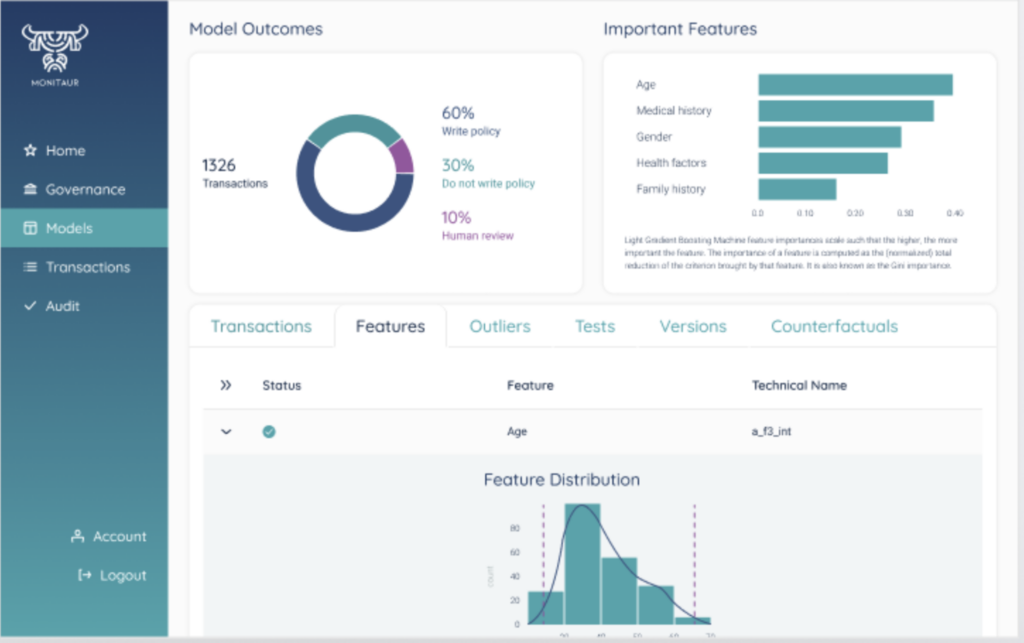
Monitaur’s approach to AI governance is structured around record-keeping: capturing model metadata, governance decisions, testing results, and approval workflows in a format that satisfies both internal risk teams and external regulators.
The platform is particularly well-suited to financial services and insurance organizations, where model risk management has been a regulatory requirement for years. Monitaur brings that same discipline to AI systems — giving model risk management teams a way to govern machine learning models and large language models using processes they already understand.
Key Features
- Structured AI lifecycle documentation that captures model cards and metadata, testing records, and approval decisions.
- Audit trails designed to meet the documentation standards required by financial and insurance regulators.
- Governance workflows that route AI systems through defined review and approval processes before deployment.
- AI registry that maintains a centralized record of all models in development and production.
- Support for both internal models and external models sourced from third-party vendors.
Use Cases
- Meeting model risk management requirements in banking, insurance, and other regulated industries.
- Documenting AI governance decisions for internal audit and external regulatory review.
- Managing the approval and oversight of AI systems across the full AI lifecycle.
Best For
Monitaur is purpose-built for regulated industries where audit readiness isn’t optional.
It’s the strongest choice for risk and compliance teams that need to manage model risk with the same rigor they apply to traditional financial models.
4. Fiddler AI
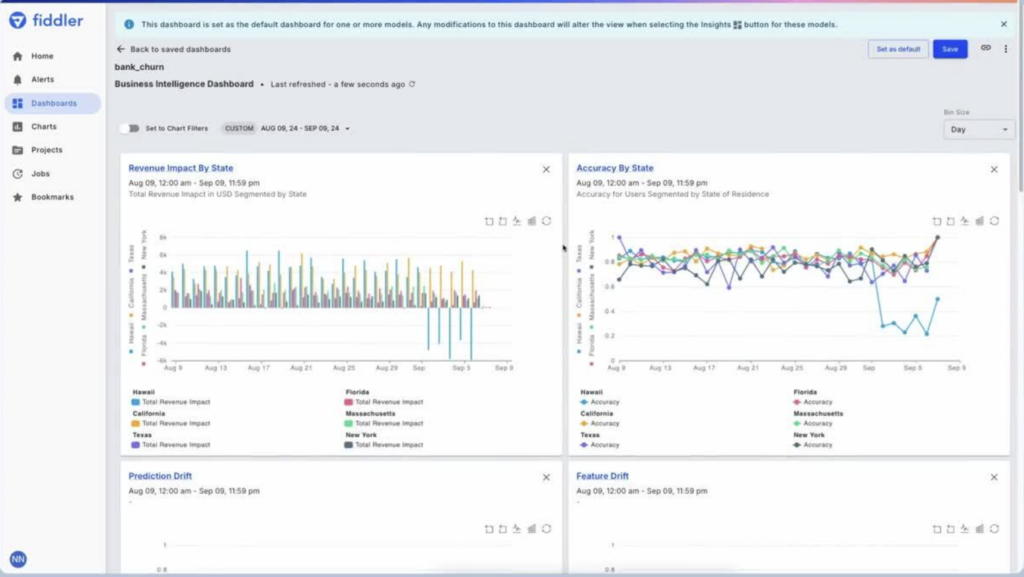
Fiddler AI focuses on what happens after a model goes live. Most AI governance platforms concentrate on pre-deployment documentation and policy alignment. Fiddler’s strength is in production — monitoring model behavior, model drift detection, and making AI outcomes explainable to the people who need to act on them.
The explainability layer is what sets Fiddler apart. It doesn’t just flag when a model is underperforming; it shows why. This matters in high-stakes environments like credit decisioning, healthcare, or fraud detection, where model behavior needs to be interpretable by both technical and non-technical stakeholders.
Key Features
- Continuous monitoring of model performance in production, with alerts for model drift and degradation.
- Explainability tools that surface the factors driving individual model decisions in plain language.
- Fairness metrics tracking that flags disparate outcomes across demographic groups.
- Data quality monitoring that identifies upstream data issues affecting model behavior.
- Integration with existing ML pipelines and enterprise software for deployment in complex environments.
Use Cases
- Monitoring production ML models for drift, bias, and performance degradation in real-time.
- Providing explainability for high-stakes AI decisions in financial services, healthcare, and insurance.
- Supporting responsible AI programs with ongoing fairness assessment after deployment.
Best For
Fiddler AI is the best choice for data science and model risk teams that need post-deployment governance.
If your primary concern is what your models are doing in production — and being able to explain it — Fiddler is the strongest tool for that job.
5. IBM watsonx.governance
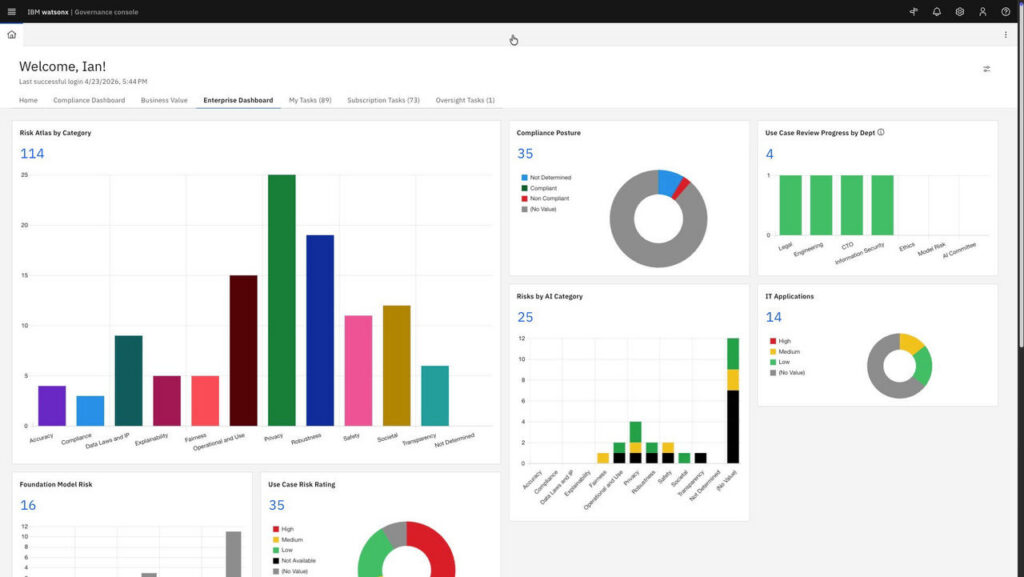
IBM watsonx.governance provides an end-to-end monitoring and governance solution designed to accelerate responsible, transparent, and explainable AI workflows across machine learning and generative AI models.
The platform enables organizations to track foundation models and machine learning assets from the initial request phase through to live production, centralizing data in a unified dashboard to support compliance and risk management goals.
Key Features
- Watson OpenScale monitoring to evaluate deployed assets against user-defined thresholds for fairness, accuracy drift, and real-time model health.
- Generative AI guardrails that alert teams when foundation models breach thresholds for hateful or abusive language and personally identifiable information (PII).
- AI Factsheets that automatically capture asset metadata, creation parameters, training data inputs, and deployment stages into a central model inventory.
- Governance console integration via IBM OpenPages to deploy Risk Assessment questionnaires, calculate risk scores, and manage compliance tasks.
- Native watsonx.ai integration to seamlessly save prompt templates and manage curated collections of large language model assets.
Use Cases
- Governing end-to-end AI workflows across distinct enterprise roles, including model owners, developers, validators, compliance managers, and MLOps engineers.
- Automating regulatory policy tracking by aggregating development and deployment facts for models built using either IBM tools or third-party providers.
- Mitigating foundational AI risks by using an integrated AI risk atlas to identify and understand potential vulnerabilities in generative and machine learning models.
Best For
IBM watsonx.governance is the best choice for enterprise risk management, compliance, and MLOps teams that require an integrated, lifecycle-wide governance framework.
If your organization needs to audit and justify AI decisions from the moment a project is conceptualized through its operational deployment across both predictive models and LLMs, it’s the most comprehensive tool for the job.
6. Holistic AI
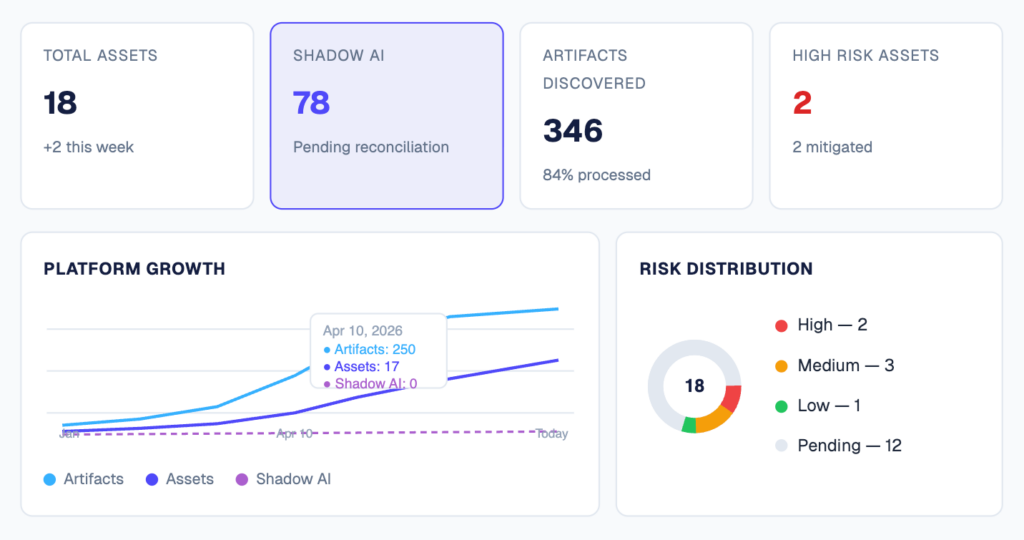
Holistic AI takes a broad view of AI governance. Its platform audits AI systems against a wide range of global regulatory frameworks, quantifying risk across multiple dimensions including fairness, robustness, explainability, and privacy. The goal is to give enterprise teams a single view of their AI risk posture.
The platform’s risk scoring approach is one of its defining characteristics. Rather than producing pass/fail compliance assessments, Holistic AI generates quantified risk scores that help organizations prioritize remediation efforts and track improvement over time.
Key Features
- AI risk scoring across fairness, robustness, explainability, and data privacy dimensions.
- Coverage of major regulatory frameworks, including the EU AI Act, NIST AI RMF, and the GDPR.
- AI inventory management that tracks systems across the organization and flags governance gaps.
- Continuous monitoring of AI systems in production against defined risk thresholds.
- Audit trails and reporting designed for regulatory submissions and board-level reporting.
Use Cases
- Conducting enterprise-wide AI risk assessments across diverse AI systems and business units.
- Tracking regulatory compliance across multiple jurisdictions with different AI governance frameworks.
- Reporting on AI risk posture to executive leadership and external regulators.
Best For
Holistic AI is a strong fit for large enterprises with complex AI portfolios that need broad regulatory coverage and quantified risk management.
It’s particularly valuable for organizations operating across multiple jurisdictions where different regulatory frameworks apply simultaneously.
7. OneTrust AI Governance
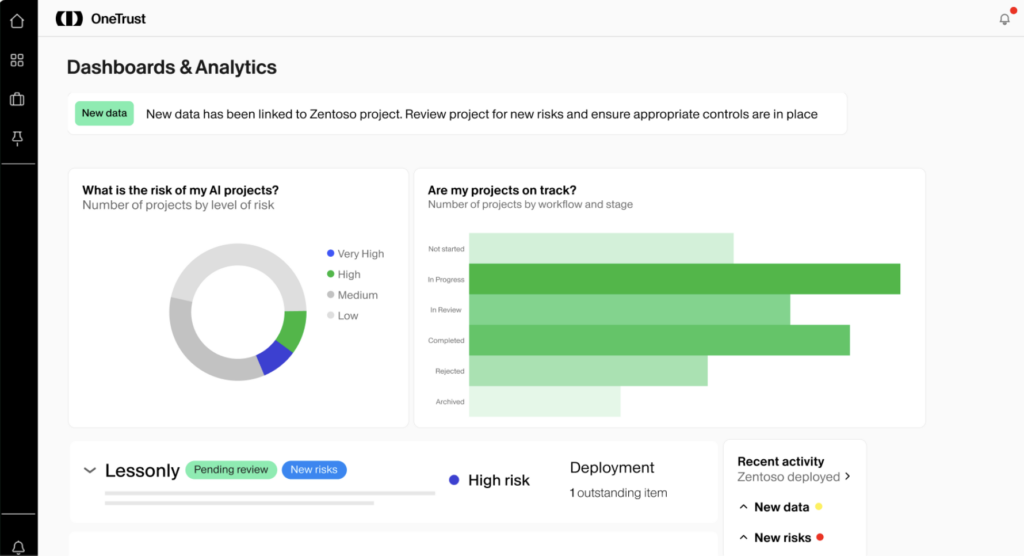
OneTrust AI Governance aligns enterprise governance with technical reality, translating AI risk into enforceable controls so organizations can scale AI safely and maintain trust. The software centralizes AI risk, ownership, compliance, and component dependencies into a single program center to manage the end-to-end AI lifecycle.
The programmatic runtime enforcement and agentic guardrail system is what sets OneTrust apart. Rather than acting as a passive document repository or a simple performance tracker, OneTrust operates as an active control plane that enforces “policy recipes” directly at runtime.
Key Features
- Centralized asset inventory to track models, datasets, autonomous agents, and third-party vendors alongside their exact lifecycle status and dependencies.
- Global framework templates including built-in alignment with the EU AI Act, NIST AI RMF, and ISO 42001 to standardize use-case risk tiering.
- Automated compliance workflows that streamline organizational intake, approvals, attestation tracking, and audit-ready reporting outputs.
- Real-time signal monitoring to ingest telemetry data across diverse AI platforms, tracking model drift, quality, safety, and performance.
- Programmatic runtime guardrails that filter prompts, intercept unsafe outputs, and block specific production behaviors based on active company policy.
Use Cases
- Enforcing safe AI behavior at runtime across enterprise platforms like AWS Bedrock by applying live redaction guardrails and blocking policy violations.
- Accelerating responsible AI delivery by converting complex regulatory frameworks into automated, policy-driven intake and approval gates.
- Scaling AI agent deployments safely by setting explicit boundary conditions, required evaluations, and permission structures for conversational assistants and autonomous tooling.
Best For
OneTrust AI Governance is the best choice for enterprise risk management, privacy, and compliance councils that need a scalable, automated solution to enforce global regulatory compliance.
If your organization needs to connect high-level policy frameworks directly to technical deployment environments — ensuring live, runtime control over privacy leaks and agent behaviors — OneTrust is the strongest platform for the job.
FAQs
What Are AI Governance Tools and Why Do Organizations Need Them?
AI governance tools are software platforms that provide visibility into how AI systems behave, where they are being used, and whether they meet regulatory and ethical standards.
Organizations need them because the rapid adoption of machine learning models, LLMs, and autonomous agents has outpaced traditional security frameworks, creating significant compliance and data leakage risks.
What is Shadow AI and How Do Governance Platforms Detect It?
Shadow AI is the unauthorized use of artificial intelligence tools by employees within an organization. Employees often bypass security blocks by renaming browser windows, using custom wrappers, or routing traffic through unfamiliar domains.
Advanced AI governance tools detect this behavior by using endpoint-level behavioral fingerprinting to identify AI tools based on their execution patterns rather than relying on simple URL blocklists.
What Features Are Most Critical When Evaluating AI Governance Tools?
An effective enterprise AI governance platform should offer a mix of deployment oversight and real-time monitoring, specifically focusing on seven core capabilities:
- Full-spectrum prompt and response logging: Capturing complete conversation threads to trace intellectual property and data leakage.
- Autonomous agent oversight: Logging the planning and sub-tasks of agentic AI systems to intercept prompt injections or hallucinations.
- Behavioral Shadow AI discovery: Finding hidden or renamed AI tools based on endpoint behavior.
- High-frequency OCR and visual evidence: Reading text directly from the screen to detect visual data exfiltration.
- Automated regulatory alignment: Continuous mapping of AI activity to frameworks like the GDPR or EU AI Act.
- AI-driven alert prioritization: Grouping isolated flags into single, coherent incident stories to reduce security noise.
- Predictive risk scoring: Correlating AI usage with shifts in employee sentiment and productivity to catch risks early.
How Do AI Governance Tools Streamline Compliance With the EU AI Act and GDPR?
Manual compliance tracking is too slow and error-prone to keep up with active AI deployments.
Governance tools automate this process by maintaining continuous, audit-ready logs of model metadata, deployment stages, and user activity. Platforms can automatically map these technical metrics to global regulatory requirements, offering risk-tiering workflows and automated compliance scoring across different business units.
How Does Teramind Differ From Traditional AI Governance Tools?
While many traditional platforms focus purely on policy creation, data classification, or post-deployment model drift, Teramind operates directly at the user and endpoint layer. It monitors how employees, contractors, and automated agents interact with AI applications in real time.
This makes it uniquely capable of capturing complete user prompts, utilizing screen-based OCR to stop data leaks, and executing zero-day tracking of Shadow AI.
