Organizations have spent years hardening their perimeters against external attackers. Yet some of the most damaging breaches today originate from within.
Insider threats — whether from disgruntled employees, compromised accounts, or AI agents — are responsible for a growing share of data loss and costly security incidents.
Traditional security tools weren’t built for this reality. Modern AI insider threat monitoring tools apply behavioral analytics, endpoint controls, and real-time forensics to detect insider threats before sensitive data leaves your environment.
This guide covers what to look for in a solution and reviews six options you should consider.
What Should You Look for in an AI Insider Threat Monitoring Tool?
As AI agents become part of everyday business workflows, the bar for effective insider threat detection has risen.
Here are the seven capabilities that matter most:
Agentic Behavior and Superhuman Speed Detection
An insider threat in 2026 isn’t just a human clicking a mouse. It can be an AI agent executing a script.
Cybercriminals increasingly use automation to exfiltrate data at speeds no analyst could catch. Your AI security platform must be able to identify these superhuman execution patterns, such as an agent performing 100+ database commands in 30 seconds or accessing sensitive data across multiple systems in a single session.
The Teramind Edge
Teramind’s AI governance tool is built for anomaly detection. It can spot these velocity-based anomalies and provide a full transcript of the agent’s sub-tasks and multi-step planning, alongside the final action.
Security operations teams get the context they need to help them distinguish legitimate automation from malicious behavior.
Prompt and Response Forensic Logging
Standard behavioral monitoring can tell you that an employee used ChatGPT. AI insider threat detection can tell you what they said.
The real risk isn’t the generative AI tool; it’s the sensitive information being fed into it. Prompt and response forensic logging captures the exact conversations your employees have with LLMs. This allows security teams to identify intellectual property leakage or jailbreaking attempts before they become AI data exfiltration.
The Teramind Edge
Teramind logs full conversation threads across ChatGPT, Gemini, Copilot, and Claude Code.
Those logs are searchable for compliance audits, in-depth forensics, and incident response workflows.
Predictive Intent Modeling
The goal of any insider threat program is to stop data breaches before they happen.
Predictive intent modeling uses machine learning to determine whether a risky action is accidental or deliberate. It does this by correlating data access patterns, unusual access patterns, sentiment shifts in communications, and behavioral anomalies (such as sudden spikes in file operations).
The Teramind Edge
Teramind’s brAIn Engine analyzes dozens of data points — including communication sentiment and withdrawal signals — to surface pre-incident red flags.
With this intel, security leaders can intervene early, significantly reducing AI security risks.
Smart Alert Prioritization
Security operations teams deal with hundreds of events every day. Alert fatigue leads to missed suspicious activity and delayed incident response.
Your AI-powered platform must act as a filter, grouping related alerts into coherent incident stories and surfacing the ones that require attention.
The Teramind Edge
Teramind’s interface presents the most pressing AI data leakage threats in a news-style feed. It helps to reduce false positives and gives analysts more time to investigate policy violations.
AI-Driven Sentiment and Toxicity Analysis
User communications are a strong insider threat indicator. A user with malicious intent often signals it through how they communicate, across Slack, Teams, business email, and personal email addresses.
Real-time sentiment monitoring can catch these signals long before any data movement occurs.
The Teramind Edge
Teramind triggers alerts based on configurable toxicity thresholds.
When an employee’s communications shift from frustrated to high-risk, it notifies your security team, allowing them to quickly address the situation.
Visual OCR for GenAI Environments
GenAI outputs are often ephemeral. They’re rendered in a browser panel and never saved to a file, making them invisible to traditional data loss prevention tools.
Visual OCR closes this gap by extracting text from on-screen images, AI-generated code snippets, and browser-rendered outputs.
The Teramind Edge
Teramind’s OCR technology can read the responses returned by coding assistants and the data inside AI-generated images.
DLP rules are triggered even when no file is ever downloaded; this is critical for protecting corporate assets in cloud environments.
Shadow AI Behavioral Fingerprinting
Employees regularly discover new, unauthorized AI tools that haven’t made it onto company blocklists. Relying on URL filtering alone leaves significant blind spots.
Behavioral fingerprinting addresses this by identifying employee AI usage based on how an application behaves on the network and endpoint, not just what it’s called.
The Teramind Edge
Teramind detects unsanctioned Shadow AI tools even when they’ve been renamed or hidden.
It supports insider threat protection by comprehensively monitoring and logging user actions across every AI application that employees touch.
What AI Insider Threat Monitoring Tools Should You Consider?
| Tool | Best For | Core Approach | Key Differentiator |
|---|---|---|---|
| Teramind | End-to-end insider threat detection | Combines user activity monitoring, behavioral analytics, and forensic logging in a single platform | Only tool with agentic behavior detection, prompt forensics, and visual OCR for GenAI environments |
| Exabeam | SIEM-augmentation and behavior analytics | Ingests data from existing security infrastructure and applies UEBA to surface anomalies | Strong attack timeline visualization that chains related security events automatically |
| Gurucul | Large enterprise environments with high data volume | ML-driven risk scoring across users, entities, and service accounts | Flexible open architecture integrates with a wide range of existing security tools |
| Insightful | Small-to-mid-sized teams monitoring remote workforces | Tracks user activity and flags deviations from normal behavior | Bridges workforce productivity monitoring and insider risk management in one interface |
| Swimlane | Automating incident response workflows | Orchestrates response across existing detection tools rather than detecting threats directly | AI-assisted playbooks reduce response time without adding headcount |
| EverFox | Government agencies and regulated industries | Continuous monitoring of privileged users with compliance-grade audit trails | Built specifically for classified and highly regulated environments with strict reporting requirements |
1. Teramind
Teramind is built for organizations that need both breadth and depth in their insider risk management strategy. It covers user activity monitoring, predictive modeling, and forensic-grade logging across endpoints, cloud environments, and AI-powered applications.
Where Teramind stands out is in how it combines these capabilities into a single platform. Rather than requiring separate tools for behavioral analytics, digital forensics, and AI agent monitoring, Teramind provides all of it in one place. It gives security teams a unified view from early warning signals through to full incident investigation.
Key Features
See Teramind’s AI insider threat monitoring tool in action → Access an interactive product tour
- Detects anomalous behavior from AI agents and automated scripts, including rapid data movement across multiple systems.
- Captures and indexes full LLM conversation threads for incident response and regulatory compliance.
- Uses machine learning to detect pre-incident red flags by correlating data access patterns, communication sentiment, and file operations.
- Groups security events into prioritized incident stories to reduce false positives.
- Reads on-screen AI-generated content to prevent data exfiltration from ephemeral GenAI outputs.
Use Cases
- Detecting attacks from compromised insiders or privileged users showing abnormal data access behavior.
- Preventing unauthorized access and sharing of sensitive data via AI tools.
- Supporting insider threat programs with comprehensive reporting, detailed activity logs, and centralized data for compliance audits.
Best For
Teramind is the strongest choice for mid-to-large enterprises that need a single platform covering the full spectrum of insider threat detection, from traditional user activity monitoring to agentic AI surveillance.
Its forensic depth, combined with proactive predictive analytics, makes it especially valuable when a reactive approach is no longer suitable.
2. Exabeam
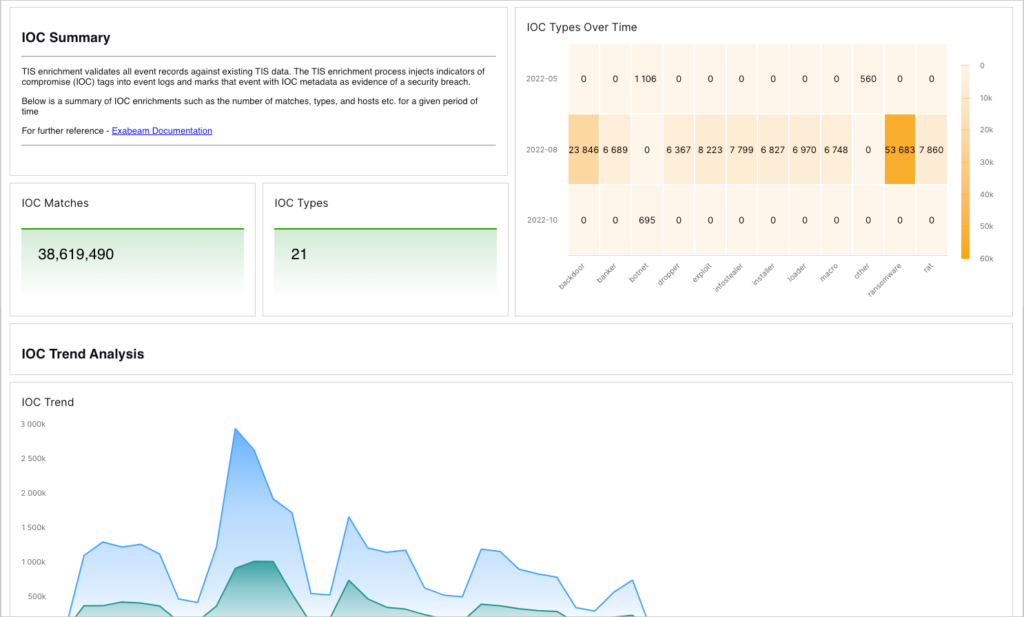
Exabeam is a well-established name in the SIEM and UEBA space. Its cloud-native platform applies user and entity behavior analytics to identify anomalies that diverge from an established baseline, flagging suspicious behavior from human users and service accounts without requiring manual rule creation.
The platform performs well in environments where correlating security events across multiple systems is a priority. Exabeam ingests data from existing security information sources and third-party tools, enriching each event with behavioral context to produce risk scores that help analysts prioritize.
Key Features
- Builds behavioral baselines for every user and entity to identify unusual data access anomalies.
- Automatically chains related security events into visual attack timelines to accelerate incident response.
- Aggregates logs from cloud environments, endpoints, and network traffic into a unified view.
- Detects lateral movement and credential misuse by correlating user actions across sessions and multiple systems.
- Uses ML to reduce false positives and surface alerts most likely to represent genuine insider threats.
Use Cases
- Identifying compromised accounts through behavioral deviations from established user baselines.
- Detecting data exfiltration attempts by privileged users with access to sensitive information.
- Helping security operations teams perform faster investigations using correlated behavioral timelines.
Best For
Exabeam suits organizations that need a scalable UEBA platform to layer on top of existing security controls and event management infrastructure.
It works particularly well in enterprise environments where centralized data and comprehensive reporting are priorities.
3. Gurucul
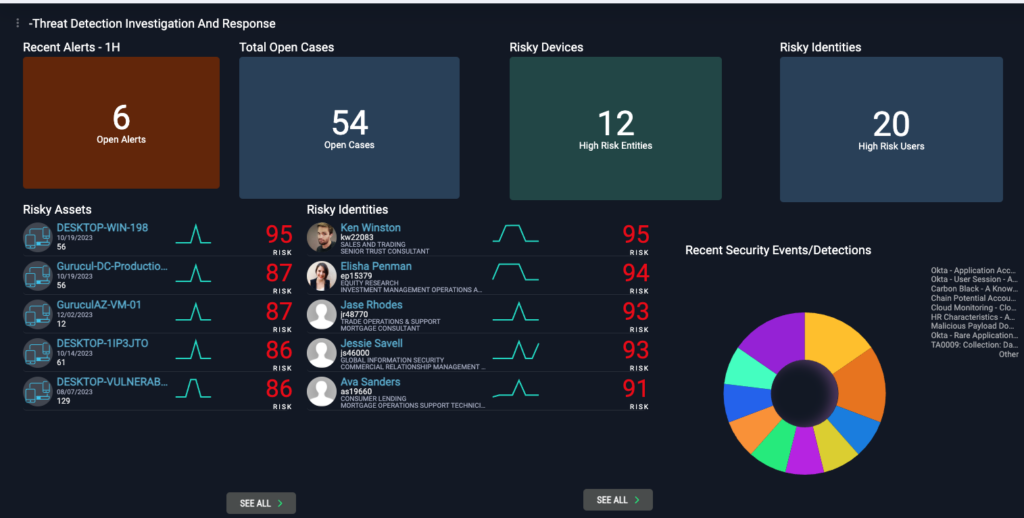
Gurucul takes a data-science-first approach to AI insider risk management. Its machine learning models evaluate user behavior, data movement, and access patterns continuously, assigning dynamic risk scores that help security teams focus on the individuals and accounts posing the greatest threat at any given moment.
The platform supports a wide range of data sources and can be deployed across cloud, on-premises, or hybrid environments. Its open architecture integrates with existing security infrastructure, including SIEMs, SOARs, and identity management systems, without requiring a full replacement of existing tools.
Key Features
- Dynamically scores users, service accounts, and entities based on behavioral analytics and data access patterns.
- Correlates user actions with identity data to detect access creep, privilege abuse, and anomalies involving privileged users.
- Connects with DLP solutions to provide contextual behavioral insight alongside data movement alerts.
- Extends continuous monitoring to cloud environments, tracking user activity across SaaS applications.
- Provides security leaders with tools for proactive threat hunting across historical and real-time data.
Use Cases
- Detecting malicious insider threats across large, geographically distributed workforces.
- Monitoring privileged users and service accounts for unauthorized sharing or unusual patterns of accessing sensitive data.
- Supporting incident response workflows with detailed risk timelines and comprehensive reporting.
Best For
Gurucul fits large enterprises and organizations in regulated industries that need a flexible behavior analytics engine.
It’s particularly well-suited for security teams managing high-volume environments where manual processes can’t scale.
4. Insightful
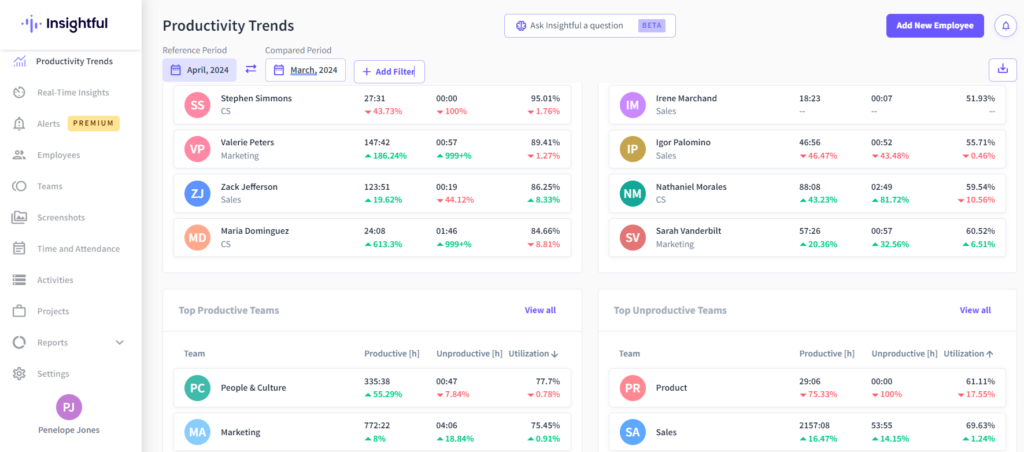
Insightful sits at the intersection of workforce analytics and security monitoring. It gives organizations visibility into user behavior without the complexity of a full SIEM deployment, making it an accessible option for smaller or mid-market security teams managing insider risk concerns alongside productivity monitoring.
The approach is straightforward: Insightful tracks what users are doing, when they’re doing it, and flags deviations that may indicate suspicious activity or unauthorized sharing of enterprise data. The fact that employees can be informed that monitoring is in place also serves as a deterrent against attacks.
Key Features
- Captures granular user activity across applications and websites, providing a foundation for in-depth forensics and regulatory compliance.
- Identifies patterns where declining engagement coincides with increased data access or unusual file operations.
- Provides screenshot-based evidence to support internal investigations.
- Flags deviations from normal user behavior in real time through centralized dashboards.
- Triggers data loss prevention alerts when users interact with sensitive data outside established security controls.
Use Cases
- Monitoring remote workforces for signs of data theft or unauthorized sharing of sensitive information.
- Supporting HR and legal teams with detailed activity logs and screenshot evidence during investigations.
- Helping smaller security operations teams maintain comprehensive monitoring without significant technical overhead.
Best For
Insightful is a practical fit for small-to-mid-sized organizations building out their insider threat programs.
It lacks the advanced ML and entity behavior analytics of enterprise-grade platforms, but its accessibility and continuous monitoring capabilities make it a solid starting point.
5. Swimlane
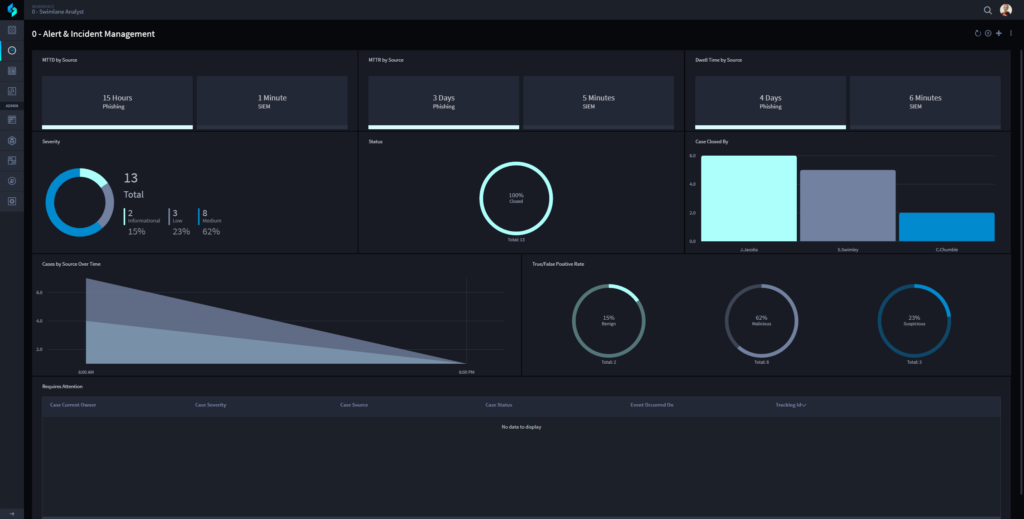
Swimlane approaches insider threat from the security operations side. It’s primarily a SOAR platform that excels at automating incident response workflows when potential insider threats are detected. In environments where multiple security tools are already running, Swimlane acts as the connective tissue, aggregating signals and orchestrating a coordinated response.
Its AI-assisted playbooks can automatically detect insider threats, gather forensic evidence, and notify the right stakeholders. This reduces the time between detecting suspicious activity and containing the threat.
Key Features
- Automates multi-step incident response workflows triggered by insider threat detection alerts.
- Pulls security events from existing security information and event management platforms, DLP tools, and endpoint agents into a unified incident view.
- Connects with behavior analytics platforms to launch response workflows when suspicious behavior crosses defined thresholds.
- Generates audit-ready reports on security incidents, user actions, and response activities.
- Provides security operations teams with centralized case management from detection through remediation.
Use Cases
- Automating the response to data exfiltration alerts, including account lockdowns, manager notifications, and evidence preservation.
- Coordinating cross-team incident response for insider attacks involving multiple systems.
- Enforcing consistent, documented response procedures across all security incidents involving sensitive data.
Best For
Swimlane is the right fit for organizations with mature detection capabilities that need to improve the speed and consistency of their incident response.
It’s particularly useful for security operations teams that need to detect insider threats and respond at scale without adding headcount.
6. EverFox
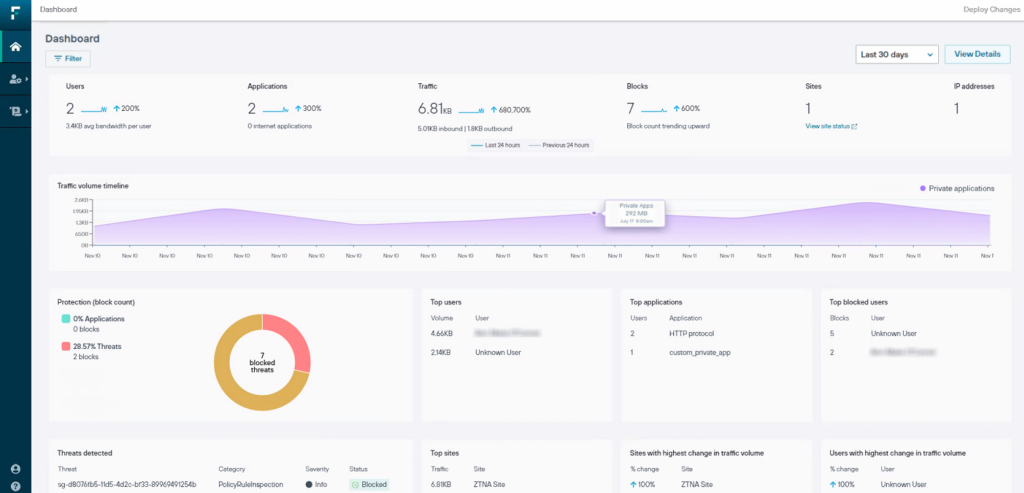
EverFox (formerly Forcepoint’s Insider Threat division) has a long track record of building insider threat detection tools for government agencies, defense contractors, and critical infrastructure operators. Its platform is designed for environments where the stakes of insider attacks are high, and compliance with regulatory frameworks is mandatory.
EverFox focuses on continuous monitoring of privileged users and high-risk individuals. It combines behavior analytics with deep visibility into data movement, file operations, and user activity across both on-premises and classified cloud environments.
Key Features
- Provides deep visibility into the actions of service accounts, administrators, and other privileged users with access to critical assets.
- Continuously evaluates user behavior against established baselines to identify unusual access patterns and pre-incident signals.
- Monitors and logs all data movement across endpoints, removable media, and network traffic.
- Enforces granular security controls around accessing sensitive data, with automated alerts or blocks when policies are violated.
- Generates detailed activity logs and audit trails to meet regulatory compliance mandates across government, healthcare, and financial services.
Use Cases
- Protecting critical assets in government agencies and defense organizations from insider attacks.
- Monitoring privileged users and contractors with access to sensitive data in classified environments.
- Supporting insider threat programs with forensic evidence collection and comprehensive reporting for regulatory audits.
Best For
EverFox is a solid choice for government agencies, defense contractors, and enterprises in heavily regulated industries.
Its forensic depth, continuous monitoring, and compliance-grade reporting are built for security leaders where the cost of an insider threat incident extends well beyond financial damage.
Why is Teramind Ideal for AI Insider Threat Intelligence?
Choosing an AI insider threat tool comes down to one question for security leaders:
Do you want to document data breaches after they happen, or stop them in real-time?
GenAI has shifted risk directly to the user's desktop. Teramind stands apart from many other tools by securing the threat where AI actually operates: at the endpoint.
Here are the key differentiators for security leaders/CISOs:
- Endpoint-First Visibility: Network DLP and CASBs are blind to local LLMs, browser extensions, and IDE assistants. Sitting directly at the endpoint, Teramind captures 100% of online and offline AI interactions, identifying hidden or renamed agents (like OpenClaw) via command velocity and network signatures.
- Real-Time Prevention vs. Incident Journaling: Legacy IRM tools log events long after data has been exfiltrated. Teramind pairs predictive intent modeling with instant enforcement, automatically blocking sensitive clipboard pastes, file uploads, or unauthorized API keys at the moment of entry.
- Visibility for Non-Human and Agentic AI: Traditional tools only track human activity. Teramind monitors autonomous AI agents running at superhuman speeds, capturing full shell transcripts (e.g., Claude Code), visual OCR for on-screen GenAI output, and CLI execution patterns.
- Contextual Clarity via Timmy Copilot: To eliminate alert fatigue, Teramind’s AI copilot, Timmy, correlates multi-week behavioral trends and converts raw telemetry into clear, plain-language risk narratives.
- Unified Security Plane: Instead of managing separate tools for user monitoring, behavioral analytics, DLP, and AI governance, Teramind consolidates the entire capability stack into a single agent.
