
How To Identify Process Improvement Opportunities

Every organization has workflows that could work better, faster, or cheaper — but figuring out where to focus is the hard part. Knowing how to identify process improvement opportunities is the difference between companies that adapt and those that stagnate. Whether you’re dealing with bottlenecks in production, bloated approval chains, or rising customer complaints, the ability to pinpoint and fix what’s broken is a core competitive skill.

This guide walks you through the frameworks, tools, and strategies that leading organizations use to uncover process improvement opportunities, prioritize them, and turn insights into measurable results.

What Is Process Improvement, and Why Does It Matter?

At its core, process improvement is the practice of analyzing, refining, and optimizing the way work gets done — producing better outcomes with fewer resources, less time, and fewer errors. Business process improvement touches everything from how you onboard employees to how you deliver products to customers.

Organizations that invest in continuous improvement outperform those that don’t — not because they have better people, but because they build systems that get better over time. A culture of continuous improvement means problems are surfaced early, solutions are tested quickly, and gains compound quarter over quarter. It’s an ongoing discipline, and the first step is learning to spot the opportunities hiding in plain sight across your business operations.

How to Identify Process Improvement Opportunities

Learning how to identify process improvement opportunities requires a structured approach that combines data, direct observation, and stakeholder input.

1. Map Your Current Processes

You can’t improve what you don’t understand. Process mapping is the foundational step that gives you visibility into how work actually flows — not how it’s supposed to flow. By documenting your current processes end-to-end, you expose the gaps between perception and reality.

Process mapping techniques like flowcharts, swimlane diagrams, and SIPOC models help you visualize handoffs, decision points, and dependencies. Start with your highest-volume or most error-prone workflows and document each step of the business process — who owns it, what inputs it requires, and what outputs it produces. The goal is to create a clear picture of your existing processes so you can analyze them objectively. This is also where standardizing processes begins: you need a shared understanding of how things work today before you can design how they should work tomorrow.

2. Analyze Existing Processes with Data

Once mapped, it’s time to dig in. Look at each step critically: Is it adding value? Creating delays? A frequent source of human error?

Analyzing processes with hard data rather than intuition is what separates effective improvement efforts from guesswork. Use key performance indicators tied to each workflow to baseline process performance. Strong starting metrics include:

  • Cycle time and throughput — how long each step takes and how much work moves through the process
  • Error and defect rates — where human error or system failures cause rework
  • Cost per transaction — what each process step actually costs the business
  • Customer wait time — where delays create friction for the people you serve

Without clear KPIs, you’ll struggle to measure whether your changes actually move the needle. Also examine processes from the customer’s perspective — are your workflows aligned with customer expectations, or are there gaps that erode trust and customer satisfaction?

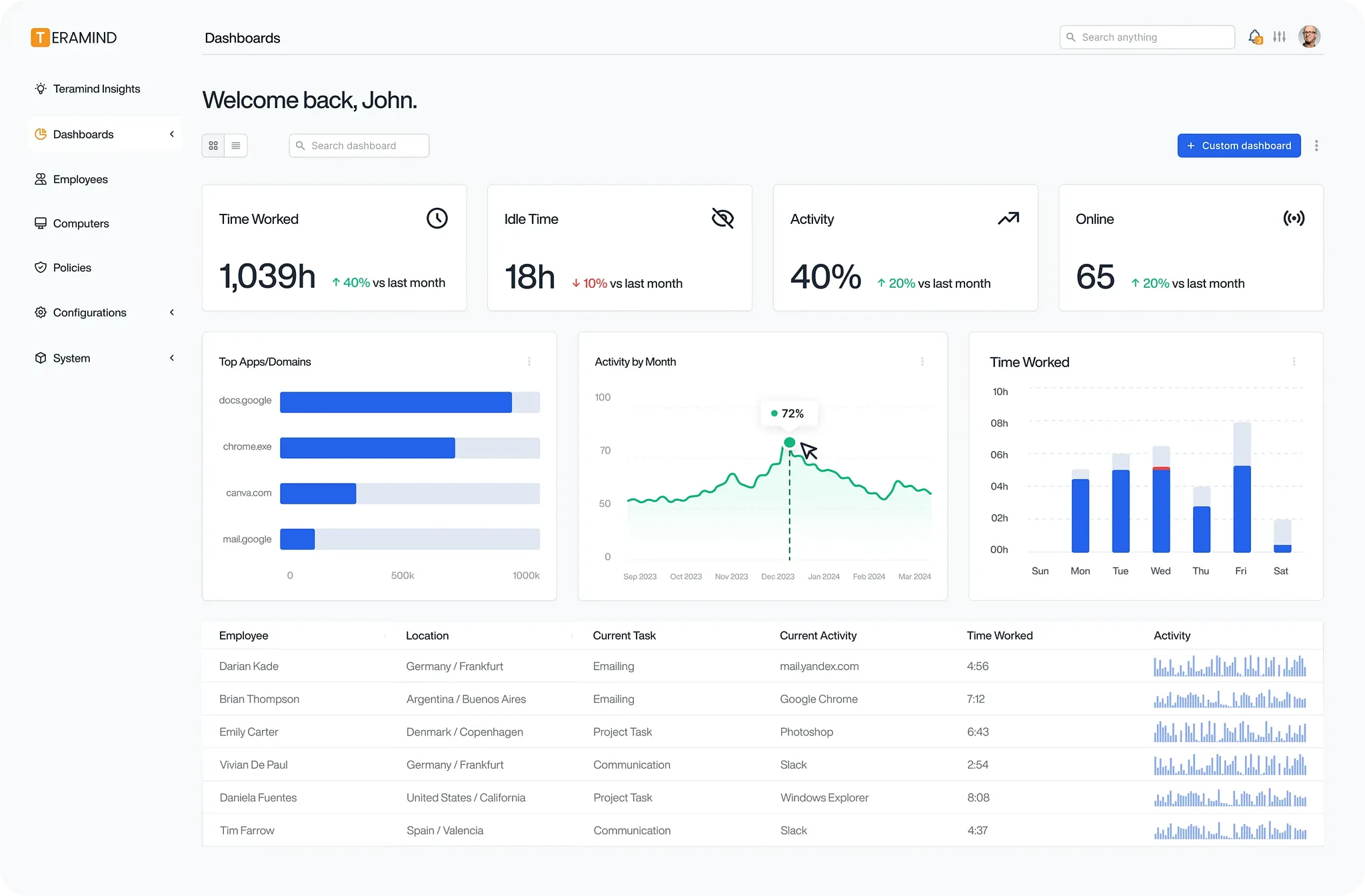
This is where tools like Teramind add significant value. Rather than relying on self-reported data or time-consuming manual audits, Teramind’s workforce analytics platform shows you how employees actually interact with systems and workflows — revealing productivity gaps, application usage patterns, and time sinks that traditional analyzing processes methods miss.

3. Listen to Employees and Customers

Frontline employees see the workarounds, bottlenecks, and inefficient processes every day. Build formal channels for employee engagement in improvement work — surveys, retrospectives, and suggestion programs all give employees a voice. When people see that their input leads to real process change, engagement deepens and the organization builds a self-reinforcing improvement culture.

Customer feedback is equally powerful. Complaints, support tickets, NPS scores, and churn data all point toward broken processes on the back end. Track customer feedback over time to spot patterns — individual complaints may seem random, but in aggregate they often reveal systemic failures.

4. Identify Root Causes, Not Just Symptoms

Surface-level fixes address symptoms. Lasting improvement requires you to identify inefficiencies at their source. Techniques like the “5 Whys,” fishbone diagrams, and Pareto analysis help you drill down to the root causes of recurring problems.

For example, if orders are shipping late, the surface issue might be a slow warehouse. But the root causes might include inaccurate inventory data, unclear pick instructions, or understaffing during peak hours. Fixing the root cause prevents recurrence; fixing the symptom only provides temporary relief. Learning to eliminate inefficiencies systematically is the foundation of meaningful business process management — and it ensures your improvement strategies target the right problems.

5. Benchmark and Monitor Continuously

Sometimes opportunities are invisible without an external reference point. Benchmarking your performance against industry leaders helps you quantify the gap between where you are and where you should be. Study how other organizations use process automation, their staffing models, and their cycle times. The gap between your future process performance goals and your current state defines your improvement roadmap.

Equally important is continuous monitoring. Processes drift over time — what worked six months ago may no longer be optimal. Teramind’s real-time continuous monitoring capabilities ensure you catch degradation before it impacts customers, giving you always-on visibility into process performance across your organization.

Process Improvement Methodologies That Work

Understanding the major process improvement methodologies gives you a toolkit for tackling different types of problems. The best practitioners draw from multiple frameworks depending on context.

Lean: Eliminating Waste and Maximizing Value

Lean methodology, rooted in the Toyota Production System, focuses on eliminating waste — anything that doesn’t add customer value. Lean manufacturing principles have been adapted far beyond the factory floor into healthcare, finance, software development, and services. The seven wastes provide a practical checklist:

  • Overproduction — making more than what’s needed
  • Waiting — idle time between process steps
  • Transport and motion — unnecessary movement of materials or people
  • Extra processing — doing more work than the customer requires
  • Inventory — excess stock tying up capital
  • Defects — errors that require rework or scrap

The core question lean asks is: “Does this step create value for the customer?” If not, it’s a candidate for removal. Lean also emphasizes respect for people — the workers closest to the process are empowered to reduce waste at the source.

Six Sigma: Reducing Variation and Defects

Six Sigma uses the DMAIC framework (Define, Measure, Analyze, Improve, Control) and statistical tools to enhance quality and reduce variation. It’s particularly effective when process variability is driving defects or rework. By applying statistical analysis, teams can pinpoint exactly where variation enters a process and develop solutions with targeted countermeasures. Combined with lean — often called “Lean Six Sigma” — it’s one of the most widely adopted business process improvement methodologies.

Value Stream Mapping

Value stream mapping provides a visual representation of every step required to deliver a product or service, capturing both information and material flow alongside metrics like cycle time and lead time. Stream mapping exercises are especially useful for identifying large-scale improvement opportunities across departments by comparing a “current state” map with a “future state” map.

Total Quality Management (TQM)

Total Quality Management (TQM) is a management philosophy centered on consistent quality across every function. Total quality management emphasizes customer focus, employee involvement, process-centered thinking, and fact-based decision making — one of the broadest process improvement methodologies, encompassing culture, systems, and tools.

The PDCA Cycle and Other Methods

The PDCA cycle — Plan, Do, Check, Act — is a simple framework for iterative improvement: plan a change, test it small, evaluate results, then standardize or adjust. It’s ideal for teams new to continuous process improvement because it’s low-risk and builds confidence.

Other process improvement methods include Business Process Reengineering (BPR) for fundamental redesigns, Kaizen for small daily improvements, and Agile methodologies for iterative delivery. Each of these process improvement methods has strengths depending on the context — Kaizen is particularly effective for building a culture of continuous improvement through small wins, while BPR is appropriate when a process is so broken that incremental fixes won’t cut it.

Essential Process Improvement Tools

The right process improvement tools help you move from analysis to action. Key categories include:

  • Process mining and monitoring software — analyzes event logs and user behavior to reconstruct how processes actually execute, exposing every exception and delay. Workforce analytics platforms like Teramind excel here by showing how employees navigate workflows in real time, surfacing inefficient processes and bottlenecks that traditional tools miss.
  • Process automation platforms — RPA and workflow orchestration tools eliminate redundant tasks, reduce errors, and accelerate throughput. Target high-volume, rule-based tasks first (data entry, report generation, invoice processing) for the fastest ROI.
  • Project management tools — hold process improvement initiatives together by providing visibility, ownership, and accountability. Without strong project management discipline, improvement ideas pile up and momentum fades.

Implementing Process Improvement

Knowing where the opportunities are is only half the battle. Implementing process improvement successfully requires disciplined execution.

Prioritize, Test, and Scale

Use an impact/effort matrix to rank opportunities by potential value and ease of implementation. Align priorities with business goals — an improvement only matters if it supports strategic objectives. Focus first on changes that deliver high impact with relatively low effort to build momentum and credibility for your improvement strategies.

Develop solutions by involving the people who do the work — they’ll generate better ideas and be more committed to making changes stick. Pilot new processes in a controlled environment, measure results, and iterate before rolling out broadly. This is where the PDCA cycle shines: test small, learn fast, then scale what works. Document and communicate new processes clearly — ambiguity kills adoption.

Sustain and Measure

Short-term wins matter, but the real goal is building a system that continuously gets better. Develop strategies that embed improvement into daily operations through continuous learning, regular reviews, and real-time monitoring. Standardizing processes creates the stable baseline needed for meaningful measurement, and continuous learning keeps your improvement capabilities sharp.

Every initiative should have defined success metrics before implementation begins — cycle time reduction, error rate reduction, cost reduction, customer satisfaction scores. Use dashboards to track progress and monitor future process performance to ensure gains are sustained. Build control mechanisms (standard work, audits, automated alerts) that catch drift early. Use what you learn to feed the next cycle. This is the essence of continuous process improvement and the engine behind long-term operational excellence.

The Business Case for Process Improvement

Improving processes delivers benefits across every dimension of performance. Organizations gain significant advantages when they commit to implementing process improvement as an ongoing discipline:Efficiency and Cost Savings

Streamlining workflows and eliminating redundant tasks frees up capacity without adding headcount. This leads to improved operational efficiency as work moves faster with fewer handoffs and less rework.

  • Organizations that invest in improving processes often reduce costs by 15–30% in targeted areas.
  • The ability to streamline processes and reduce costs while improving outcomes is the hallmark of well-executed process improvement efforts.

Quality and Customer Satisfaction

Quality improvement is a direct outcome of reducing variation and enhancing quality at every step. As customer demands and evolving expectations shift, organizations with strong improvement capabilities adapt faster.

  • Improving existing processes also reduces the hidden costs of poor quality—warranty claims, returns, and reputational damage.
  • Ongoing enhancements driven by customer feedback ensure you’re always closing the gap between what you deliver and what the market expects.

Competitive Advantage and Growth

Organizations that master continuous improvement build a durable competitive advantage—they’re faster, more reliable, and more responsive.

  • Sustainable growth comes from building capability, not just chasing revenue.
  • When you enhance productivity by removing friction and enhance efficiency across teams, people accomplish more without working harder.

Consistently working to improve quality and enhance performance is one of the highest-leverage investments any organization can make, driving operational excellence and improving productivity outcomes across the board.

Getting Started

If your organization is new to formal process improvement, start with a focused pilot. Choose a process that’s visible, painful, and bounded — early wins build credibility for broader process improvement initiatives. Assemble a cross-functional team, map the current state, collect data, analyze root causes, and test improvements before scaling. Build continuous monitoring into the process so you catch regression early and feed insights into the next cycle.

This systematic approach works whether you’re tackling a single workflow or launching an enterprise-wide transformation. Ongoing enhancements compound over time, and even small improvements — when sustained — add up to transformative results.

Unlock Improvement Opportunities with Teramind

Every strategy in this guide depends on one thing: visibility into how work actually gets done. Teramind’s workforce analytics and user activity monitoring platform delivers exactly that — real-time insight into application usage, workflow navigation, productivity patterns, and time allocation across your organization.

With Teramind, you can identify inefficiencies precisely, prioritize them based on actual impact, and measure results with confidence. Whether you’re focused on cost reduction, customer satisfaction, or operational excellence, Teramind provides the data foundation that makes process improvement efforts measurable and sustainable growth achievable — helping you streamline processes, reduce waste, and improve productivity at scale.

Author

Try Teramind's Live Demo

Try a live instance of Teramind to see our insider threat detection, productivity monitoring, data loss prevention, and privacy features in action (no email required).

Table of Contents