
Mimecast Incydr (formerly Code42 Incydr) has long been a fixture in insider risk management. By tracking file movements, mapping file provenance, and scoring risk without complex classification policies, Incydr provides security teams with lightweight visibility into high-volume data egress across endpoints and cloud services.
Over recent releases, Incydr has expanded beyond passive alerting to introduce native preventative controls, including browser-level upload restrictions, untrusted clipboard paste blocking, origin-based "Block by Source" enforcement, and GenAI governance through its Agent Risk Center.
However, modern security architectures often demand controls that extend beyond the browser and file-origin tagging.
Many organizations require deep, kernel-level inline enforcement that intercepts data across any desktop software, network share, or peripheral port. Others need timestamped visual session replays for indisputable investigative proof, on-screen Optical Character Recognition (OCR), or fully on-premises and air-gapped deployments.
Whether your priority is multi-channel OS-level blocking, forensic video capture, or flexible architecture, here is an evaluation of the 10 best Mimecast Incydr alternatives for your security stack.
What should you look for in a Mimecast Incydr alternative?
Evaluating a data loss prevention (DLP) or insider threat detection tool requires balancing user productivity with operational containment.
While Incydr excels at tracking file lineage and managing browser-based egress, security teams evaluating alternatives frequently require deeper endpoint intervention, visual evidence, and broader infrastructure support.
Use this criteria checklist to assess potential platforms:
Kernel-level inline prevention (beyond browser extensions)
Mimecast Incydr’s preventative controls (such as upload blocking and paste restrictions) rely heavily on a browser extension and file-origin tagging.
Look for an alternative that provides true OS- and kernel-level enforcement capable of intercepting exfiltration attempts across native desktop software, command-line interfaces (CLIs), local network shares, print queues, and offline peripheral devices.
Deep content inspection and multi-modal OCR
File-origin tracking identifies where a document came from, but it cannot determine what is inside an unsourced document, a transformed file, or a screen grab.
Effective alternatives pair pattern matching, regular expressions, natural language processing, and live Optical Character Recognition (OCR) to inspect payloads, clipboard text, and on-screen visual data in real-time.
System-wide activity context (beyond file events)
File system activity accounts for only a fraction of insider risk.
Prioritize platforms that monitor user behaviors (including application usage, active versus idle time, search queries, terminal commands, and system administrative changes) to detect early indicators of compromise or malicious intent before file transfers occur.
Visual session replay for definitive forensics
Metadata logs show that a file or string was moved, but they cannot prove user intent.
Because Incydr doesn’t capture screen recordings, HR, legal, and compliance teams must manually reconstruct incidents from tabular telemetry. Solutions featuring continuous or event-triggered video capture provide visual proof of employee actions.
Direct threat containment and live takeover
When a critical insider incident is detected, analysts need immediate containment workflows directly within the security console.
Prioritize tools that allow operators to freeze active user sessions, lock out compromised accounts, send instant user coaching alerts, or initiate live remote desktop takeovers without relying on third-party orchestration playbooks.
Flexible deployment architectures
Incydr is delivered exclusively as a multi-tenant cloud SaaS platform.
Organizations subject to data sovereignty mandates, defense regulations, or air-gapped network designs need alternatives that offer fully on-premises and private cloud (AWS/Azure) deployments alongside SaaS options.
How does Mimecast Incydr compare to leading alternatives?
The table below contrasts the 10 leading Mimecast Incydr alternatives across their primary strengths, inline enforcement mechanisms, forensic capabilities, AI governance scope, and supported deployment architectures:
| Solution | Best For | Inline Blocking Scope | Visual Session Replay | Shadow AI & Prompt DLP | Deployment Models |
|---|---|---|---|---|---|
| Teramind | Behavior analytics, kernel-level enforcement, and visual forensics | Full OS-Level (Real-time blocking of apps, clipboard, USB, print, and web) | Yes (Continuous or rule-based video capture with OCR search) | Yes (Inspects browser prompts, clipboard, desktop apps, and screen OCR) | Cloud SaaS, On-Premises, Private Cloud |
| DTEX InTERCEPT | Privacy-first behavioral telemetry without surveillance | Risk-Adaptive (Dynamic endpoint lockdown triggered by risk scores) | No (High-fidelity pseudonymized metadata reconstruction) | Partial (Application visibility, GenAI tracking, and cloud exfiltration) | Cloud SaaS |
| Proofpoint ITM | Evidence collection for HR, compliance, and legal investigations | Full Endpoint (Policy-based blocking across web, apps, and USB) | Yes (Session screen recording and activity playback) | Partial (Browser controls, paste monitoring, and cloud egress) | Cloud SaaS |
| Microsoft Purview | Standardized Windows 11 and Microsoft 365 enterprises | Full Native OS (OS-level blocking via Purview DLP & Adaptive Protection) | Partial (Windows Forensic Evidence screen-clip add-on) | Yes (Native Microsoft Copilot, Edge browser, and cloud DLP) | Cloud SaaS |
| Cyberhaven | Multi-hop data lineage and transformed data tracking | Lineage-Driven (Real-time blocking based on data provenance graph) | No (Interactive graph-based data flow and incident mapping) | Yes (Data Behavior Analytics across browsers, SaaS, and AI prompts) | Cloud SaaS, Hybrid |
| Strac | Inline API masking, SaaS redaction, and GenAI/MCP protection | API & Inline Masking (Real-time redaction, masking, and API blocking) | No (Text-level payload logs and remediation audit trails) | Yes (Pre-prompt redaction in LLMs, MCP agents, and image OCR) | Cloud API & SaaS |
| Safetica | Mid-market teams needing low-friction DLP & device control | Full Endpoint (Endpoint, peripheral, network share, and web blocking) | No (User activity auditing and event logs; no video capture) | Partial (Web/app access restrictions and prompt inspection) | Cloud SaaS, On-Premises |
| Forcepoint DLP | Global enterprises requiring pre-built regulatory templates | Full Enterprise (Network, cloud CASB, web gateway, and endpoint engines) | No (Risk-Adaptive behavioral analytics; no screen recording) | Yes (AI Data Security, prompt redaction, and CASB guardrails) | Cloud SaaS, On-Premises, Hybrid |
| Symantec DLP | Exact database fingerprinting (EDM) and complex on-prem estates | Full Deep Content (Deep content inspection and policy enforcement engines) | No (Host, network, and gateway audit logs) | Partial (Web gateway, CASB cloud connectors, and prompt policies) | On-Premises, Hybrid, Cloud SaaS |
| ManageEngine Endpoint DLP Plus | Cost-effective device, peripheral, and local egress control | Peripheral & Device (USB, local print, network share, and web blocking) | No (Audit logs and compliance incident reporting) | No (Focused on device-level files and standard cloud uploads) | On-Premises, Cloud SaaS |
What are the top 10 leading alternatives to Mimecast Incydr?
1. Teramind
Best for: Unified behavior analytics, multi-channel kernel-level enforcement, and visual forensics.
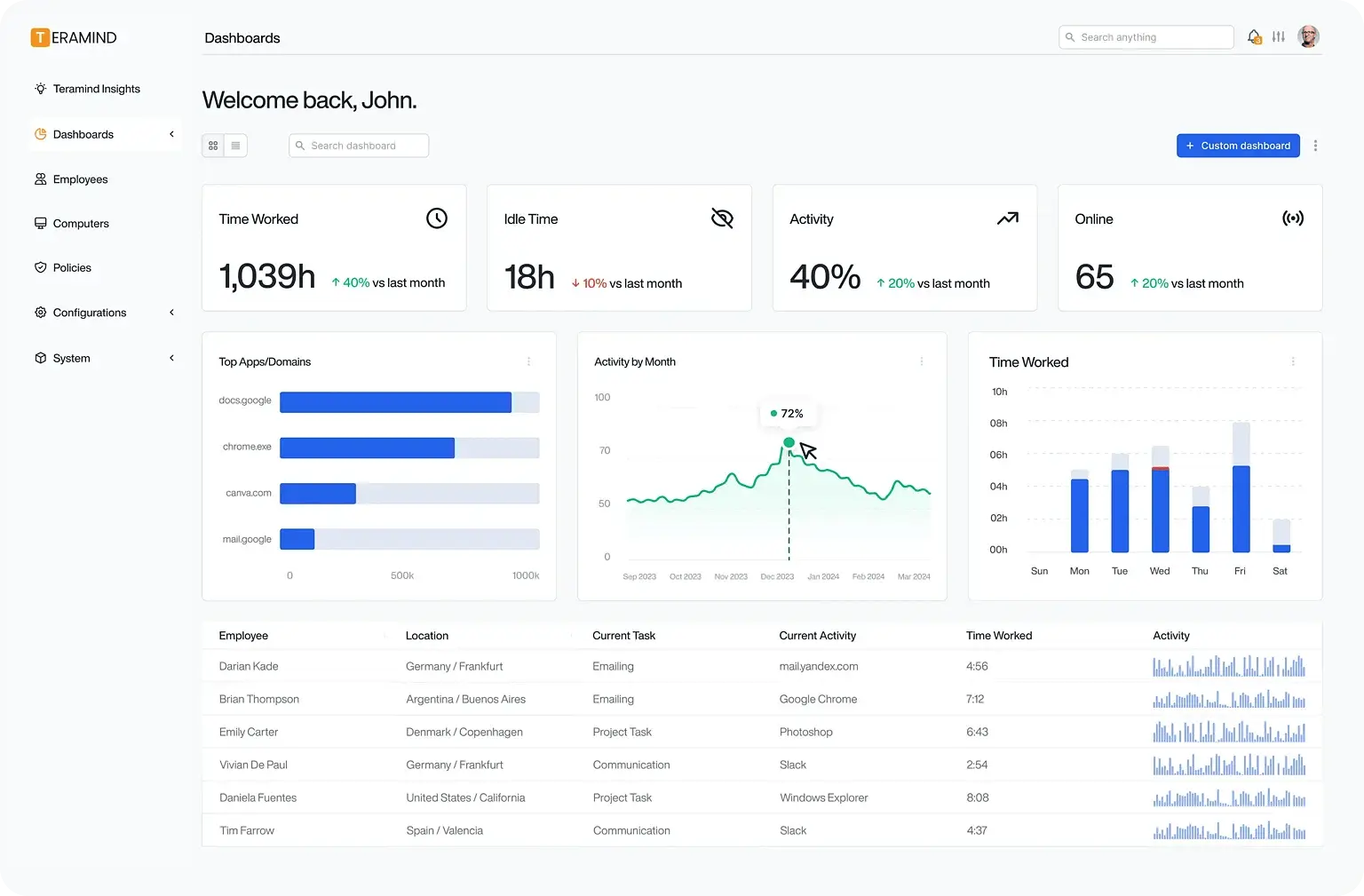
Teramind integrates endpoint data loss prevention (DLP), insider threat intelligence, and user activity monitoring into a single, lightweight agent.
While point solutions focus primarily on file-system metadata or browser traffic, Teramind delivers 360-degree visibility across more than 15 system vectors, including desktop screens, native applications, network traffic, system clipboards, print spools, and command-line terminals.
By combining behavioral baselining with patented real-time Optical Character Recognition (OCR), Teramind inspects data at rest, in transit, and in use, intercepting exfiltration attempts before sensitive records leave the endpoint.
Key features
- Kernel-level prevention: Intercepts risky behavior instantly by blocking unauthorized web uploads, restricting system-wide clipboard operations, disabling unauthorized USB devices, blocking print jobs, and terminating compromised user sessions.
- Patented OCR and session playback: Scans and indexes text rendered on live screens, within scanned images, and across legacy applications. It pairs content-aware policy rules with timestamped video replays to furnish legally defensible evidence for HR and legal teams.
- System-wide Shadow AI and agent governance: Detects unauthorized AI tools across browsers and native apps, monitors shell-based developer AI agents, inspects prompt text, and prevents sensitive intellectual property, PII, or API keys from being pasted into models like ChatGPT, Claude, and Gemini.
Contrast with Incydr
Mimecast Incydr’s preventative controls (such as upload blocking and paste restrictions) operate primarily through its browser extension and rely heavily on file-origin metadata. This leaves gaps across native desktop applications, offline peripheral ports, print spools, and command-line interfaces.
Teramind operates at the operating system level, providing uniform inline enforcement across all applications, whether browser-based or desktop-native.
Furthermore, while Incydr relies on log correlation and requires investigators to infer user intent from metadata, Teramind provides synchronized video recordings and live desktop takeovers to definitively establish intent.
Read more → Mimecast Incydr vs. Teramind: DLP Software Comparison
Pricing
Teramind offers structured pricing with complete feature parity across SaaS cloud, on-premises, and private cloud (AWS/Azure) environments:
- Starter ($14/seat/month billed annually): Basic user activity monitoring, website and application tracking, and operational metrics.
- UAM ($28/seat/month billed annually): Behavioral baselining, keystroke logging, network monitoring, and real-time OCR.
- DLP ($32/seat/month billed annually): Comprehensive content inspection, real-time exfiltration blocking, clipboard/USB/print controls, and AI prompt DLP.
- Enterprise (Custom pricing): Tailored architecture for large deployments requiring long-term video retention, multi-tenant node management, and dedicated support.
2. DTEX
Best for: Lightweight, privacy-first behavioral telemetry and early risk detection.
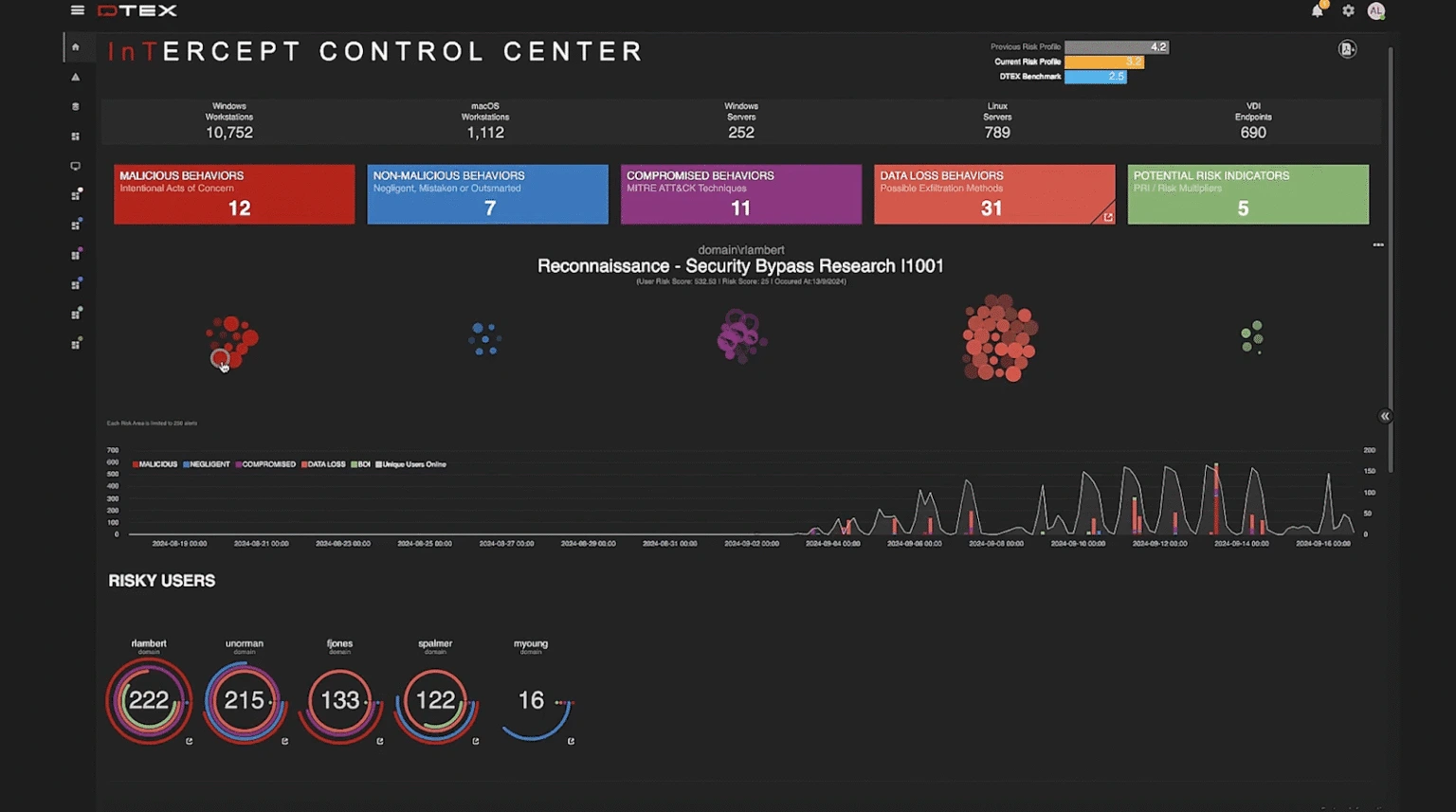
DTEX focuses on human behavior intelligence rather than content inspection or screen capture.
Using an endpoint forwarder that consumes minimal CPU, DTEX maps workforce behavioral patterns against indicators of intent (such as privilege escalation, off-hours reconnaissance, and data aggregation) to stop insider risks before data reaches an egress channel.
Key features
- Privacy-by-design pseudonymization: Collects system and user metadata while masking personally identifiable information. DTEX enables teams in unionized or GDPR-governed environments to detect anomalies without compromising employee trust.
- AI-driven defenders: Features autonomous analytical capabilities (Triage Guardian and Threat Hunter) to correlate alert telemetry, surface flight risks, and identify abnormal script velocities.
- Risk-adaptive policy controls: Implements automated, dynamic endpoint restrictions (such as severing network connections or locking down removable storage) when a user's cumulative risk score crosses established thresholds.
Contrast with Incydr
While Incydr anchors its analysis on file movement and browser egress pathways, DTEX focuses on human intent.
Incydr identifies when a sensitive file is touched or staged for data exfiltration, whereas DTEX analyzes behavioral markers (such as disengagement indicators, unusual file archiving, or administrative tampering), allowing security teams to intervene during the planning phase of an insider event.
Read more → DTEX Alternatives Compared
Pricing
DTEX does not provide public pricing. Licensing is structured on an enterprise subscription model based on seat count and selected platform modules. A custom quote can be requested via their sales team.
3. Proofpoint
Best for: Enterprise insider investigations and context-rich forensic evidence.
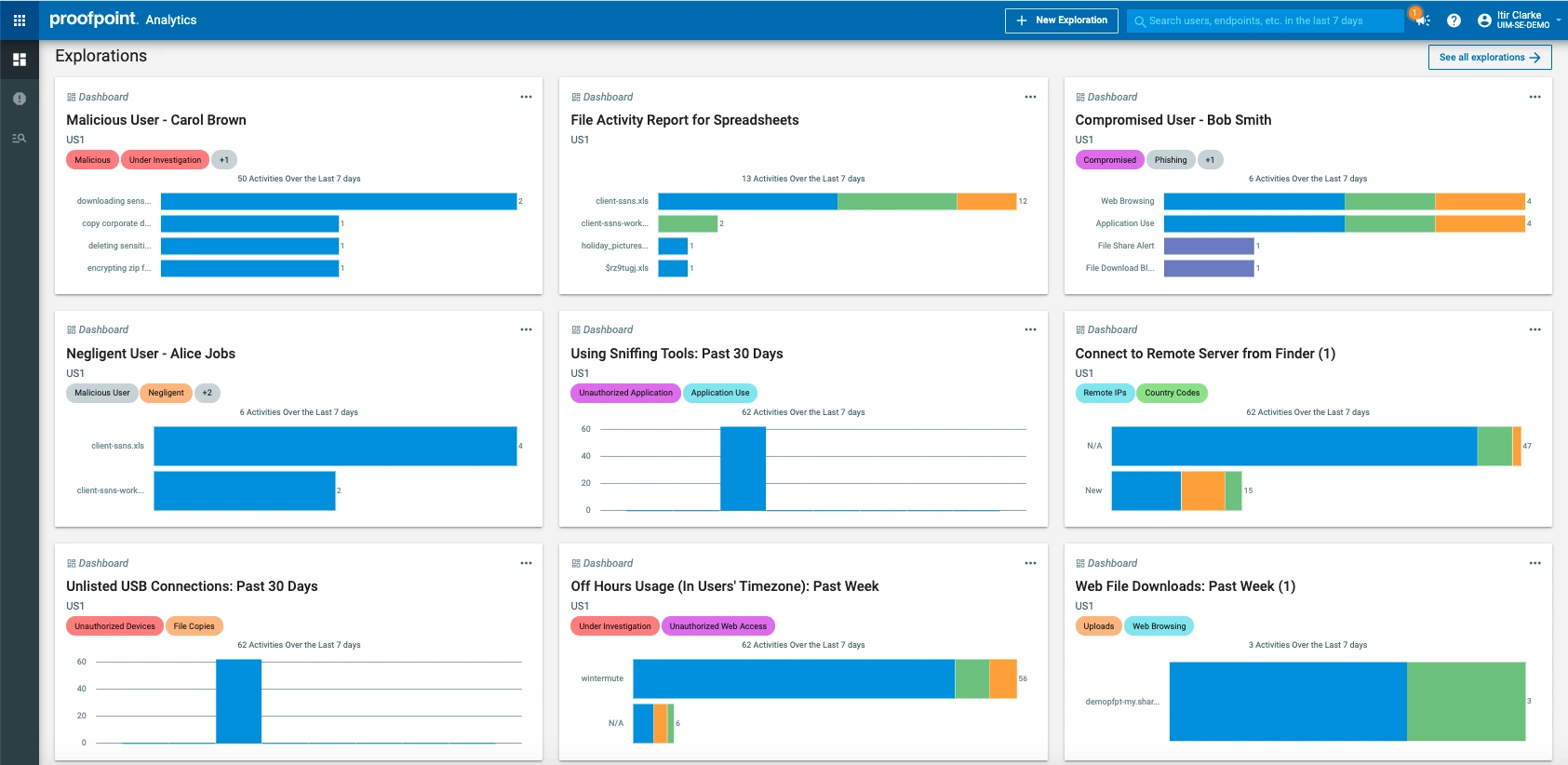
Proofpoint Insider Threat Management (ITM, built on its ObserveIT acquisition) is a people-centric platform designed to correlate user context, endpoint activity, and cross-channel communications.
The platform connects endpoint activity with its wider enterprise security ecosystem (including email security and CASB) to accelerate internal investigations.
Key features
- Visual activity playback: Records and plays back endpoint desktop sessions during triggered alert conditions. Proofpoint gives HR, compliance, and legal teams visual verification of an incident.
- Cross-channel incident correlation: Links endpoint events directly to email gateways and cloud repositories, providing a unified timeline of data movement across corporate channels.
- Runtime AI governance: Monitors employee AI usage, restricts unsanctioned browser-based AI platforms, and logs audit trails of pasted prompt content.
Contrast with Incydr
Mimecast Incydr generates file-lineage graphs and tabular activity logs to illustrate file transfers.
Proofpoint ITM places heavier emphasis on human investigation by capturing visual desktop screen recordings alongside telemetry.
While Incydr requires analysts to deduce user motivation from metadata, Proofpoint provides screen playback that clarifies whether an action stemmed from employee negligence or malicious insiders.
Read more → Mimecast Incydr vs. Proofpoint: Features, Pros & Cons
Pricing
Proofpoint ITM requires a custom enterprise quote. Subscriptions scale according to user seat count and add-on modules, including Cloud App Security brokers, Email DLP, and extended forensic storage.
4. Microsoft Purview
Best for: Organizations standardized on Windows 11 and Microsoft 365 E5 architectures.
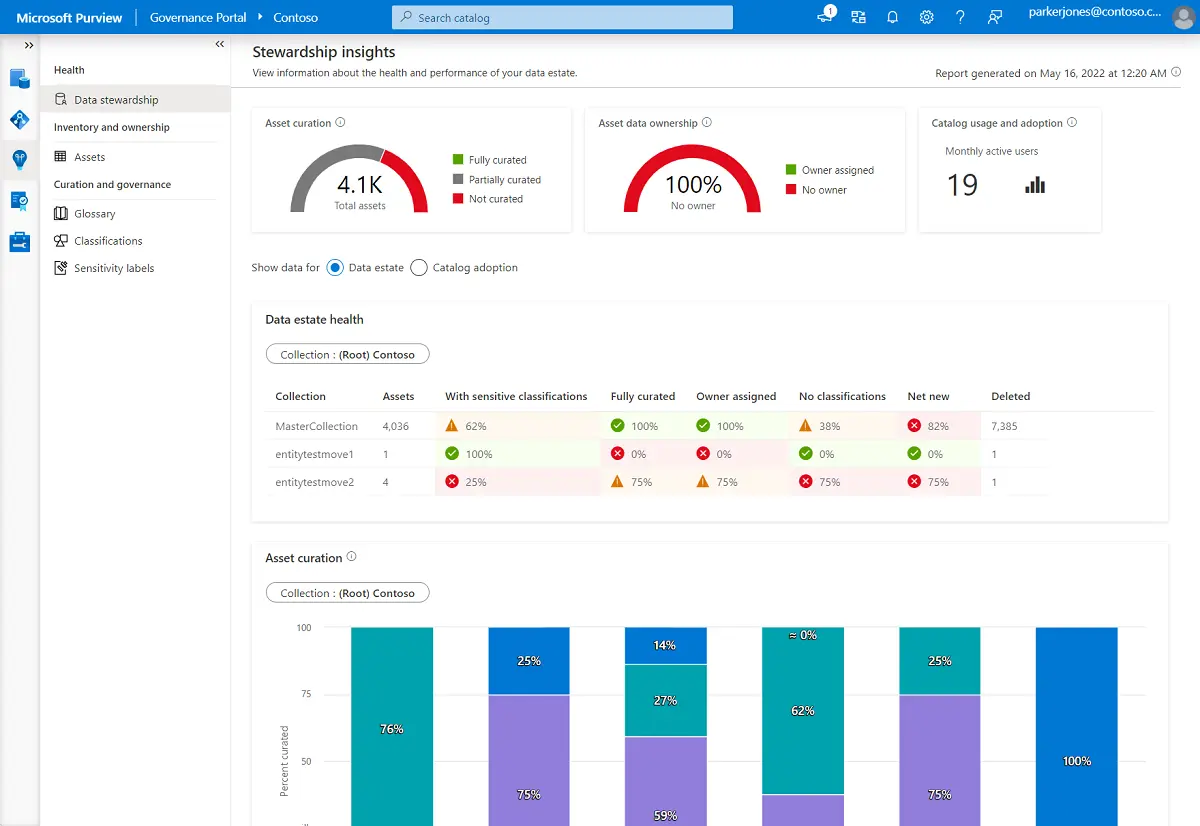
Microsoft Purview embeds data loss prevention, information protection, and insider risk management natively into the Windows operating system and Microsoft 365 applications (Word, Excel, Teams, SharePoint, and Edge).
This architectural integration allows organizations to enforce DLP policies and monitor data movement without deploying a third-party endpoint sensor.
Key features
- Native Windows and M365 integration: Operates directly inside Windows 10/11 and Office applications to enforce copy-paste restrictions, browser upload blocks, and USB write controls with zero third-party agent overhead.
- HR-driven adaptive protection: Ingests human resources signals (e.g., resignation notices, PIPs, role changes) to automatically escalate a user's risk tier and apply tighter DLP blocking rules.
- Deep Copilot and GenAI guardrails: Delivers native controls over Microsoft 365 Copilot interactions while auditing and restricting sensitive data sharing across supported web browsers.
Contrast with Incydr
Incydr requires deploying a dedicated agent and browser extension to monitor file movements and enforce web restrictions.
In contrast, Microsoft Purview leverages native OS and application hooks on Windows endpoints.
Purview also integrates directly with Microsoft Entra ID and corporate HR systems to dynamically adjust enforcement based on employment lifecycle changes, whereas Incydr relies primarily on file attributes and its proprietary PRISM risk scoring.
Pricing
Microsoft Purview licensing is tied to enterprise agreements:
- Microsoft 365 E5 ($60/user/month billed annually): Includes the full Microsoft Purview suite (Insider Risk Management, Endpoint DLP, and Information Protection).
- Microsoft Purview Suite Add-On ($12/user/month billed annually): Adds advanced compliance and data governance capabilities for organizations on a base Microsoft 365 E3 license.
- Pay-as-you-go offering: Extends Purview data governance across non-Microsoft multi-cloud environments via Azure consumption billing.
5. Cyberhaven
Best for: Graph-based data lineage, complex file transformations, and AI security.
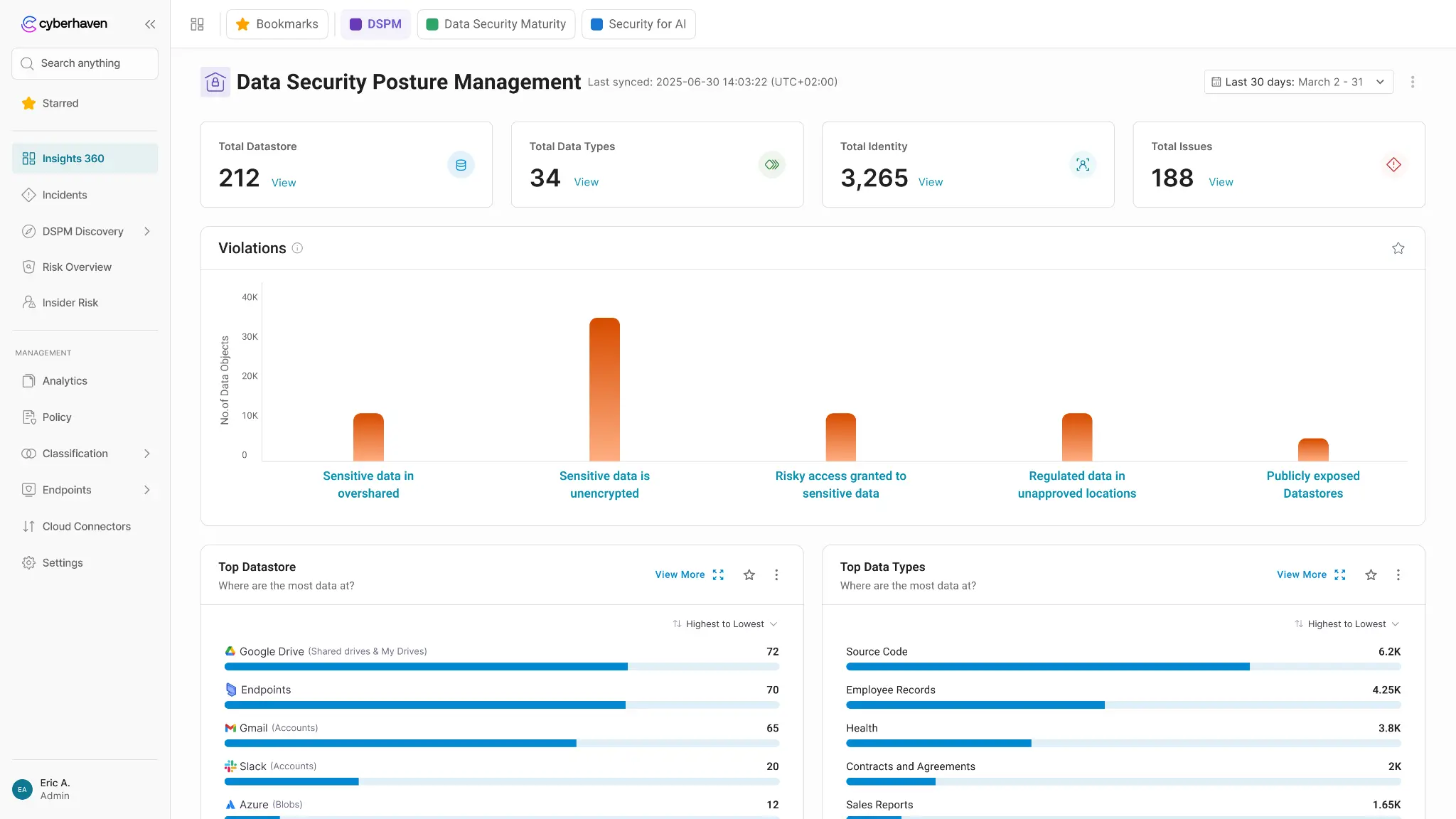
Cyberhaven utilizes a graph-based data tracing model that tracks data units across their lifecycle.
Rather than relying solely on file names or static fingerprinting, Cyberhaven’s Linea AI engine monitors data as it is copied, pasted, converted into different file formats, renamed, or input into cloud and AI applications.
Key features
- Unbroken data provenance: Tracks data continuously through transformations, such as copying table cells from an Excel sheet into a text file, archiving it in a ZIP folder, or pasting it into an email.
- Linea AI analyst agents: Employs Large Lineage Models (LLiMs) to analyze data flows across endpoints, cloud apps, and browsers. Cyberhaven generates automated, evidence-backed incident summaries.
- Agentic AI and Shadow AI governance: Detects unapproved AI tools, inspects AI prompts, and prevents users from feeding proprietary source code or confidential datasets into external LLMs and MCP servers.
Contrast with Incydr
Mimecast Incydr tracks file origins and file-system modifications, but it can lose visibility when data undergoes significant restructuring, such as when an insider copies raw text from an ERP database into a personal document.
Cyberhaven tracks the underlying data flow itself across system boundaries, ensuring policies persist even when file formats, extensions, or applications change.
Read more → Mimecast Incydr vs. Cyberhaven: Features, Pros & Cons
Pricing
Cyberhaven does not publish its pricing online. The platform is licensed via annual enterprise subscriptions based on total user count and the scope of protected environments (endpoints, SaaS, IaaS). Custom quotes are provided following a technical scoping session.
6. Strac
Best for: Automated inline redaction, SaaS/cloud DSPM, and GenAI/MCP security.
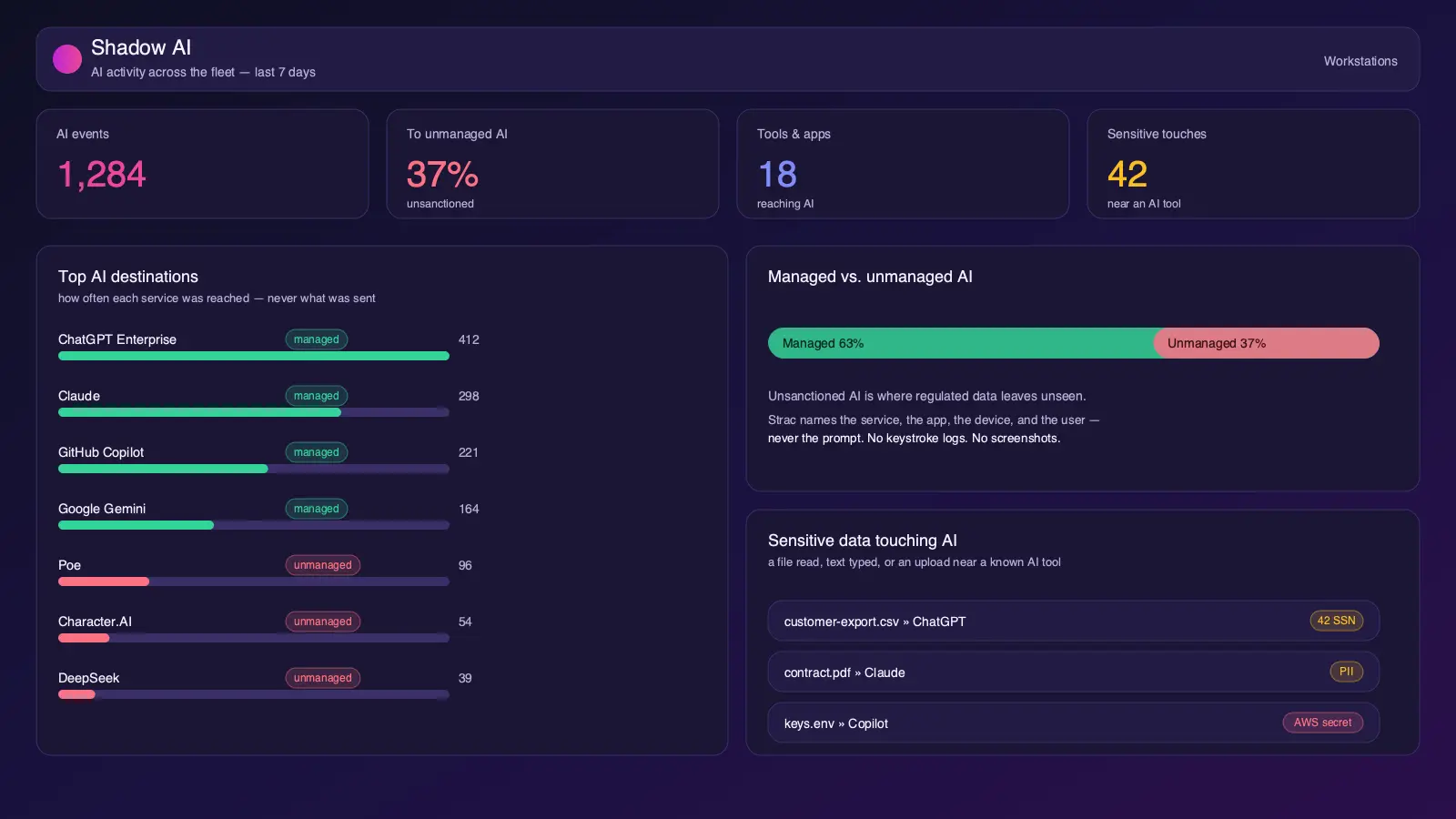
Strac provides a modern, API-first data security platform that unifies Data Loss Prevention (DLP) and Data Security Posture Management (DSPM).
Built to secure SaaS applications, cloud infrastructure (AWS/Azure/GCP), and AI interfaces, Strac emphasizes real-time inline redaction and masking rather than perimeter blocking.
Key features
- Automated data redaction: Continuously scans data at rest and in transit across SaaS tools like Slack, Google Drive, Microsoft 365, Zendesk, and Jira. Strac automatically masks or removes sensitive records (PII, PCI, API keys, source code).
- GenAI and MCP data protection: Intercepts prompts, document uploads, and AI agent tool calls in ChatGPT, Claude, and Gemini, masking sensitive text before it reaches external language models.
- Persistent endpoint tagging: Automatically tracks files downloaded from cloud repositories (e.g., Google Drive or SharePoint) to local endpoints, maintaining security tags across local edits and renaming.
Contrast with Incydr
While Incydr focuses on endpoint file egress and browser-based uploads, Strac delivers deep API-level inspection directly inside enterprise SaaS applications and cloud datastores.
Strac actively sanitizes sensitive data by redacting sensitive characters inline, whereas Incydr relies on blocking file transfers or alerting analysts after an unauthorized sync occurs.
Pricing
Strac provides custom quotes within 24 hours following an introductory scoping call. Licensing is calculated based on:
- Protected surfaces: Specific integrations selected across SaaS apps, endpoints (Mac/Windows/Linux), cloud platforms, and GenAI/MCP tools.
- Headcount: Counted by the users within the active scope rather than total organizational directory size.
- Data volume: Applied exclusively to historical at-rest discovery scans; real-time DLP streaming is not billed on data volume.
7. Safetica
Best for: Context-aware endpoint DLP, peripheral control, and hybrid deployment flexibility.
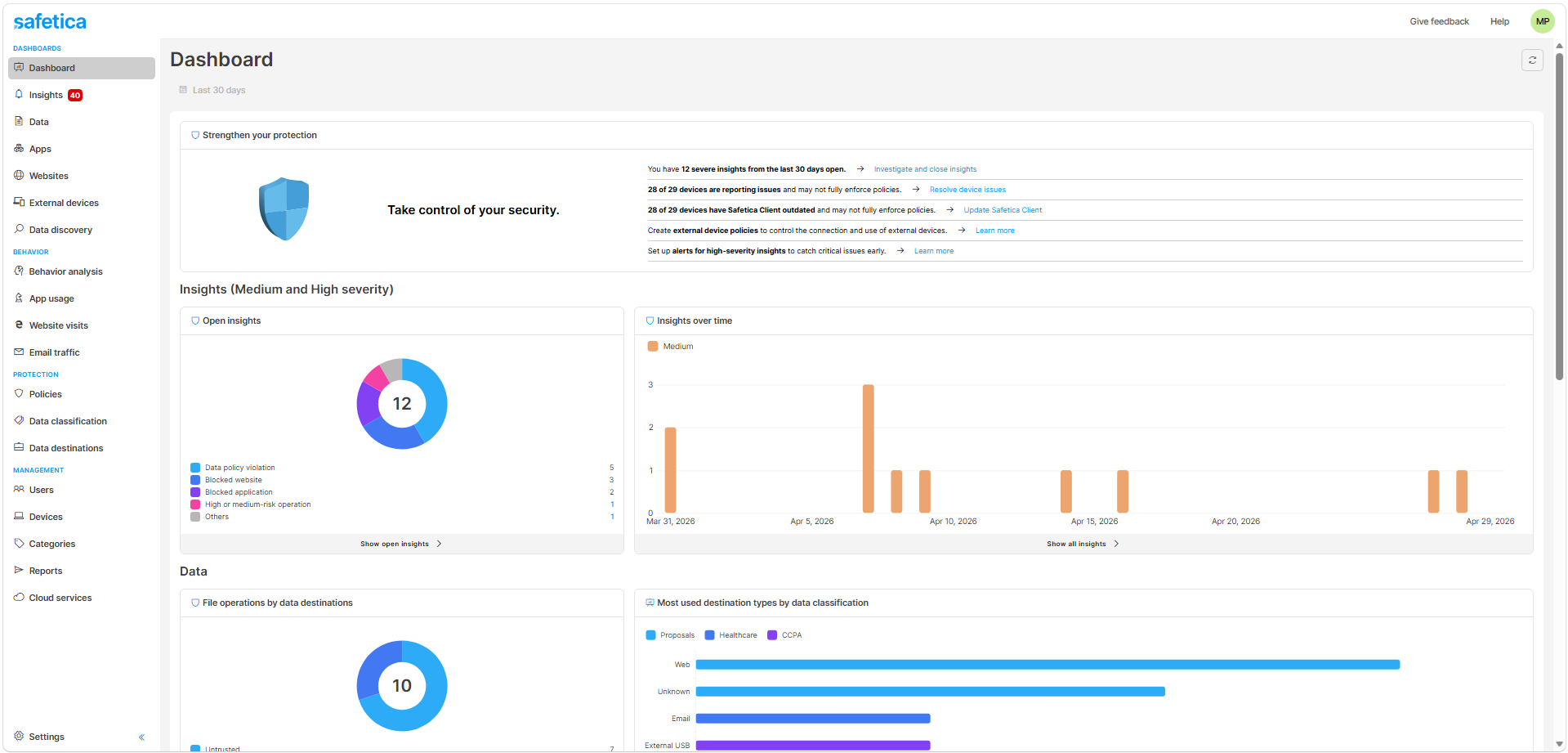
Safetica provides an intuitive data protection and insider risk management suite tailored for mid-market and enterprise organizations.
It balances data loss prevention with operational simplicity, allowing administrators to establish classification-based and context-aware policies across Windows and macOS endpoints without extensive administrative overhead.
Key features
- Contextual endpoint controls: Regulates data transfers based on user activity baselines, device trust, and classification tags. Safetica enforces warnings, override prompts, or hard blocks across USB drives, local printers, network paths, and websites.
- Shadow AI and cloud governance: Discovers unsanctioned generative AI tools, restricts web-based prompt uploads, and monitors sensitive data movement across Microsoft 365 and Google Workspace environments.
- Hybrid and on-premises architecture: Offers both an agent-based SaaS deployment and a self-hosted on-premises deployment, catering to organizations with strict data sovereignty mandates or air-gapped environments.
Contrast with Incydr
Incydr is delivered strictly as a cloud-hosted SaaS application. Safetica accommodates organizations that cannot store operational telemetry in multi-tenant cloud environments by offering an on-premises deployment option.
Additionally, Safetica provides broader native peripheral controls, including granular management over local hardware ports, network shares, and local print queues.
Read more → Safetica Competitors Compared
Pricing
Safetica publishes baseline per-user pricing for its cloud-hosted platform, with custom quotes available for on-premises deployments:
- Standard (Starts at $72/user/year): Core data protection, basic AI visibility, application auditing, 5 admin seats, and 12-month data retention.
- Premium (Starts at $96/user/year): Adds AI data classification (Smart Tags), shadow copies, and cloud protection for Microsoft 365 and Google Drive.
- Enterprise (Starts at $144/user/year): Tailored for global deployments, adding SIEM integrations, unlimited reporting, up to 50 admin accounts, and 36-month data retention.
- Safetica On-Premises: Scoped via custom sales quotes for organizations requiring self-hosted infrastructure.
8. Forcepoint
Best for: Large enterprises requiring multi-vector regulatory compliance and risk-adaptive policies.
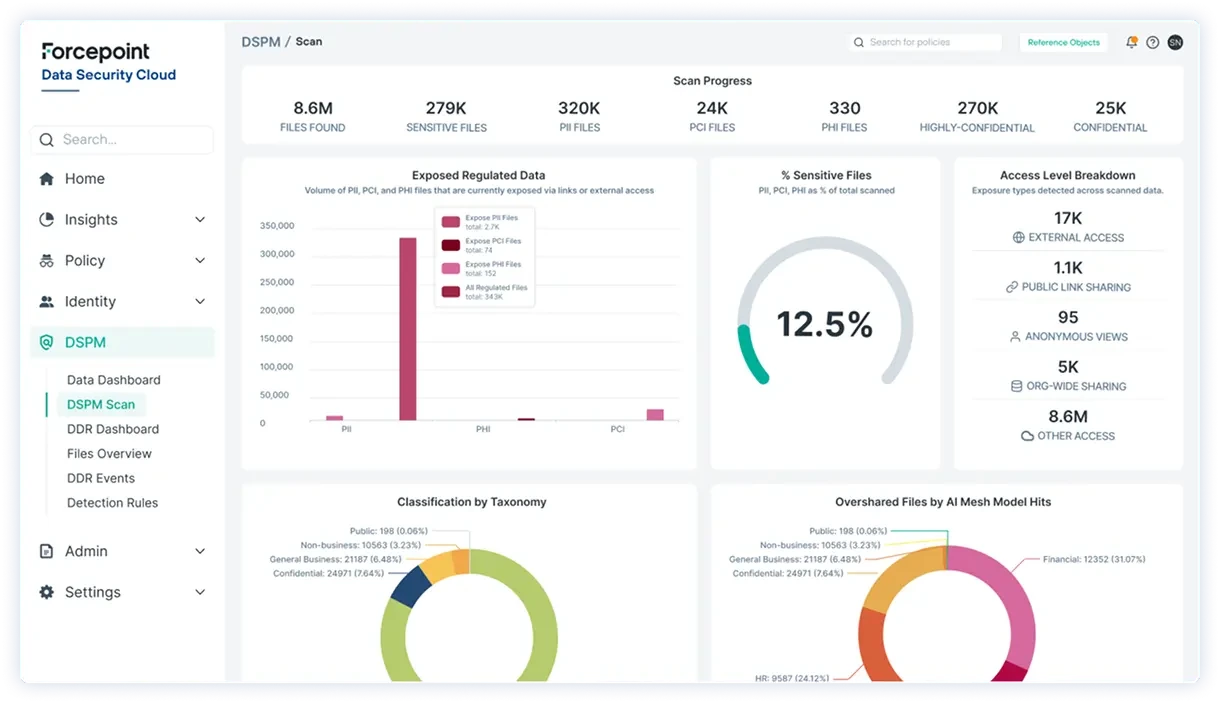
Forcepoint is an enterprise-scale platform built around a "One Policy Everywhere" framework.
It allows security teams to define unified data protection policies that apply across network gateways, endpoints, cloud services (CASB), web channels, and email, simplifying administration across complex global IT estates.
Key features
- Risk-Adaptive Protection (RAP): Dynamically adjusts enforcement policies (ranging from silent auditing and user coaching dialogs to real-time blocking) based on continuous, individualized user behavioral risk scores.
- Pre-packaged regulatory profiles: Features a comprehensive library of pre-built compliance templates covering global data privacy regulations (GDPR, HIPAA, PCI-DSS) across diverse jurisdictions.
- Unified single-policy engine: Enforces consistent policies across endpoints, network proxies, email gateways, and cloud applications from a centralized management plane.
Contrast with Incydr
Mimecast Incydr is specialized for endpoint file tracking, browser egress, and SaaS monitoring.
Forcepoint delivers a broader, multi-vector enforcement architecture that inspects and blocks data across on-premises network backbones, email infrastructure, and web proxies.
While Incydr's blocking centers on browser interactions and source tagging, Forcepoint enforces deep content inspection across all egress vectors.
Read more → Mimecast Incydr vs. Forcepoint: Features, Pros & Cons
Pricing
Forcepoint pricing is customized based on deployment parameters. Licensing is calculated by protected seat count, chosen architecture (cloud-native, hybrid, or on-premises), and the specific functional modules required (such as Endpoint DLP, Network DLP, or Risk-Adaptive Protection).
9. Symantec DLP
Best for: Exact database fingerprinting (EDM) and complex on-premises data estates.
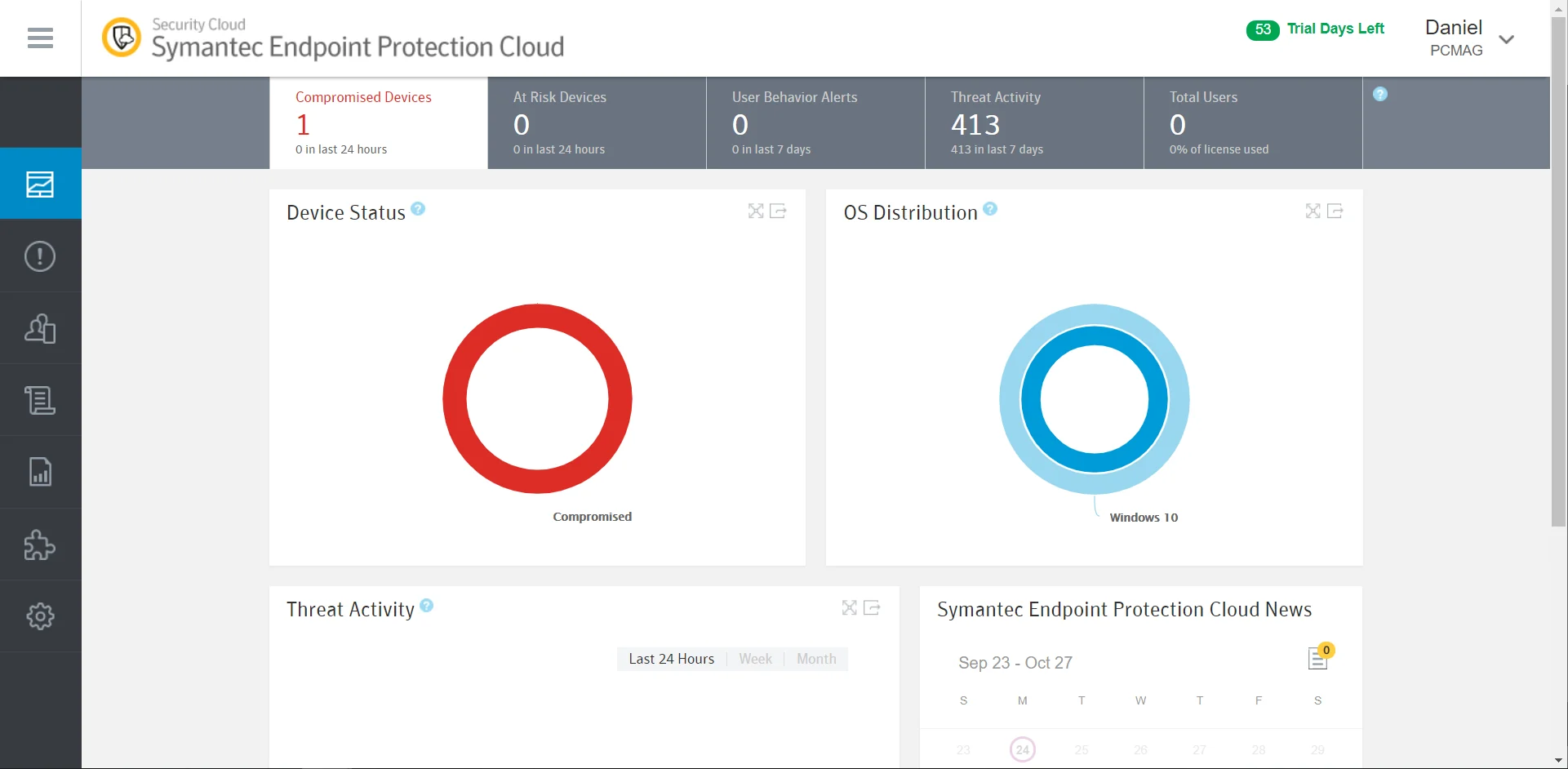
Broadcom’s Symantec DLP is an established enterprise suite designed for deep content inspection across large-scale, heterogeneous environments.
Symantec focuses on identifying and protecting proprietary information through advanced fingerprinting technologies, making it a standard choice for financial institutions, healthcare providers, and defense contractors.
Key features
- Advanced data fingerprinting: Uses Exact Data Matching (EDM) to fingerprint structured database records and Indexed Document Matching (IDM) to recognize unstructured intellectual property, minimizing false positives.
- Dual-suite architecture: Combines on-premises components (Endpoint Discover/Prevent, Network Monitor, Network Prevent) with Symantec DLP Cloud and CloudSOC CASB under a unified console.
- Generative AI safeguards: Audits, controls, and inspects interactions with public and Shadow AI tools. Symantec enforces prompt-level data redaction and upload restrictions across enterprise browsers.
Contrast with Incydr
Incydr avoids heavy classification databases in favor of tracking file lineage and origin tags. In contrast, Symantec DLP is built for organizations that require high-precision content inspection against massive, structured database records and proprietary documents.
While Incydr requires minimal initial setup, Symantec offers granular cryptographic fingerprinting across traditional corporate infrastructure.
Read more → Mimecast Incydr vs. Symantec DLP: Features, Pros & Cons
Pricing
Symantec DLP licenses are sold by Broadcom sales representatives and authorized partners. Enterprise agreements are structured around seat counts, deployment scale, and specific network or endpoint modules.
10. ManageEngine Endpoint DLP Plus
Best for: Budget-conscious teams prioritizing peripheral, printer, and device-level egress controls.
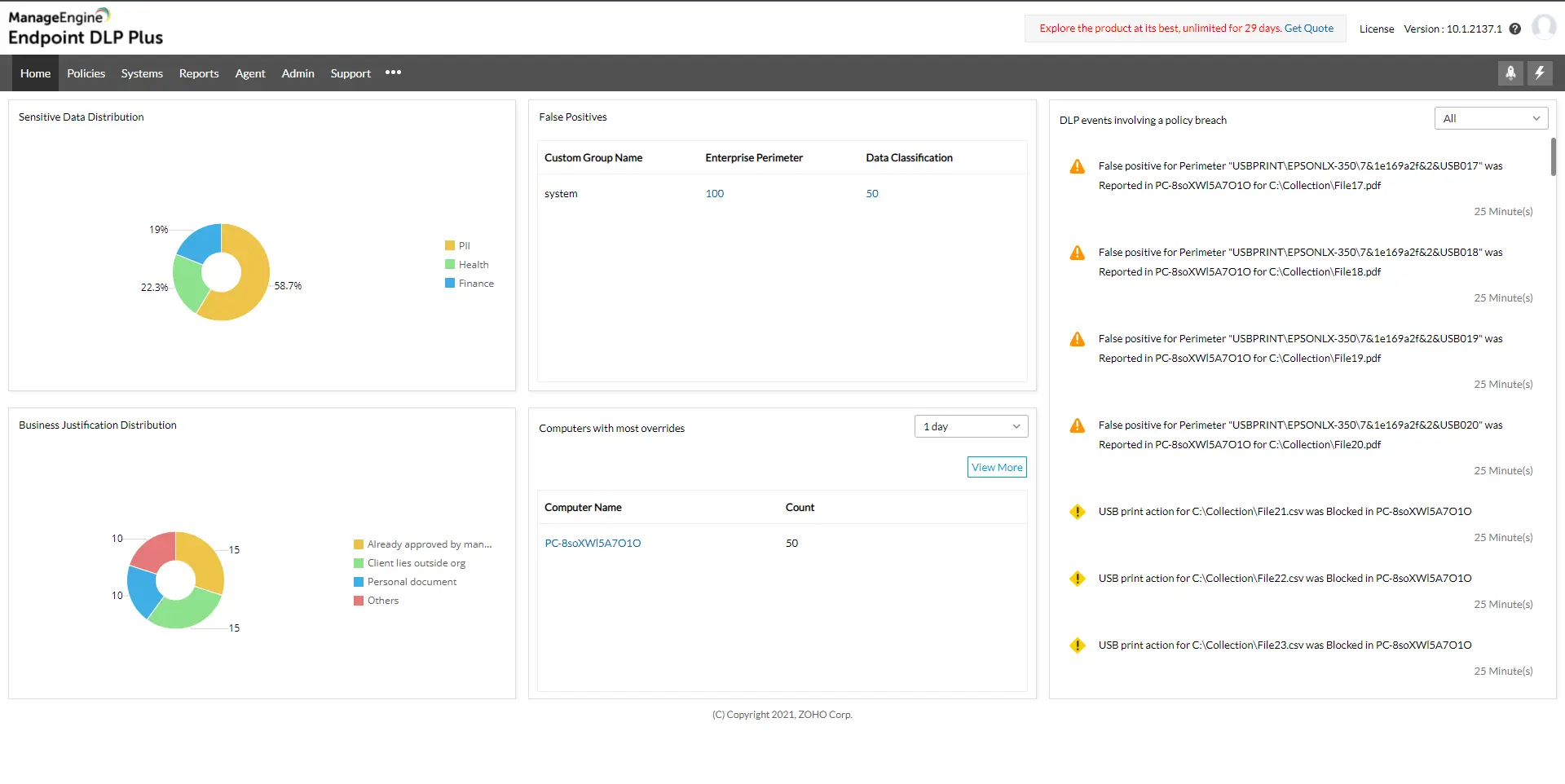
ManageEngine Endpoint DLP Plus is an endpoint security solution engineered to discover, categorize, and protect sensitive data on managed workstations.
It emphasizes device-level perimeter defense, helping IT and security teams secure physical ports, local printers, network shares, and web uploads without the operational complexity of heavy enterprise platforms.
Key features
- Peripheral and removable storage control: Restricts unauthorized USB drives, external hard drives, and auxiliary hardware through granular read-only, encryption, or hard-block policies.
- Content discovery and OCR: Scans endpoints for regulated records (PII, PCI, PHI) using pattern templates and an integrated OCR engine to inspect images, scanned PDFs, and screenshots.
- Local print and network controls: Intercepts and audits local print jobs, network file transfers, and unauthorized cloud uploads directly at the endpoint operating system level.
Contrast with Incydr
Incydr operates primarily as a cloud-native insider risk solution focused on tracking file movements and browser-based uploads. ManageEngine Endpoint DLP Plus focuses on device-tier enforcement, providing strict administrative control over physical ports, USB storage, and printer spools.
ManageEngine also offers an on-premises deployment model, whereas Incydr is strictly cloud SaaS.
Pricing
ManageEngine publishes transparent list pricing for its Professional Edition:
- Professional Edition: Starts at $795 per year for 100 endpoints (~$7.95 per endpoint/year), covering content discovery, device control, printer restrictions, and web upload controls.
- Free trial: Fully functional 30-day trial for up to 25 computers.
- Endpoint Central bundle: Available as an add-on or integrated module within ManageEngine’s broader Endpoint Central unified endpoint management (UEM) suite.
Buyer’s decision matrix: Which Mimecast Incydr alternative fits your needs?
Selecting the ideal data loss prevention platform requires aligning your organization's specific operational constraints, architectural requirements, and risk profile.
The matrix below highlights four distinct architectural approaches to replacing or augmenting Incydr:
| Platform | Primary Buying Trigger | Deployment Footprint | Core Differentiator |
|---|---|---|---|
| Teramind | Multi-channel OS-level prevention, visual proof, & user behavior analytics | Endpoint agent (Cloud SaaS, On-Premises, or Private Cloud) | Kernel-level blocking (clipboard, print, USB, apps), real-time OCR, and continuous session video playback. |
| Microsoft Purview | Vendor consolidation for Windows- and Microsoft 365-centric estates | Native OS/cloud integration (Agentless on Win 10/11 & M365; package for macOS) | Built directly into Windows and Office applications; zero third-party agent overhead for pure Microsoft environments. |
| Strac | SaaS collaboration security, Cloud DSPM, & GenAI/MCP protection | Agentless Cloud API + optional browser extension & endpoint sensor | Automated inline masking and redaction across Slack, Google Drive, Zendesk, and AI/MCP prompts. |
| DTEX InTERCEPT | Privacy-first monitoring for unionized or European workforces | Lightweight endpoint forwarder (Collects metadata only; <0.5% CPU) | Patented pseudonymization and behavioral baselining that complies with GDPR without capturing screens or keystrokes. |
Decision breakdown
Choose Teramind if:
- You need kernel-level inline prevention, comprehensive system monitoring, and visual video proof for internal investigations.
- If an employee attempts to leak intellectual property, print confidential documents, or paste sensitive code into unauthorized applications, Teramind intercepts the transfer and captures synchronized video recordings, keystroke records, and OCR-indexed audit logs.
Choose Microsoft Purview if:
- Your organization is fully invested in Windows 11 and Microsoft 365 E5 licenses.
- Purview operates directly within Microsoft productivity applications, Edge, and the Windows OS, maximizing ROI for dedicated Microsoft shops.
Choose Strac if:
- Your primary threat vector is employees sharing credentials, customer records, or source code across SaaS platforms and AI tools.
- Strac automatically sanitizes, redacts, and masks sensitive data inline within Slack, Zendesk, Google Workspace, and GenAI models before exposure occurs.
Choose DTEX if:
- Strict privacy regulations, works councils, or labor agreements govern your employee monitoring program.
- DTEX captures pseudonymized, lightweight metadata to surface behavioral anomalies without logging keystrokes or recording user desktop screens.
Why should you consider Teramind as an alternative to Mimecast Incydr?
While Mimecast Incydr has introduced preventative controls such as browser upload restrictions, untrusted paste blocking, and origin-based "Block by Source" policies, its enforcement is anchored to browser extensions and file-origin tagging.
Teramind expands beyond these boundaries by providing comprehensive, OS-level intervention, deep contextual forensics, and multi-vector visibility.
It provides kernel-level inline protection beyond the browser
Incydr’s preventative controls rely primarily on its browser extension to block uploads and pastes to untrusted domains.
Teramind operates at the OS kernel level. It enforces real-time blocking across native desktop applications, local network shares, offline USB storage devices, system clipboards, and local printer spools.
It captures forensic video recordings and live desktop playback
Incydr provides file-event metadata and risk-trend scores, leaving investigators to infer human motivation from log entries.
Teramind captures timestamped, high-definition desktop video recordings synchronized with user actions. Security and HR teams can review employee activities leading up to an incident or initiate a live remote desktop view to assess insider threats.
It delivers comprehensive oversight across 15+ system channels
While Incydr concentrates on file-system events, cloud sync folders, and browser destinations, Teramind inspects more than 15 system channels.
It monitors desktop applications, system-wide copy-paste buffers, instant messaging platforms, email body text, network connections, file access, and command-line shell executions.
It includes patented real-time Optical Character Recognition (OCR)
Insider data breaches often bypass file-based controls when employees capture desktop screenshots, view confidential records in legacy ERP systems, or handle image-based PDFs.
Teramind’s patented OCR engine scans and indexes text displayed on the screen in real-time, triggering alerts and blocking actions based on visual content.
It governs multi-surface generative AI and autonomous agents
Teramind monitors generative AI tools across both web browsers and native desktop clients.
It inspects prompts, blocks unauthorized code or PII pastes into tools like ChatGPT and Claude, and audits developer interactions with terminal-based autonomous AI agents to flag anomalous execution velocities.
It offers architectural flexibility (on-premises, private cloud, and SaaS)
Incydr is delivered strictly as a multi-tenant cloud SaaS solution.
Teramind provides complete functional parity whether deployed as a multi-tenant SaaS, hosted within a private cloud (AWS or Azure), or installed completely on-premises for organizations operating in air-gapped, sovereign, or defense environments.
It unifies DLP, UEBA, and workforce analytics
Teramind consolidates data loss prevention, User and Entity Behavior Analytics (UEBA), and employee productivity monitoring into a single endpoint client.
It eliminates tool sprawl and delivers security and operational visibility from a single console.
Explore Teramind's Free Interactive Demo | Start Your Free Trial Today
FAQs
Why do organizations look for Mimecast Incydr alternatives?
Security teams typically evaluate alternatives when their requirements outgrow Incydr's browser-centric preventative model and cloud-only delivery.
Common drivers include:
- System-wide inline prevention: The need to block transfers across native desktop software, network shares, command-line interfaces, and offline USB devices, rather than relying on browser extensions and origin tagging.
- Deep content inspection and live OCR: The requirement to inspect unstructured file payloads, clipboard buffers, and on-screen text rather than relying on file lineage and domain trust lists.
- Visual session replays: The need for timestamped video evidence to confirm user intent for HR, legal, and compliance inquiries.
- On-premises infrastructure: Compliance mandates requiring self-hosted or air-gapped deployments that Incydr's cloud SaaS architecture cannot accommodate.
What is the primary difference between Mimecast Incydr and Teramind?
Mimecast Incydr is primarily an insider risk management platform focused on tracking file lineage, scoring risk, and enforcing origin- and browser-based restrictions.
Teramind is an active, endpoint-centric data loss prevention and behavioral intelligence platform. It enforces kernel-level blocking across all system channels and captures forensic video evidence.
Isn't Teramind too invasive compared to Incydr's metadata model? How does it protect employee privacy?
Teramind incorporates privacy-by-design controls to meet GDPR, HIPAA, and works council standards:
- Conditional monitoring: Policies can be scoped to monitor only business-critical applications during working hours. Teramind automatically pauses monitoring during personal breaks or on non-work tools.
- Automated PII masking: Teramind’s OCR dynamically blurs sensitive personal data, passwords, and banking details within session recordings and audit logs.
- Dual-custody and role-based access: Access to recorded sessions can be restricted to authorized HR or legal personnel, with dual-authorization workflows requiring multiple administrative approvals to unlock recordings.
Will running continuous video recording and OCR cause endpoint performance lag?
No. Teramind’s agent uses a lightweight kernel driver engineered to consume minimal system resources (typically 1-3% CPU).
Screen capture is handled asynchronously via frame differential capture, recording only when on-screen changes occur.
OCR processing is optimized to run selectively against targeted windows, active applications, or policy-triggered events. This prevents device-side compute bottlenecks.
How do Mimecast Incydr alternatives handle Generative AI leaks and prompt exfiltration?
While Incydr offers browser extension controls to restrict paste operations into untrusted web tools, modern alternatives enforce protection across multiple layers:
- Clipboard and desktop interception (Teramind): Inspects clipboard text and native application windows in real-time, preventing employees from pasting sensitive source code, customer records, or API keys into AI tools.
- API-level redaction (Strac): Automatically masks sensitive tokens, PII, and credentials inline before the prompt is transmitted to the external language model.
- Provenance tracking (Cyberhaven): Traces data fragments originating from enterprise repositories and prevents those data chains from being submitted to unauthorized LLMs.
Will active inline blocking disrupt legitimate employee workflows and create false positives?
Not when deployed using a tiered rollout strategy.
While passive tools avoid workflow friction by alerting admins after an event, modern inline platforms offer progressive policy enforcement that balances protection with business continuity.
Teramind mitigates false positives through flexible enforcement modes:
- Audit and learn mode (Stealth): Run policies silently during initial deployment to establish behavioral baselines, identify legitimate data flows, and fine-tune rules without blocking any actions.
- Coaching nudges and user overrides: Instead of hard blocks, trigger interactive warning dialogs that prompt users to acknowledge company policy, specify a business justification, or cancel the transfer.
- Contextual policy exceptions: Build rules that permit data transfers within authorized cloud tenancies (e.g., sanctioned corporate Google Drive accounts) while blocking transfers to personal cloud domains.
Which Mimecast Incydr alternatives support on-premises or air-gapped deployments?
Organizations with strict data residency mandates or air-gapped data centers should evaluate:
- Teramind: Full functional parity across self-hosted on-premises servers, air-gapped networks, private clouds (AWS/Azure), and multi-tenant SaaS.
- Safetica: Offers a self-hosted on-premises server architecture alongside its cloud platform.
- ManageEngine Endpoint DLP Plus: Provides native on-premises server deployment as well as a cloud option.
- Forcepoint DLP: Supports enterprise on-premises and sovereign hybrid deployments.
- Symantec DLP: Features an established on-premises DLP Core suite (Endpoint Discover/Prevent and Network Prevent).
Why is visual session replay necessary if we already collect endpoint log data?
Event logs indicate what action occurred, but they cannot prove user intent.
A log entry showing that 50 files were uploaded to a personal cloud drive cannot verify whether an employee acted maliciously or simply synced an authorized folder by mistake.
Visual replay provides exact, timestamped video evidence of mouse movements, active windows, and surrounding context. This gives HR and legal teams conclusive proof during incident response investigations.
