
Enterprises want AI technology capabilities without the chaos. They want developers using AI to ship faster, analysts leveraging AI for insights — but within boundaries that prevent data leaks, compliance violations, and reputational damage.
This is impossible for many companies because traditional IT governance doesn’t fit the modern AI landscape. Processes designed for predictable software with defined behaviors break down when applied to systems that generate unpredictable outputs.
This then creates a governance vulnerability loop:
- Lock down AI too tightly and you eliminate the productivity gains driving adoption.
- Leave it too open, and you create unacceptable risk.
Enterprise AI governance offers a possible solution. It gives organizations a way to scale AI initiatives and other AI projects without turning adoption into unmanaged risk.
This blog will show you how to make AI a governed enabler of growth and long-term competitive advantage.
What is Enterprise AI Governance?
Enterprise AI governance is the set of policies, controls, processes, and oversight mechanisms that ensure artificial intelligence systems are used responsibly, securely, and in alignment with business objectives and regulatory requirements.
In simple terms, it defines who can use AI, how it can be used, what data it can access, and how its behavior is monitored and controlled.
AI governance also covers the full lifecycle of AI systems from model selection and deployment to runtime monitoring and retirement. It addresses issues such as data privacy, security risks, model accountability, bias management, compliance obligations, and operational oversight.
What Are the Principles of Enterprise AI Governance?
A strong AI governance program rests on a set of foundational principles. These principles guide how AI systems are built, deployed, monitored, and corrected when things go wrong.
Transparency
Organizations must be able to explain how AI systems function. That includes documenting model sources, data lineage, system prompts, decision logic, and integration points.
Transparency ensures that when an AI-driven output affects a customer, financial decision, or operational process, the organization can trace how and why it occurred.
Accountability
Every AI system must have defined ownership. Governance requires clearly assigning responsibility for model deployment, monitoring, output validation, and incident response.
When failures occur — whether via biased outputs, AI data leaks, or operational errors — you must have teams accountable for remediation and oversight.
Fairness
AI systems must be evaluated for bias in both training data and outputs.
Governance programs should include structured bias detection, dataset validation, and continuous review mechanisms. This reduces discriminatory or harmful outcomes.
Ethical Alignment
AI use cases should align with corporate values and broader societal expectations. This means defining acceptable and unacceptable AI applications upfront.
Your governance framework must contain rules for employee AI usage in accordance with your company’s ethical boundaries.
Legal and Regulatory Compliance
AI deployments must adhere to global and industry-specific regulations. That includes obligations under frameworks such as the GDPR or HIPAA, especially when systems process personal data or generate outputs that affect customer rights, employment decisions, or regulated workflows.
Governance ensures that AI systems operate within established legal constraints and that documentation exists to demonstrate compliance during audits or investigations.
Security
AI expands the attack surface. Governance requires securing Large Language Models (LLMs), APIs, orchestration layers, and data pipelines against cyber threats such as prompt injection, model manipulation, credential abuse, and unauthorized access.
Security controls must extend to both infrastructure and AI-specific risks.
Privacy and Data Protection
In enterprise settings, AI can process sensitive data. Governance mandates strict access controls, anonymization where appropriate, and safeguards to prevent exposure of personally identifiable information (PII) and intellectual property (IP).
Data usage should be purpose-bound and monitored throughout the AI lifecycle.
Why Does AI Governance Matter More Than Ever in 2026?
The Incident Curve is Rising, and the Harms Are Getting More Serious
In 2026, the most important shift is that AI failures now cross categories. A single issue can be a security problem, a business continuity problem, a compliance problem, and a trust problem at the same time.
Deepfakes are a good example. In the Hong Kong case documented by the Commonwealth Fraud Prevention Centre, an employee was tricked by a deepfake video call into making 15 transfers totaling HK$200 million.
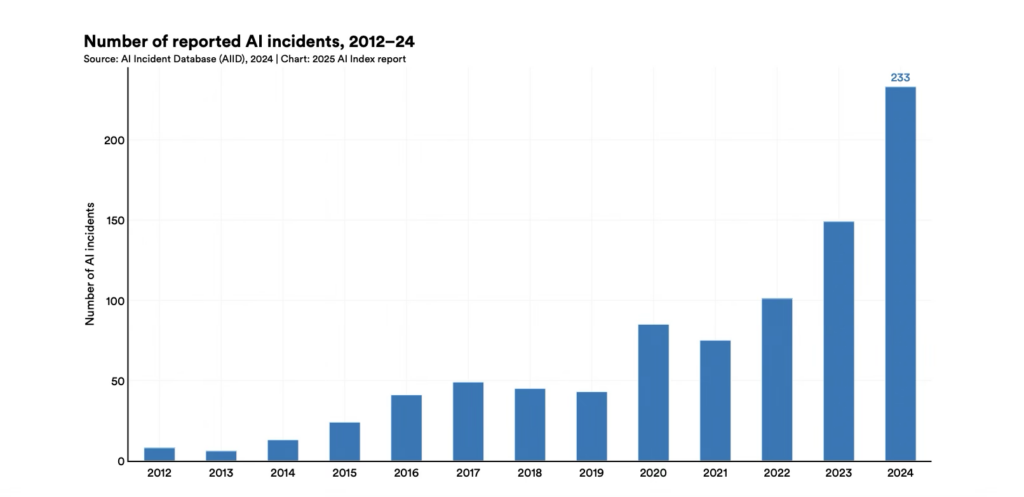
Stanford HAI also reported that the number of AI-related incidents tracked by the AI Incidents Database (AIID) reached 233 in 2024, a 56.4% increase over 2023.
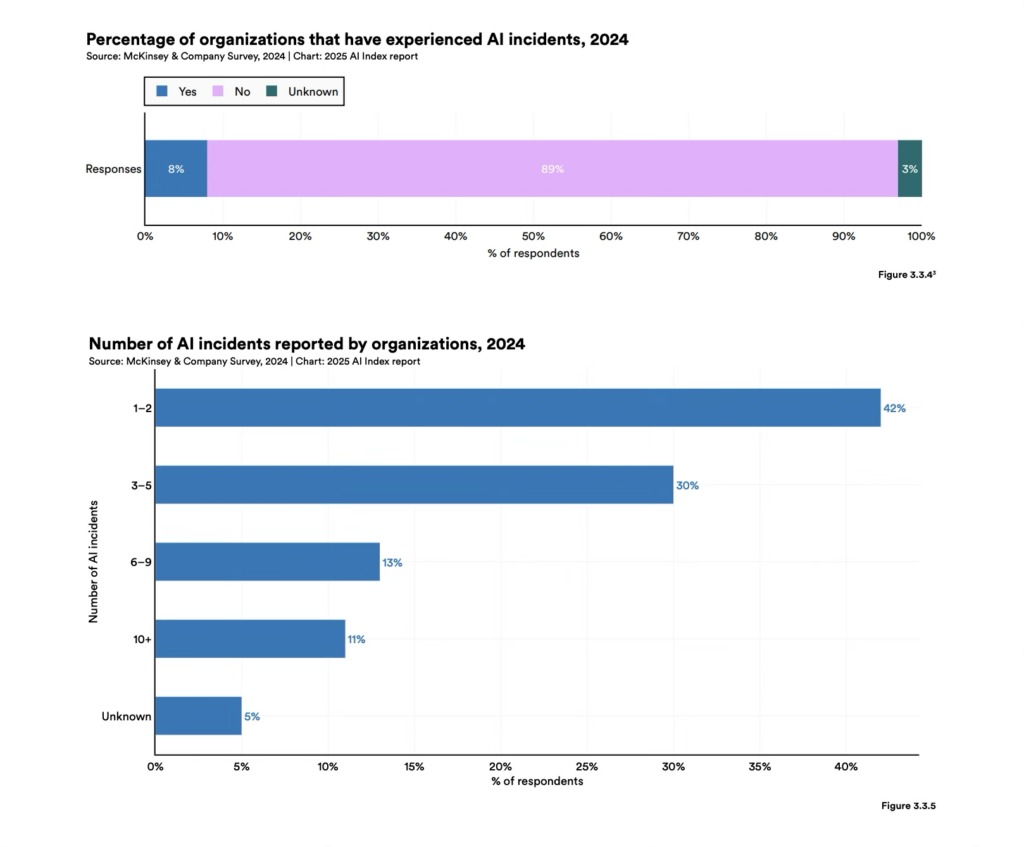
The same report notes that only 8% of surveyed organizations said they experienced AI-related incidents in 2024, which suggests many companies are still in the detection and classification stages and haven’t yet arrived at the governance stage.
Regulators Have Moved From Principles to Enforceable Obligations
AI regulatory pressure in Europe is fast becoming the center of the conversation. The EU AI Act entered into force on 1 August 2024 and becomes fully applicable on 2 August 2026, with some rules already in force earlier.
For example, the ban on AI systems posing unacceptable risks started to apply on 2 February 2025.
And in the US, Stanford’s 2025 AI Index says federal agencies introduced 59 AI-related regulations in 2024, more than double the number in 2023.
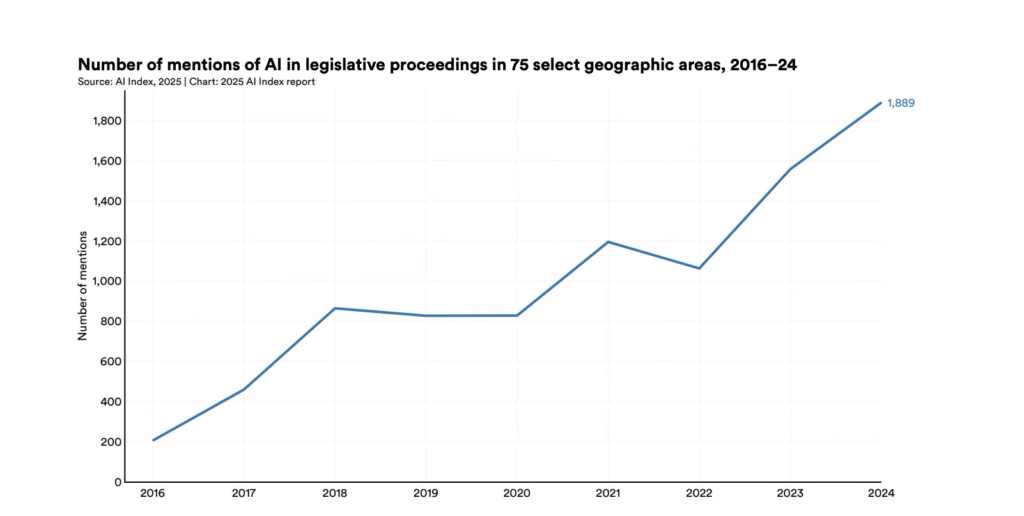
In addition, AI-related legislative mentions rose 21.3% across 75 countries in one year.
Shadow AI and Weak Oversight Now Have Measurable Financial Costs
Poor AI governance now shows up directly in breach data.
IBM’s 2025 Cost of a Data Breach research found that among organizations that suffered an AI-related security incident, 97% lacked proper AI access controls, and 63% lacked policies to manage AI or prevent Shadow AI.
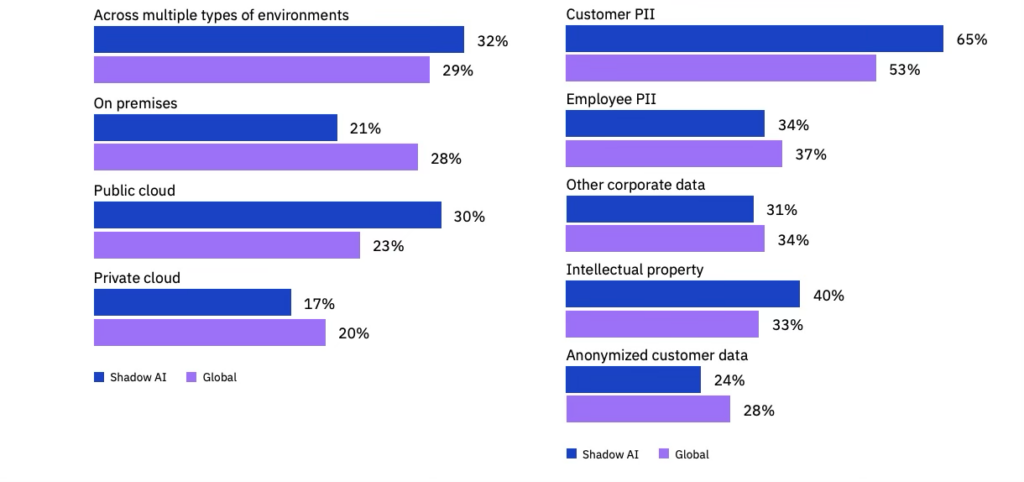
IBM also reported that one in five organizations had suffered a breach due to Shadow AI, and organizations with high levels of Shadow AI saw $670,000 higher breach costs on average than organizations with little or no Shadow AI.
This matters because Shadow AI isn’t usually driven by malicious insiders. It’s driven by normal employees trying to move faster. They use tools like ChatGPT and AI agents without understanding the downstream compliance risks or cybersecurity exposure involved.
Enterprise governance is what decides which tools are approved, what data can enter them, how usage is monitored, what logging exists, and what controls sit around human and machine access.
Without it, AI adoption becomes a huge data security problem.
Trust, Accuracy, and Human Accountability Are Becoming Board-Level Issues
AI mistakes are increasingly creating public liability and internal inconvenience. A good example is Air Canada’s chatbot case. The bot gave a customer incorrect bereavement fare information, and the ruling held that Air Canada was responsible for what its chatbot said because the chatbot was part of its website.
Similarly, in the legal sector, the fallout from Mata v. Avianca and the wave of later sanctions it influenced reinforces the same point: if professionals rely on AI outputs without verification, the human user and the organization still carry the responsibility.
This is the part many teams underestimate. Aside from blocking unsafe tools, governance is also about preserving trust in high-stakes decisions.
If AI is helping produce legal work, customer guidance, or executive decisions, then governance ensures there is a human owner, a validation step, and a clear escalation path when the model is wrong.
What Are the Leading Enterprise AI Governance Frameworks?
NIST AI Risk Management Framework (AI RMF)
The NIST AI RMF is a voluntary framework designed to help organizations identify, assess, manage, and reduce AI risks in a structured way.
It’s not a law or certification standard. Instead, it gives organizations a common operating model for making AI systems more trustworthy, which NIST ties to characteristics such as validity, reliability, safety, security, privacy, explainability, and accountability.
What makes the AI RMF useful is that it’s practical and lifecycle-based. It organizes AI governance around four core functions: Govern, Map, Measure, and Manage.
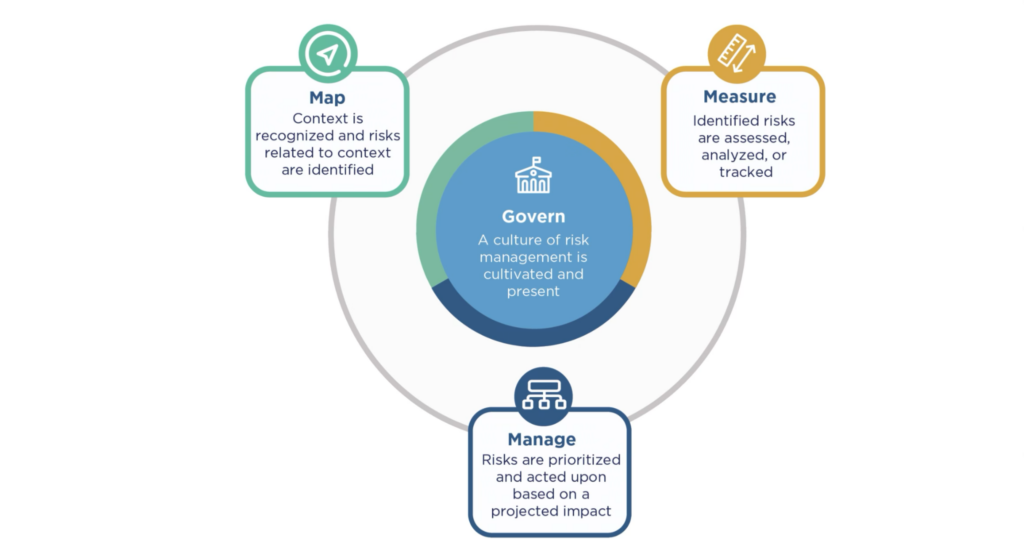
NIST also published a Generative AI Profile to help organizations apply the RMF to GenAI use cases. This is useful for organizations deploying LLMs and other machine learning systems that need stronger controls around data handling, monitoring, and human accountability.
ISO/IEC 42001
ISO/IEC 42001 is the first international management system standard specifically designed for artificial intelligence. It defines the requirements for establishing, implementing, maintaining, and continually improving an Artificial Intelligence Management System (AIMS).
It’s also certifiable, which means organizations can formally demonstrate that they have structured controls governing responsible AI development, deployment, model risk management, and oversight.
This standard integrates governance into existing management systems (such as ISO 27001 for information security), making it especially relevant for enterprises that need formal compliance documentation.
The EU AI Act
The EU AI Act is a binding regulatory framework that classifies AI systems based on risk levels: unacceptable risk, high risk, limited risk, and minimal risk.
High-risk systems such as those used in critical infrastructure, healthcare, finance, employment decisions, and biometric identification face strict requirements.
These include mandatory risk assessments, human oversight, transparency obligations, documentation, and post-market monitoring.
The EU AI Act also imposes legal consequences for non-compliance — up to €35 million or 7% of global annual revenue for the most serious violations.
Companies operating in or serving the European market must ensure that their AI deployments meet these regulatory standards.
Singapore Model AI Governance Framework
The Singapore Model AI Governance Framework is a practical guide developed to help organizations translate AI ethics principles into operational practices.
It is sector-agnostic and implementation-focused. It provides actionable guidance on areas such as internal governance structures, risk assessments, model explainability, stakeholder communication, and human oversight mechanisms.
Many organizations adopt it as a practical bridge between abstract ethical principles and day-to-day deployment controls.
OECD AI Principles
The Organisation for Economic Co-operation and Development’s AI Principles provide internationally recognized standards shaping national AI policies across 42+ member countries.
These principles influence how nations develop AI regulation, what industry standards emerge, and how multinational corporations approach AI governance across different jurisdictions.
The five core principles are:
- Inclusive Growth, Sustainable Development, and Well-being: AI should benefit people and the planet.
- Human-centered Values and Fairness: AI should respect human rights, diversity, and fairness.
- Transparency and Explainability: Stakeholders should understand AI systems and their outcomes.
- Robustness, Security, and Safety: AI should function reliably and securely throughout its lifecycle.
- Accountability: Organizations deploying AI should be accountable for its proper functioning.
Enterprises use the OECD Principles as high-level guidance aligning AI governance with international norms.
White House Blueprint for an AI Bill of Rights
The US White House Blueprint for an AI Bill of Rights articulates principles protecting Americans from potential harms of automated systems. It focuses on civil rights, civil liberties, and democratic values.
While not a legally binding federal regulation, the Blueprint influences federal agency rulemaking, state-level AI legislation, and industry self-regulation in the United States.
The Blueprint establishes five principles:
- Safe and Effective Systems: Protection from unsafe or ineffective AI through design, testing, and ongoing monitoring.
- Algorithmic Discrimination Protections: Freedom from discrimination by algorithms via proactive equity assessments.
- Data Privacy: Built-in protections from abusive data practices.
- Notice and Explanation: Knowledge that automated systems are being used and understanding how they contribute to outcomes.
- Human Alternatives, Consideration, and Fallback: Ability to opt out where appropriate and access to human review of automated decisions.
What Are the Core Components of an AI Governance Framework?
Effective enterprise governance requires interconnected components working together across the AI lifecycle.
Organizations can’t govern LLMs, machine learning models, and automation systems through isolated controls.
Instead, they need integrated frameworks spanning organizational structures, technical capabilities, and operational processes.
Cross-Functional Ownership and Accountability
Governance structure requires distributed accountability across functions:
- Business stakeholders define acceptable AI use cases, risk tolerance, and success criteria. They determine the problems AI should solve, what outcomes are desirable, and what impacts are unacceptable based on organizational strategy and values.
- Legal and compliance teams interpret regulatory requirements, assess AI systems against legal obligations, identify compliance gaps, and advise on liability exposure.
- Security teams protect AI infrastructure, implement access controls, monitor AI for threats, and respond to incidents.
- Data engineering and science teams build AI systems, implement technical controls, ensure data quality, and check for model drift.
- Risk management assesses AI-related risks holistically, prioritizes governance investments, and ensures risk treatments align with organizational risk appetite. They connect AI governance to enterprise risk management frameworks.
Without this shared accountability, governance gaps emerge. For example, models that meet performance goals but violate compliance requirements.
Data Quality, Lineage, and AIOps
Data is the foundation of every AI tool; governance at this layer determines whether outputs are reliable, reproducible, and safe. Poor data quality or weak controls at this stage often lead to downstream issues that are difficult to detect and even harder to fix.
A strong governance framework enforces strict data validation, schema consistency, and source verification before data enters training or retrieval pipelines.
It also requires full data lineage — knowing exactly where data originated, how it was transformed, and where it’s used. This is critical for debugging issues, making auditing decisions, and proving compliance.
AIOps extends this further by operationalizing model management: versioning datasets and models, ensuring reproducible pipelines, and enabling controlled updates without introducing inconsistencies or hidden risks.
This ensures that AI models behave predictably over time, even as inputs and environments change.
Visibility and AI Asset Inventory
Companies need a complete and continuously updated view of all AI-related assets in their environment (models, datasets, prompts, APIs, integrations, and third-party tools).
This inventory should include metadata such as model purpose, data dependencies, access permissions, ownership, risk classification, and usage patterns. This allows teams to understand what is deployed, how it’s being used, and where risks may exist.
Importantly, this also extends to Shadow AI. Without visibility into these unauthorized AI tools, sensitive data can flow outside corporate networks. At this point, governance becomes ineffective.
A centralized inventory ensures that all AI activity is accounted for and can be governed consistently.
Continuous Orchestration and Monitoring
AI is dynamic by nature. It interacts with changing data, evolving user behavior, and new integrations.
As a result, governance can’t be static. It must operate continuously, with mechanisms to monitor, evaluate, and adjust controls in real-time.
This involves tracking model performance metrics, detecting data drift, monitoring how users interact with AI, and identifying anomalies in outputs or behavior.
Automated feedback loops are critical here. If a model begins producing unexpected results, accessing new types of data, or being used outside its intended scope, governance controls should detect and respond immediately.
This could mean triggering alerts, restricting access, or adjusting policies dynamically.
AI Security and Risk Controls
AI introduces new attack surfaces and amplifies existing ones, which makes security a core part of governance.
This component focuses on protecting both the models and the data they interact with from misuse, unauthorized access, and adversarial threats.
At a foundational level, this includes enforcing zero-trust principles — i.e., verifying every user, system, and interaction before granting access. Permissions must be tightly scoped so models and users can only access what is necessary for their role.
Beyond access control, continuous monitoring is required to detect threats such as prompt injection, AI data exfiltration attempts, and abuse of connected tools or APIs.
Infrastructure and integration points also need to be secured, ensuring that models can’t be exploited through weak APIs, exposed endpoints, or misconfigured environments.
This ensures that even if other components misfire, the business remains protected against both internal misuse and external attacks.
What Are the Common Challenges in Enterprise AI Governance?
Rampant Shadow AI
Shadow AI is one of the hardest governance problems. Why?
Because employees are using AI faster than security teams can inventory it.
Microsoft reports that 29% of employees use unsanctioned AI agents for work tasks, while only 47% of organizations say they’re implementing GenAI security controls.
On one hand, there’s an unauthorized tool usage problem looming. And on the other, there is the loss of visibility into who used what, what data was entered, and whether security teams can trace policy violations afterward.
Once AI usage moves outside approved systems, governance teams can no longer reliably audit interactions, verify identities, or stop sensitive information from leaking.
Autonomous Agent Risks
Autonomous agents create a governance problem because they act without restriction. They can execute tasks, modify files, trigger workflows, and interact with systems at machine speed.
PwC found that 79% of executives say AI agents are already being adopted in their companies.
Meanwhile, McKinsey reports that 62% of organizations are at least experimenting with AI agents.
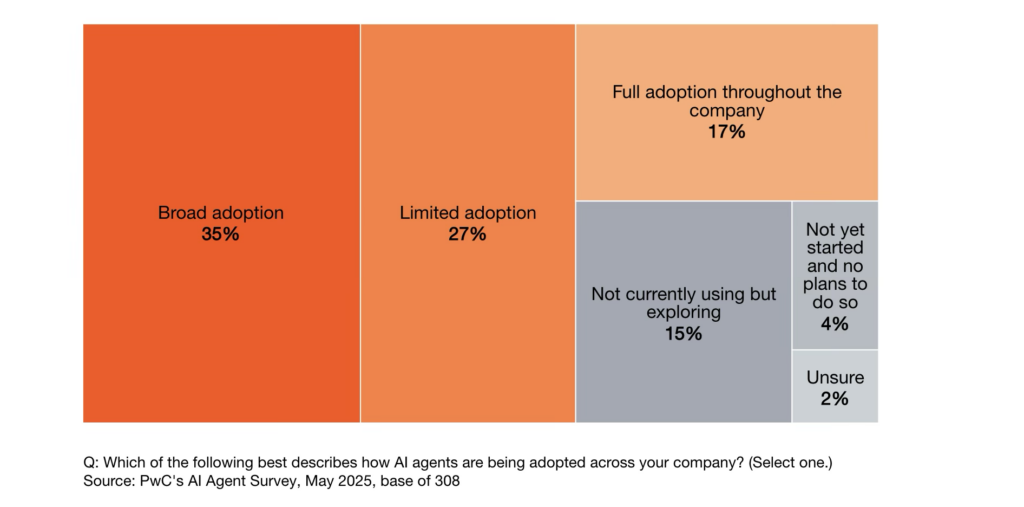
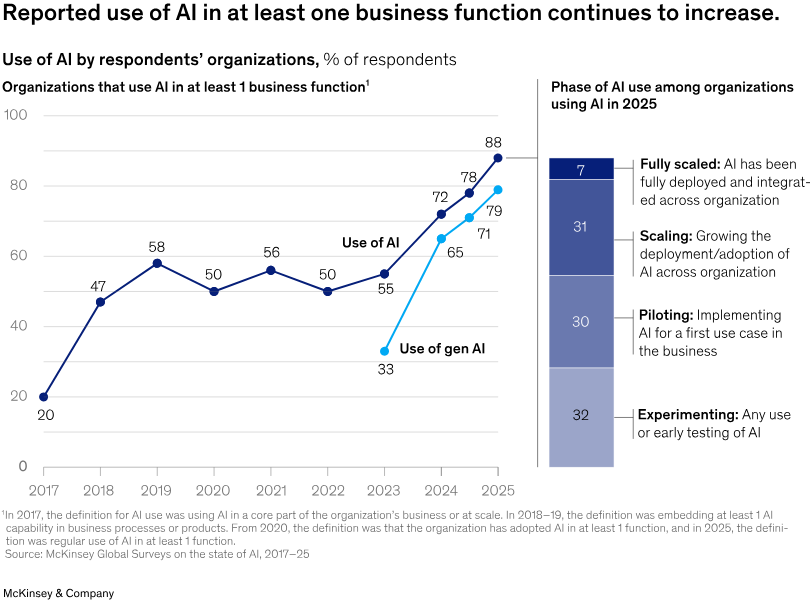
As this adoption rises, the control challenge changes from “what did the model say?” to “what did the agent do?”
An agent can run hundreds of actions in seconds, and by the time a legacy monitoring system flags the behavior, the impact has already happened. To be effective, agentic AI security needs to operate at the same speed as the agent.
Fragmented Data Privacy
Data privacy becomes much harder when employees routinely move information across systems.
Employees paste data into web interfaces, upload files to AI services through browsers, dictate information to voice-based AI, and share screens containing sensitive information. Each channel bypasses traditional data loss prevention tools.
A recent report on insider threat found that 39.7% of AI interactions involve sensitive data, which shows how often employees are pasting regulated or confidential information into AI workflows.
IBM also reports that 35% of breaches involved data stored in unmanaged data sources, and those breaches took longer to identify and contain, averaging 291 days when shadow data was involved.
This is what makes privacy governance fragmented rather than simply ‘weak’. The data is no longer in a governed system. Now, it’s constantly moving across public tools, enterprise copilots, cloud environments, unmanaged data sources, and employee-driven workflows.
Siloed Accountability
Many AI governance programs fail because ownership is unclear. Teams may have policies, committees, or principles, but no one owns decisions end to end.
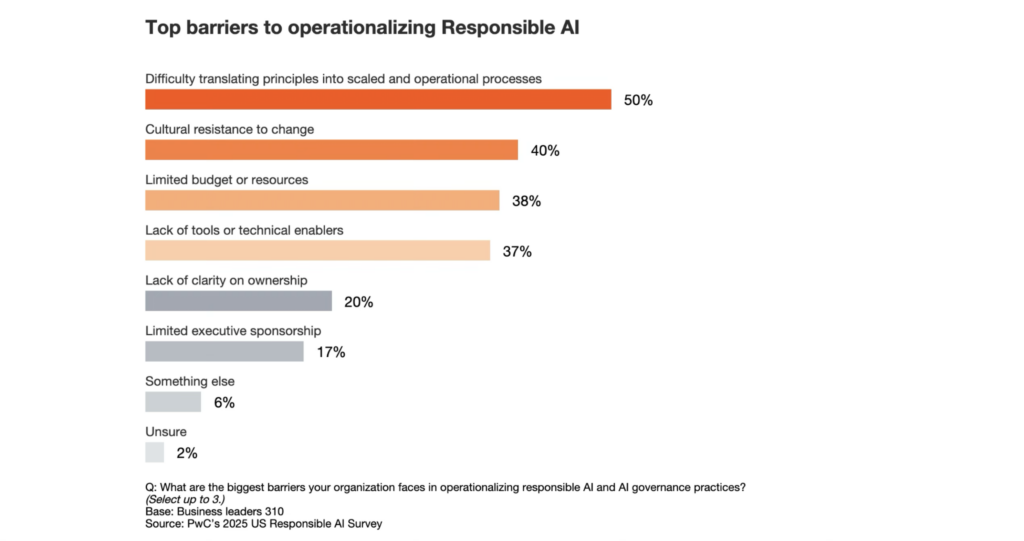
PwC identifies ‘lack of clarity on ownership’ as one of the top barriers to operationalizing responsible AI. Its survey emphasizes that governance becomes more effective when responsibility is embedded directly into the build and operating teams.
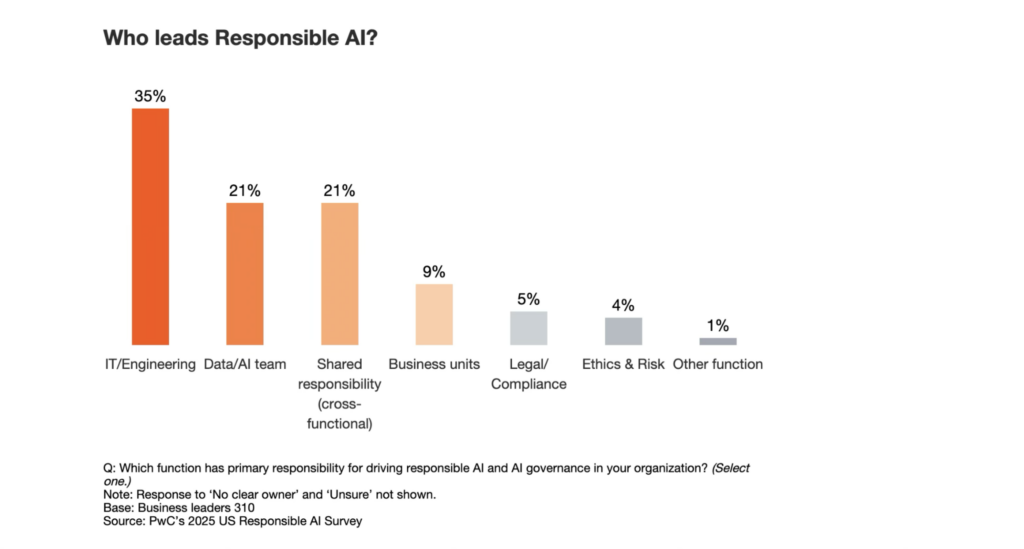
PwC also notes that 56% of executives say first-line teams such as IT, engineering, data, and AI now lead responsible AI efforts. This shows that organizations are trying to move accountability closer to where deployment decisions happen.
However, many businesses aren’t set up this way. McKinsey’s workplace AI research says the biggest barrier to scaling AI is leadership and operating-model gaps. And only 1% of companies consider themselves mature in deployment.
Model Degradation and Data Drift
AI models trained on historical data gradually become less accurate as real-world conditions change.
Customer behavior shifts, market dynamics evolve, product offerings change, and external factors alter patterns the model learned. When models encounter data distributions significantly different from training data, predictions degrade.
The governance issue is that many organizations are deploying AI faster than they’re building mature monitoring and observability practices around it.
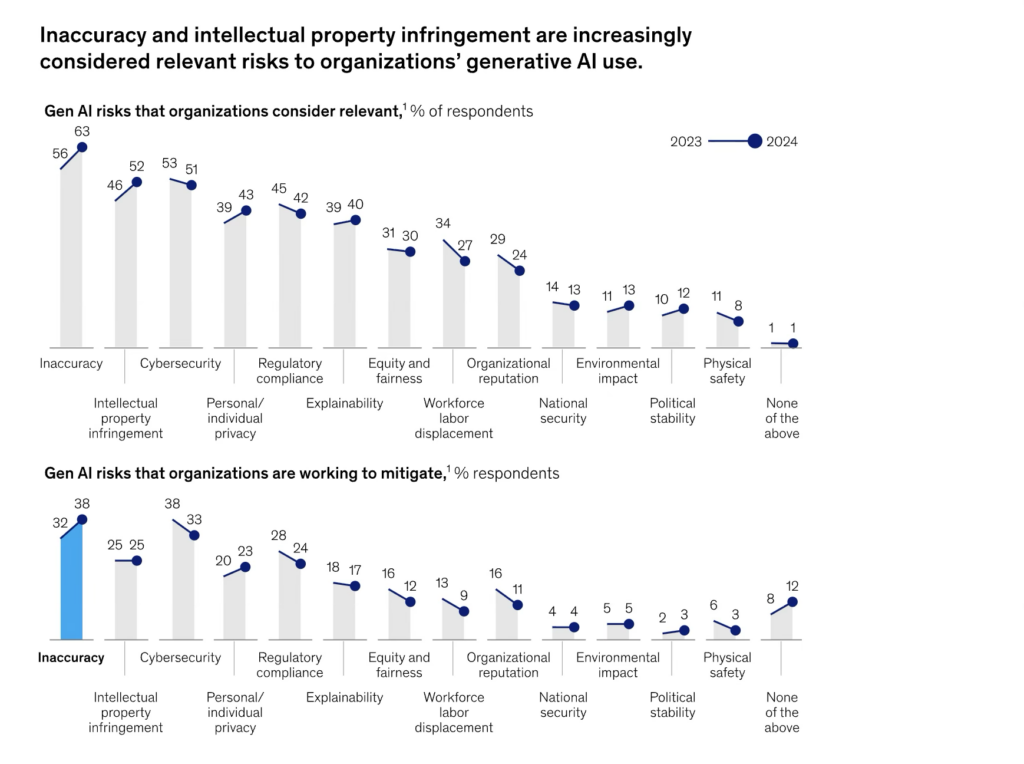
The gap shows up in broader risk posture. McKinsey found that 47% of organizations using GenAI experienced at least one negative consequence from its use, and 40% identified explainability as a key adoption risk. Yet, only 17% said they were actively working to mitigate it.
Bias drift creates additional governance challenges. Models tested for fairness during development can develop bias in production as data patterns change or as models encounter edge cases that testing didn’t cover.
Lack of Reproducible Auditability
Auditability is still a major weakness in enterprise AI governance. Many organizations can’t fully reconstruct what a model saw, which prompt path it followed, which data source it used, or why a given output was produced.
That makes compliance reporting, internal investigations, and incident response much harder than they should be.
The practical consequence is that without lineage, prompt history, and system traceability, teams can’t prove control. As such, they can’t defend against legal challenges questioning AI decision-making.
It gets more complicated when the outputs are non-deterministic. The same prompt can produce different responses across runs due to model randomness, temperature settings, or subtle context differences.
In short, if an organization can’t recreate the model’s decision path, it will struggle to satisfy auditors, explain failures, or respond quickly when something goes wrong.
How Do You Implement Responsible AI Practices in an Enterprise Environment?
1. Establish an AI Governance Committee With Cross-functional Representation
Create a governance body including representatives from legal, security, data science, business units, risk management, and ethics.
The committee will review AI deployments before production, approve high-risk systems, address incidents, and adapt governance policies as AI capabilities evolve.
2. Classify AI Systems by Risk Level and Apply Proportional Controls
Not all AI requires identical governance. Some tools are low-risk productivity aids.
Others sit closer to critical decision support, regulated data handling, or customer-facing technology. The control model should reflect that difference.
As such, you need to classify the AI based on:
- What Data It Processes: Public vs. confidential vs. regulated.
- What Decisions It Makes: Recommendations vs. automated actions.
- What Impact Errors Create: Minor inconvenience vs. financial loss vs. harm to people.
For example:
With high-risk systems, you can implement security reviews, bias testing, human oversight, and agentic monitoring. While for low-risk systems, you can use baseline controls without extensive overhead.
3. Create and Maintain a Comprehensive AI Inventory
You can’t govern what you don’t know exists. Build a centralized registry capturing all AI systems operating in your environment.
For each system, track:
- Ownership (who’s responsible).
- Purpose (what business problem it solves).
- Data sources (what information it uses).
- Deployment location (where it runs).
Also, you should update your inventory continuously through automated discovery, integration with development workflows, and periodic audits.
4. Implement Pre-Deployment Security and Compliance Reviews
Establish formal review gates before AI systems enter production. These reviews should assess security, compliance, data handling, fairness, and risk alignment.
Define clear approval criteria so teams know the standards that AI must meet. Document all review outcomes for audit logs and block production deployment until approval is complete.
Teramind Tip
Streamline reviews for low-risk systems to avoid governance becoming a bottleneck.
5. Deploy Data Loss Prevention for AI Interactions
Traditional DLP monitoring of email and file transfers doesn’t catch AI-related data exposure.
As such, it’s best to implement controls that monitor what employees send to AI tools — both approved systems and Shadow AI discovered through behavioral detection.
In addition, you can configure DLP to detect when users attempt to paste sensitive information into prompts, upload confidential files to AI services, or share screens containing regulated data during AI interactions.
Another approach is to block sensitive patterns (SSNs, credit cards, API keys, customer data, proprietary code) in real-time before they reach external AI servers.
6. Establish Clear Data Governance for AI Training and Fine-Tuning
Outline explicit policies for which data AI systems can use in training based on data classification, consent requirements, and regulatory constraints.
Implement approval workflows requiring sign-off before using new datasets, particularly when those datasets contain personal data, confidential business information, or regulated content.
Restrict access to training data and model weights, encrypting them at rest and in transit. When regulations change or consent is revoked, have processes for removing data from training sets and retraining affected models.
7. Provide Training on Responsible AI Use for All Employees
Employees using AI tools need to understand governance requirements, security risks, and appropriate use.
Ensure the training covers:
- What data can and cannot be shared with AI tools.
- How to detect and report Shadow AI.
- When AI-generated content needs review.
- What to do when AI produces problematic outputs.
- Who to contact with questions.
It’s important to also tailor training by role. For example, developers need deep technical guidance, business users need practical usage policies, and executives need high-level overviews.
8. Conduct Regular Bias Testing and Fairness Audits
Test AI systems for discriminatory outcomes before deployment and during operation. You can measure performance across demographic groups, protected classes, and other fairness dimensions.
This helps you identify disparate impact (whether AI produces systematically different outcomes for different groups), assess whether differences are justified by legitimate factors, and implement mitigation strategies when unjustified disparities exist.
Document your testing methodology, results, and any accepted trade-offs between fairness and other objectives.
Re-test when models are retrained, when new features are added, or when deployment context changes.
Why is Teramind an Ideal Enterprise AI Governance Tool?
See Teramind’s AI governance solution in action → Take a self-guided product tour
AI governance only works when policies are backed by real-world visibility and enforcement. As organizations adopt generative AI tools, copilots, and autonomous agents, the next hurdle is visibility — i.e., seeing how your employees are really using AI.
Teramind is an AI governance platform for agentic enterprise. It provides deep, real-time visibility into employee interactions with AI tools, autonomous agent behavior, and the flow of sensitive data.
Here’s how Teramind operationalizes AI governance:
- See and Act on AI Prompts: Teramind allows you to monitor exactly what employees send to AI tools and what those tools return. It detects and blocks sensitive information — such as SSNs, financial data, or proprietary content — before it reaches platforms like ChatGPT or Gemini.
- See What Your Employees See: With advanced screen and activity monitoring, Teramind captures AI-generated suggestions, reasoning, and content as they appear. If an employee follows a risky or non-compliant AI recommendation, security teams have clear, verifiable evidence of what was shown and how it was used.
- Govern Autonomous Agents in Real-time: AI agents and coding assistants can execute tasks at machine speed. Teramind identifies these high-velocity behaviors and enforces security and compliance policies instantly.
- Detect Unauthorized Shadow AI Tools: Employees often experiment with unapproved AI applications. Teramind uses behavioral fingerprinting to identify unauthorized, renamed, or hidden AI tools. It gives enterprises full AI usage control over platforms like Microsoft Copilot, Google Gemini, ChatGPT, and other enterprise or open-source LLMs.
- Strengthen Data Protection and Compliance: By monitoring AI usage and enforcing data loss prevention policies in real-time, Teramind helps organizations prevent accidental or intentional data leakage. It supports compliance with data protection regulations and internal governance standards without disrupting employee productivity.
- Establish Audit-ready Accountability: Every AI interaction, prompt, response, and on-screen activity is recorded with precise context. Teramind creates a defensible audit trail that supports internal investigations, regulatory inquiries, and governance reporting.
Get control over AI in your organization. Start your free Teramind trial today.
