
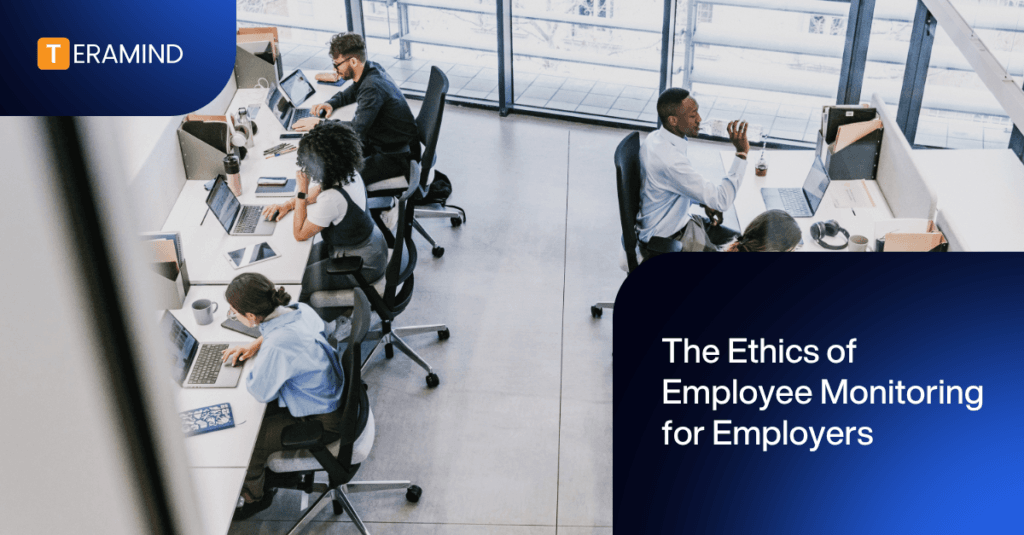
With today’s workforce more distributed than ever, businesses are leaning into tracking tools to keep teams aligned. However, introducing these tools naturally sparks a conversation around employee monitoring ethics.
Our view is that workplace tracking shouldn’t feel like “Big Brother Is Watching You”. When implemented correctly, employee monitoring software serves as a foundation for a healthier, more transparent workplace culture.
Keep reading for Teramind’s take on the ethical issues surrounding employee monitoring.
Is Employee Monitoring Legal?
Most employee monitoring practices are legal under United States law.
The federal Electronic Communications Privacy Act (ECPA) permits electronic monitoring of employee communications for legitimate business purposes. The law allows employers to use employee monitoring software to ensure smooth and safe operations.
The Stored Communications Act also permits employers to monitor employee communications stored on company-owned devices or in company-controlled cloud storage. Employers may legally review text messages or email exchanges on company-owned devices, such as smartphones or laptops.
The exception is on employees’ social media accounts. Employers must obtain employee consent to review an employee’s personal communications and social media accounts if used on a company-owned device, as they still have a reasonable right to privacy.
Why is Employee Monitoring Software Growing in Popularity?
According to Gallup’s survey, 26% of US employees are exclusively remote, while 52% work in a hybrid model and 22% work on-site. 16% of the world’s companies are now fully remote.
A distributed workforce is the main driver behind employee monitoring’s growing popularity, but when you drill down to specifics, there are many reasons why companies are opting to track their employees.
Preventing Insider Threats
Monitoring can be an organization’s best tool to defend against cybercrime or insider threats.
Should a knowledgeable employee consider leaving an organization or start sharing private documents with outside sources, employee monitoring software helps the organization detect the threat before it becomes problematic.
The organization doesn’t have to respond punitively; it may take this discovery as an opportunity to incentivize the employee to stay.
More importantly, employee monitoring can level up cybersecurity by detecting suspicious user activity or unauthorized access to the network. You can view websites visited, installed applications, and saved documents or files to determine risky user activity.
With key insights into the source of potential cyber threats, you can mitigate them more effectively and identify cybersecurity training needs throughout your business.
Improving Security and Productivity
Employee monitoring software isn’t just for safeguarding the organization internally.
Hybrid and remote employees often spend their days on public WiFi at libraries or coffee shops in addition to their home network. A company has no control over the security of networks beyond its own. Employee monitoring helps organizations establish more robust cybersecurity standards for remote and hybrid employees.
Although research from King’s College London shows that productivity increased by 10.5% after employees switched to remote work, there are always exceptions. Monitoring tools track productivity outside the office, which is a good litmus test for whether working remotely suits your employees.
Preventing Data Leaks
Data leaks are disastrous for customers and a company’s reputation. A common way they happen is through internal mishandling of data.
Although data compliance regulations have become more stringent — especially in Europe with the GDPR — all it takes is one individual oversight to cause a data breach.
Monitoring software helps employers enforce data compliance by giving them insight into how their teams handle sensitive data.
Optimizing Business Processes
One of the best uses of employee monitoring software is identifying ways to improve day-to-day operations.
Tools like Teramind give you greater insight into how individuals and teams work. With this information, you get a bird’s-eye view of processes from payroll to inventory processing. Then, if you spot anything not working well, you can make quick adjustments.
Identifying Unproductive Employees
Companies are only as strong as their people. Employee monitoring helps identify less productive employees, whether due to work ethic or talent.
Again, actions taken don’t have to be punitive. If you’re finding many unproductive employees, the question to ask may be why so many people aren’t feeling motivated at your company.
Compliance and Risk Mitigation
Depending on the industry, companies may have various compliance and risk mitigation requirements to uphold. Certain industries may have regulations that require complete organizational buy-in to remain compliant.
Employee monitoring helps enforce those standards and identify potential dangers to the company.
How Do You Ethically Monitor Employees?
Employee monitoring technology has many benefits, but that doesn’t mean employees will celebrate being tracked. You need rank-and-file buy-in to ensure a successful monitoring program.
The bottom line is:
Transparency and a collaborative spirit are crucial to making employees feel comfortable and avoiding a hostile work environment.
Let Employees Know What’s Being Monitored
Don’t make employees guess what is and isn’t being monitored.
Failing to inform employees about monitoring may violate workplace privacy laws and employees’ expectations of privacy. This can hurt employee morale. Consult your legal counsel to ensure that your monitoring efforts comply with the law.
Always inform employees about:
- The data that is and isn’t being collected.
- How the data will be used.
- Who has access to the data.
A good monitoring solution will provide analytics to help managers and employees understand and act on work patterns and behaviors.
Only Monitor Employees on Corporate Devices
Monitoring work-related activities on personal devices without employee consent or knowledge is an invasion of privacy that could result in legal consequences.
You should monitor activity on company-owned devices only, and clearly notify employees that you’re doing so. This is the safest way to remain compliant and retain employee trust.
Encourage Employees to Provide Feedback
A monitoring program shouldn’t feel like micromanagement. It’s an opportunity for the entire organization to improve, so you should invite employee feedback.
Evaluate and state your motivations for implementing such a program, but also ask employees to think about the data they want to see about their work and how they’d like the company to use that data.
Some will have legitimate privacy concerns. However, you may find that your employees are more willing to be monitored if you show them how it will help their career development. Employee engagement is the key to successful workplace monitoring.
Monitor Communication Channels
One of the primary reasons companies use monitoring software is to oversee communication channels to protect their sensitive information.
It’s a smart move for an organization to make, but make sure you’re only monitoring company-centric channels like employee emails, Slack, and texts sent on company-owned devices. Avoid personal social media conversations and general internet usage.
Track Locations with Geolocation
Employee location tracking is a good way to determine whether remote or hybrid workers are working or taking unrequested time off.
But again, be transparent about tracking locations, and only do so on company-owned devices.
Train Employees on Ethics and Compliance
Compliance and ethics regulations are complicated. Some employees will have good knowledge of regulations, but others won’t.
Ethics and compliance training will communicate to your employees why monitoring is essential. It will also level up compliance knowledge across your organization. Which is a win-win!
Check Employee Idle Time
Nobody should be expected to work every second of every day. That said, you do expect employees to work most of their scheduled hours.
Monitoring idle time is one of the most practical applications of employee monitoring software. Ensure your in-office and remote workers know you’re keeping an eye on their behavior and how much time they’re spending away from work, but also tell them it’s okay to take short breaks throughout the day.
Set Up Rules and Alerts to Notify You of Major Issues
Spending your whole day watching what your employees are doing is not a good use of anyone’s time and will make employees resentful.
Instead, set up rules and alerts in your monitoring platform to inform you about suspicious activity, extended idle time, policy violations, and other significant activities you want to know about.
How Do You Implement Employee Monitoring Software?
Understanding the ethics of employee monitoring is a good start.
If you’d like to add employee monitoring to your company policies, here are some best practices for doing so.
Confirm Monitoring Laws in Countries Where You Operate
Every country has different laws regarding monitoring. For instance, while the US is more lax, the EU has stricter rules and regulations.
Confirm both national and local monitoring laws wherever your organization operates.
Choose the Right Tools
Smaller companies may not need very robust monitoring tools. Larger companies will need more advanced monitoring features.
Determine your budget and why you want to monitor employees. Take the time to research and test multiple options before choosing the right tools for your business.
Determine What Needs to be Monitored
Identifying your reasons for monitoring employees is crucial for implementing a successful program.
Not only will it help you be more transparent with your staff, but it will also help you select the best tool for your use case.
Educate Employees About Monitoring Policies
Before implementing a monitoring program, set up some time to speak with employees directly about it.
Ensure they understand what’s being monitored, why it’s being monitored, and how all that data will be used. Explain that it’s not just for the company’s good but also to help reward high performers and increase team success.
Review Monitoring Data Responsibly
As noted in the previous section, setting alerts for specific activities is an excellent way to ensure you only monitor data crucial to your business goals.
You don’t need to monitor the minutiae of everyone’s day-to-day; stay focused on the activities that matter to your legitimate business interests.
Allow Employees to Provide Feedback About Monitoring
Employee buy-in is crucial to a successful monitoring program, and the best way to get it is to encourage employees to give active feedback.
Positive or negative, it doesn’t matter; just ensure that your employees are heard.
Why is Teramind Ideal for Ethical Workplace Monitoring?
Workplace tracking shouldn’t mean sacrificing trust. Teramind balances visibility and data protection with absolute employee respect through several built-in privacy guardrails:
- Transparency First (Revealed Agents): Rather than operating in the shadows, Teramind allows companies to deploy “Revealed Agents”. This grants employees complete visibility and control over when they’re being monitored, boosting engagement and mutual trust.
- Selective Monitoring: To avoid blanket surveillance, tracking policies can be customized to target only work-relevant activities during designated working hours, protecting personal time and boundaries.
- Data Minimization: Teramind strictly collects only the necessary information required for operational intelligence and compliance. This data footprint is restricted to defined retention periods and heavily protected with robust encryption.
- Granular, Role-Based Access: Monitoring parameters are fully customizable to specific teams and departments. Role-based access controls ensure that administrators can restrict who views the monitored data, preventing internal overreach.
- Non-Invasive Security Automation: Instead of forcing management to snoop through raw activity logs, smart behavioral rules and automated alerts handle security in the background. Teramind proactively blocks data exfiltration attempts — such as pasting intellectual property into unauthorized AI platforms or transferring files to unapproved locations — without compromising employee privacy.
Start your free Teramind trial today.
FAQs
What Are Employee Monitoring Ethics?
Employee monitoring ethics are the framework of principles that balance an employer’s need for operational security and productivity with an employee’s fundamental right to privacy.
It ensures that tracking tools are implemented transparently and responsibly to build workplace trust, rather than creating an environment of invasive, blanket surveillance.
What Are Ethical Considerations in Monitoring?
Organizations that monitor employees must be transparent and thorough about the data they collect and why they collect it.
Employees should know exactly what activity is and isn’t being tracked and on what devices. Employers should never monitor non-business-related activity on employees’ personal devices.
Is It Illegal for Employers to Monitor Employees?
US federal law states that monitoring employees is legal so long as it’s done for legitimate business purposes.
Regulations vary from country to country; if you intend to monitor employees in non-US jurisdictions, always consult legal advice in that area.
Is It Ethical for Employers to Monitor Employees Off-duty?
While organizations may monitor employee activity on company-owned devices or platforms, monitoring off-duty activity on personal devices is unethical.
Is Monitoring Employees Ethical or Unethical?
Monitoring employees is ethical if done with complete transparency and for legitimate business reasons.
The purpose of monitoring is to improve employee productivity and performance.
What is the Difference Between Monitoring and Surveillance?
The primary difference between monitoring and surveillance is the purpose behind each activity.
Monitoring is intended to improve employee performance, while surveillance aims to punish workers for minor infractions.
