
The most advanced data loss prevention (DLP) tools in 2026 are those that move beyond rigid, rule-based systems to incorporate AI-driven behavioral analytics.
Leading solutions like Teramind (best for AI agent governance), Microsoft Purview (best for M365 ecosystems), and Symantec (best for network DLP) provide the real-time visibility needed to stop data breaches before they occur.
In today’s workplaces, sensitive information moves faster and across more touchpoints — cloud services, remote devices, and third-party integrations — than traditional security tools can keep up with.
And with roughly 95% of successful cyber-attacks resulting from human error, DLP’s focus has shifted from blocking data movement to understanding intent.
What Are Data Loss Prevention Tools?
Data Loss Prevention (DLP) tools are security platforms designed to identify, monitor, and safeguard sensitive information across your entire digital footprint, including endpoints, networks, and cloud-based applications.
Think of them as high-tech bodyguards, overseeing the places where critical data resides and who interacts with it. They ensure that proprietary information and intellectual property don’t take an unauthorized exit — whether by accident or design.
Today, these tools do far more than just block file transfers; they actively mitigate risks from malicious data exposure, ransomware, and security incidents caused by human error.
By enforcing DLP policies and monitoring user activity in real-time, these solutions also help companies maintain regulatory compliance with global standards like the GDPR, CCPA, HIPAA, and PCI DSS.
Why Do You Need Data Protection Tools in 2026?
Last year, high-profile incidents reminded us that no one is immune.
- Qantas saw the theft of 5.7 million customer records.
- Discord suffered a leak impacting the PII of 70,000 users.
- SonicWall confirmed a data exposure affecting 17,000 organizations.
A robust DLP solution helps you avoid legal and reputational damage by identifying, tracking, and protecting sensitive data across endpoints, networks, and cloud storage.
How Did We Select the 11 Data Loss Prevention Solutions?
Navigating the crowded DLP vendor market requires more than just checking off features.
To build this list, we evaluated providers against the following criteria:
- Context-Aware Visibility: We prioritized platforms that go beyond simple keyword matching to understand the user role, data type, and intent behind every interaction.
- Behavioral Intelligence: Our top picks integrate User and Entity Behavior Analytics (UEBA) to establish baselines and detect anomalies like unauthorized data transfers.
- Automated Remediation: We looked for “set-and-forget” capabilities that can automatically block, encrypt, or quarantine an organization’s data in real-time.
- Ecosystem Integration: We selected tools that play well with others, connecting seamlessly to your existing SIEM, CASB, and EDR platforms.
- Compliance Automation: Each solution was vetted for its ability to simplify audits for data security regulations like the GDPR, HIPAA, and PCI DSS.
What DLP Solutions Should You Consider in 2026?
1. Teramind
Teramind is a leading behavioral DLP and insider risk management platform, providing deep visibility into how company data is used, accessed, and moved.
It continuously tracks user actions across endpoints, applications, and networks to detect risky behavior and block data exfiltration in real-time.
See Teramind in action → Take a self-guided product tour
- Key Feature: Teramind monitors employee interactions with LLMs, apps, and local models directly at the endpoint. It can block sensitive data pastes or unauthorized AI usage before any action is taken.
- Best For: Organizations in highly-regulated sectors that need to detect Shadow AI risks and maintain court-admissible audit trails.
- Pricing: Starts at $14/seat/month; the full DLP tier is $32/seat/month (billed annually).
- Alternatives: Explore a list of Teramind competitors.
2. Mimecast Incydr (formerly Code42 Incydr)
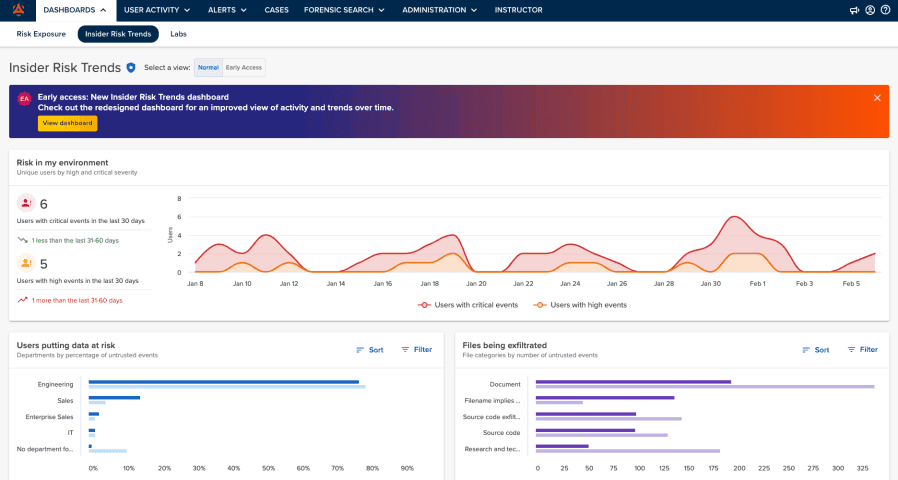
Mimecast Incydr is a cloud-native insider risk management platform that identifies and stops data exfiltration across collaboration channels.
It focuses on context and user behavior to understand who is moving data and how those actions compare to organizational expectations.
- Key Feature: Its PRISM (Proactive Risk Identification and Severity Model) uses AI and machine learning to analyze billions of signals and prioritize the most critical data threats based on user and destination context.
- Best For: Enterprises managing high-risk employee offboarding or needing to stop proprietary IP from leaking into unsanctioned shadow AI platforms.
- Pricing: Contact Mimecast’s sales team for pricing options.
- Alternative: See how Teramind compares to Mimecast Incydr.
3. Symantec DLP
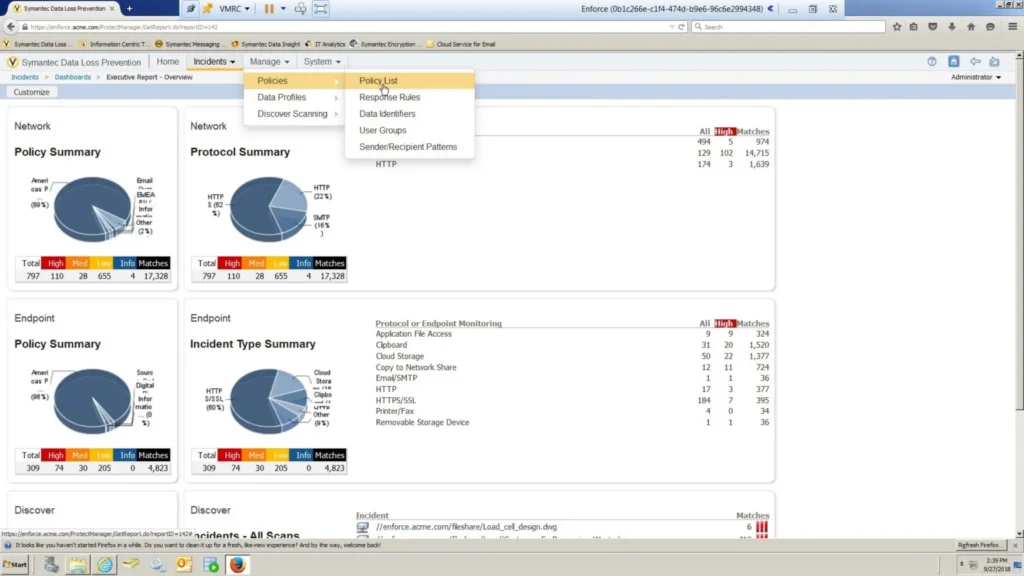
Symantec DLP is a modular enterprise suite that provides data governance across endpoints, networks, and cloud environments.
It offers a unified console to enforce consistent data protection policies wherever your information lives or travels.
- Key Feature: Its Exact Data Matching (EDM) and Indexed Document Matching (IDM) allow for high-fidelity fingerprinting of database records and sensitive documents to detect and block even partial data leakage.
- Best For: Large, highly-regulated organizations with the IT resources required to manage and tune a complex, multi-channel security infrastructure.
- Pricing: Contact Broadcom to see Symantec DLP’s pricing options.
- Alternative: See how Symantec compares to Mimecast Incydr.
4. Fortra DLP (formerly Digital Guardian)
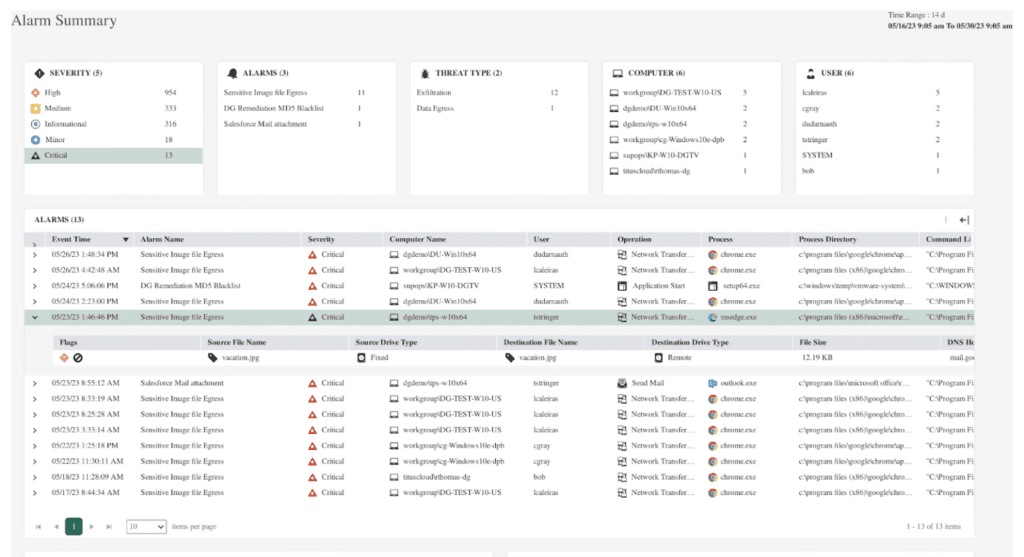
Fortra DLP is a cloud-native or managed service solution that provides deep, endpoint-to-cloud visibility.
It operates at the OS level to capture user activity across Windows, macOS, and Linux environments.
- Key Feature: Its AWS-powered Analytics and Reporting Cloud (ARC), which correlates system, user, and data activity to identify and neutralize complex risks like fileless malware and zero-day attacks.
- Best For: R&D-heavy firms and security teams that need a managed DLP-as-a-Service model to maintain strong protection without high operational overhead.
- Pricing: Fill out a form on Fortra’s website to get a customized quote.
- Alternatives: Explore a list of Fortra competitors.
5. Trellix DLP
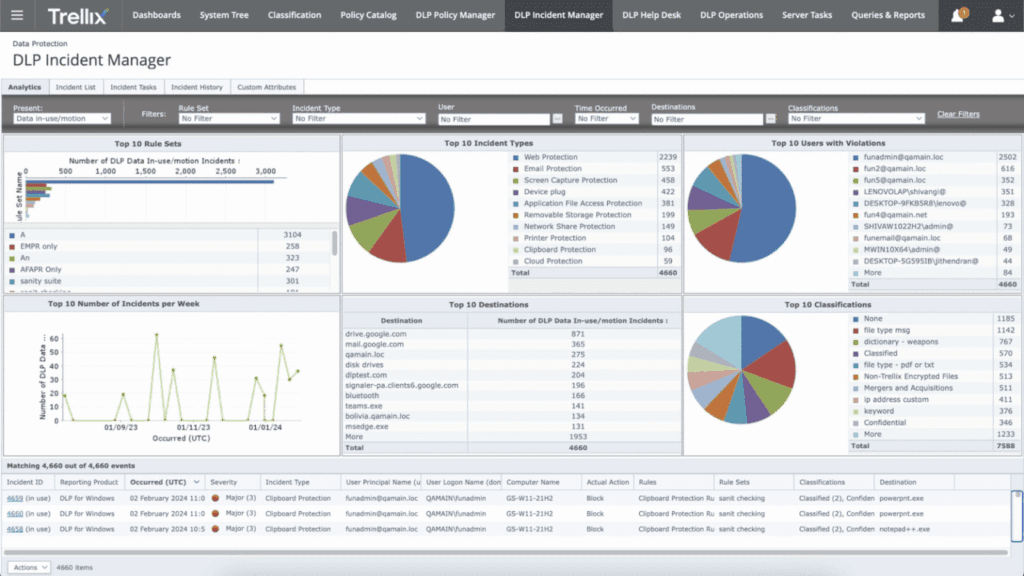
Trellix DLP offers unified, “keyboard-to-cloud” protection and access management.
It combines industry-leading data classification and discovery along with real-time incident response measures.
- Key Feature: Its specialized AI Data Risk Dashboard provides a single place to identify and mitigate exfiltration risks across more than 100 generative AI apps.
- Best For: Enterprises with massive data footprints that need to inventory and protect critical files and manage employee AI use.
- Pricing: Trellix’s pricing isn’t publicly disclosed. Request a demo on its website for more information.
- Alternatives: Explore a list of Trellix DLP competitors.
6. Forcepoint DLP
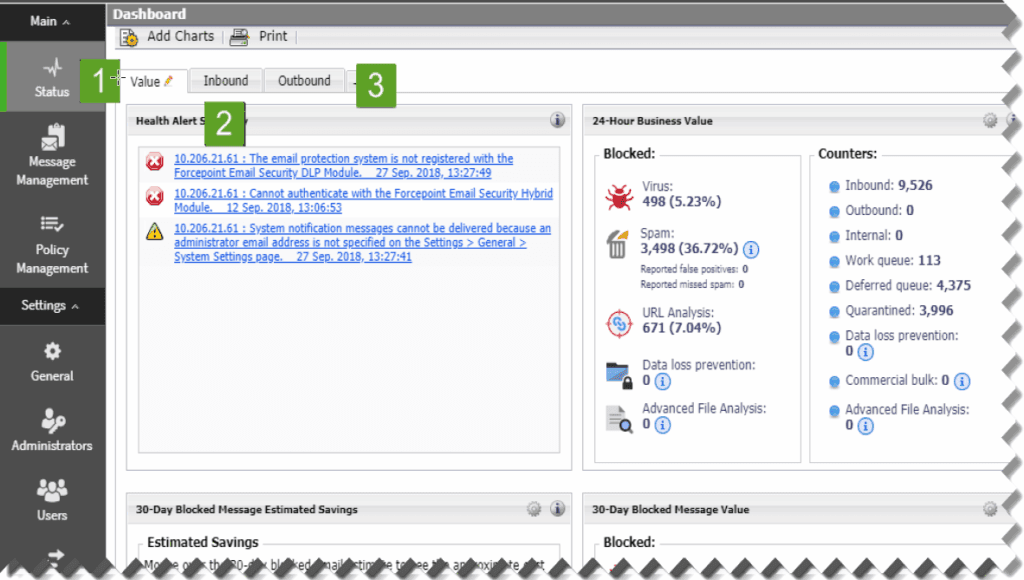
Forcepoint DLP is a unified data security platform that provides real-time, intelligent enforcement and sweeping compliance coverage across AI, cloud, web, email, and endpoints.
- Key Feature: Its Adaptive Risk Intelligence Assistant (ARIA) uses AI to surface insights, recommend protections, and deploy security policies directly through a chat interface.
- Best For: Global enterprises that need to consolidate policy management and ensure regulatory compliance across more than 80 countries.
- Pricing: Visit Forcepoint’s website to request pricing information.
- Alternatives: Explore a list of Forcepoint competitors.
7. Proofpoint DLP
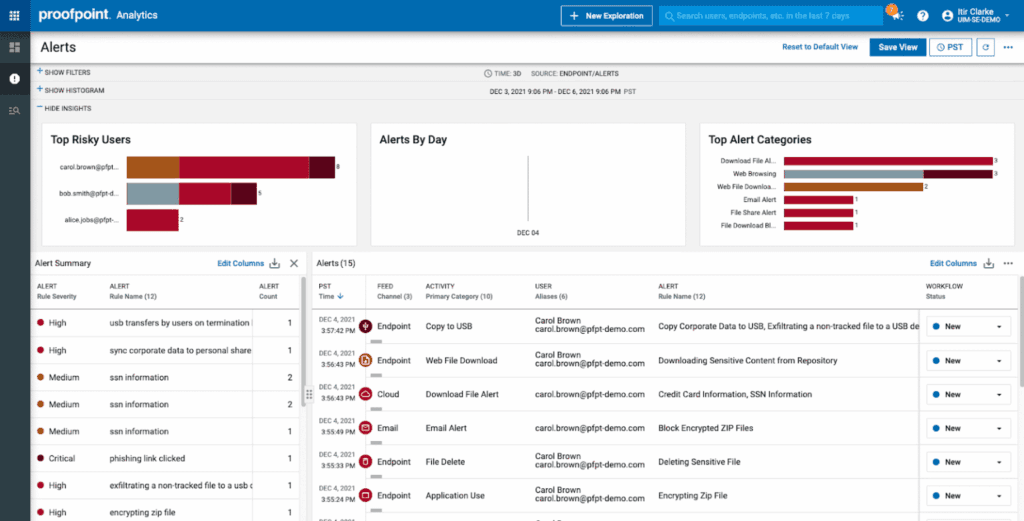
Proofpoint DLP is a human-centric security solution that monitors how workers interact with data across email, cloud applications, and managed and unmanaged endpoints.
- Key Feature: It utilizes Large Language Model (LLM) classifiers to identify and protect sensitive content in real-time.
- Best For: Large-scale enterprises that need to mitigate people-based risks while ensuring data privacy via advanced features like user data anonymization.
- Pricing: Visit Proofpoint’s website to request a quote.
- Alternative: See how Teramind compares to Proofpoint.
8. Microsoft Purview DLP
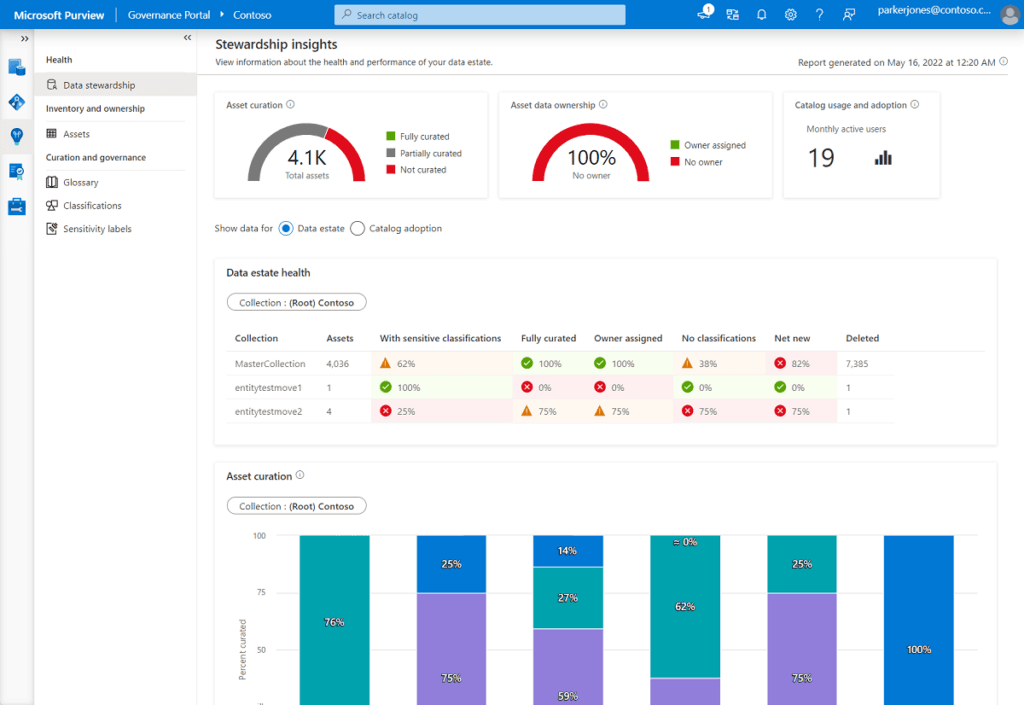
Microsoft Purview is a cloud DLP solution built into the Microsoft 365 ecosystem. It identifies and protects data across apps, email, and devices.
Purview leverages a single management portal to combine data and user context, providing a holistic approach to preventing data leaks.
- Key Feature: Its native integration with the full Microsoft stack, including Security Copilot. This allows organizations to extend data security controls into generative AI interactions and M365 workflows.
- Best For: Organizations heavily invested in Microsoft 365 that need to streamline setup and configuration while managing global compliance requirements.
- Pricing: Visit the Microsoft website for up-to-date pricing information.
9. DTEX
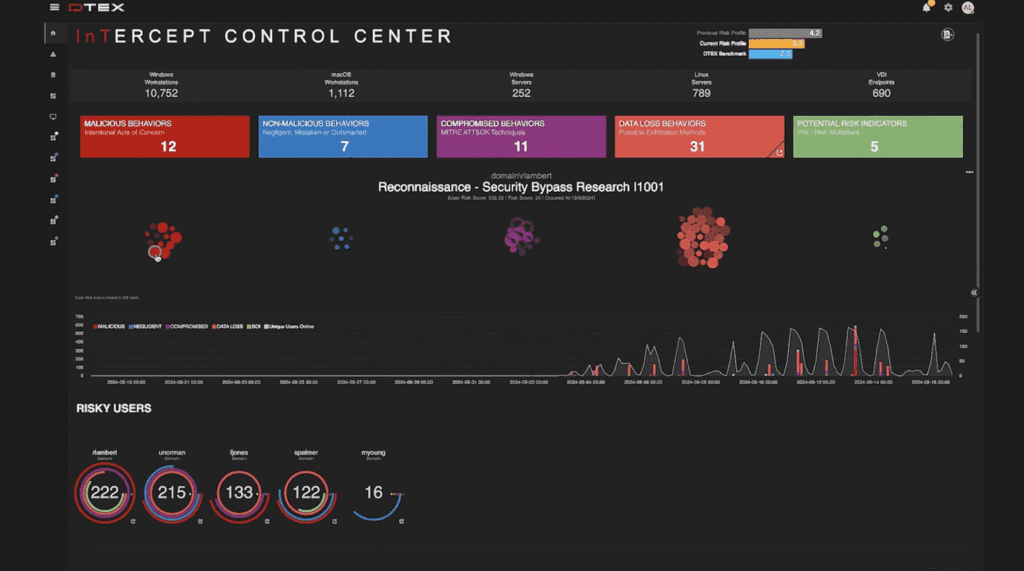
DTEX is a risk-adaptive DLP platform that unifies human, data, and AI risk telemetry to provide a fundamentally different approach to data protection.
It continuously learns from workforce behavior to proactively detect malicious, careless, or compromised activity before a breach occurs.
- Key Feature: Its Risk-Adaptive Framework™ automatically groups users into risk profiles. It then adjusts data protection policies in real-time based on evolving risk scores and behavioral intent.
- Best For: Companies prioritizing pre-exfiltration detection and human behavior visibility, especially those needing to manage access controls to generative AI tools.
- Pricing: Book a demo via DTEX’s website.
- Alternative: See how Teramind compares to DTEX.
10. Cyberhaven
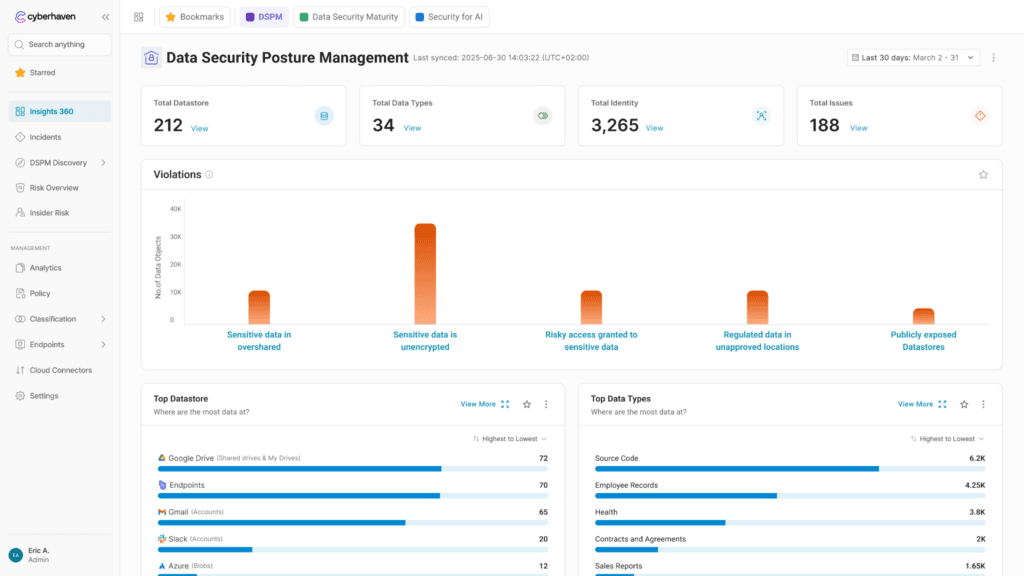
Cyberhaven uses a single product and policy to identify and protect critical information across all data exfiltration channels.
It moves beyond traditional content analysis to understand the full context of how data is used and handled inside a business.
- Key Feature: Its proprietary data lineage technology automatically traces the origin and journey of every data flow. This allows it to protect sensitive assets like source code and product designs that traditional content scanners often miss.
- Best For: High-growth, IP-heavy environments (like technology and SaaS firms) that need to prevent data loss without the high false-positive rates associated with legacy inspection tools.
- Pricing: You must book a demo to see Cyberhaven’s pricing.
- Alternatives: Explore a list of Cyberhaven competitors.
11. Netwrix Endpoint Protector
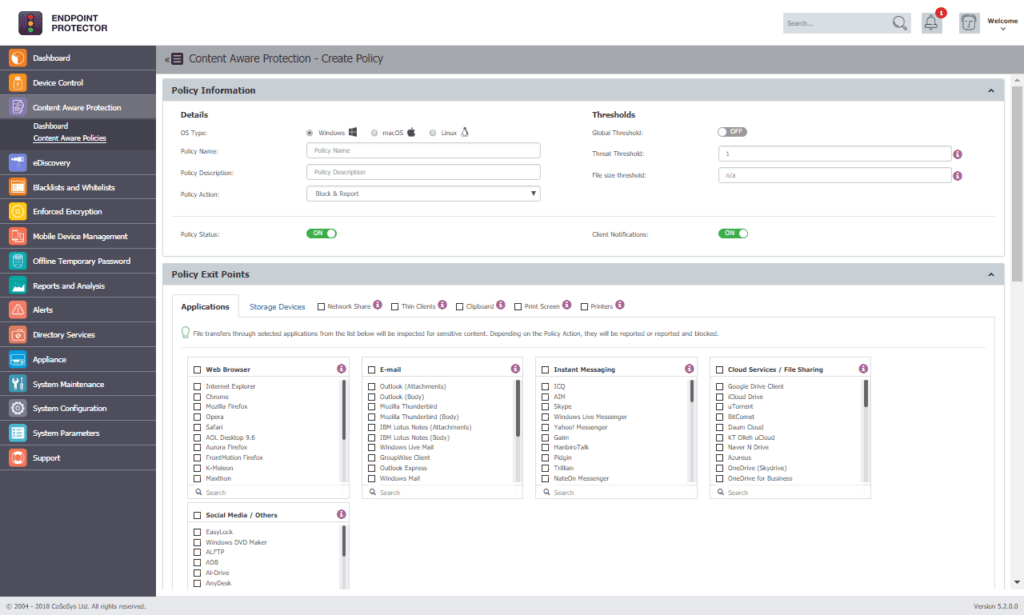
Netwrix Endpoint Protector is a multi-OS endpoint DLP solution.
By monitoring all data interactions and transfers, it secures data across Windows, macOS, and Linux systems.
- Key Feature: It provides granular device control for over 45 classes of peripherals, allowing admins to set rights based on vendor or serial number while enforcing automatic 256-bit AES encryption on authorized USBs.
- Best For: Highly-regulated organizations with mixed-OS fleets that need to maintain strict compliance standards like CMMC, PCI DSS, and GDPR at every endpoint.
- Pricing: Visit Netwrix’s website to request a personalized quote.
How Do the 11 DLP Tools Compare?
| Tool Name | Primary Focus | Best For | Pricing |
|---|---|---|---|
| Teramind | Behavioral DLP & Insider Risk | Highly-regulated sectors needing Shadow AI detection | Starts at $14/seat/month; $32/seat/month for DLP |
| Mimecast Incydr | Cloud-Native Insider Risk | High-risk employee offboarding & Shadow AI prevention | Contact sales for options |
| Symantec DLP | Modular Enterprise Governance | Large organizations with complex multi-channel needs | Contact Broadcom for options |
| Fortra DLP | Endpoint-to-Cloud Visibility | R&D-heavy firms & resource-limited security teams | Customized quote via form |
| Trellix DLP | Unified keyboard-to-cloud security | Enterprises with massive data footprints & AI usage | Request a demo on website |
| Forcepoint DLP | Unified AI, Cloud & Web Security | Global enterprises needing consolidated policy management | Request pricing on website |
| Proofpoint DLP | Human-Centric Security | Mitigating people-based risks in large-scale enterprises | Request a quote on website |
| Microsoft Purview | Cloud-Native M365 Integration | Organizations heavily invested in Microsoft 365 | Visit website for information |
| DTEX | Risk-Adaptive Behavioral Intelligence | Pre-exfiltration detection & human behavior visibility | Book a demo on website |
| Cyberhaven | Single-Product Data Lineage | High-growth Tech/SaaS firms protecting IP | Book a demo for pricing |
| Netwrix Endpoint Protector | Multi-OS Endpoint Security | Highly-regulated mixed-OS fleets (Windows, macOS, Linux) | Personalized quote on website |
What Should You Look for in a Modern DLP Tool?
To choose the right tool, you must align features with your business model. We recommend looking out for the following:
- Data Discovery: Look for platforms that can automatically identify unstructured data in formats like chat logs and PDFs.
- Policy Flexibility: Ensure the tool offers context-aware policies that can adapt based on user roles and AI insider risk levels.
- Behavior Analytics: High-performing tools use UEBA (User and Entity Behavior Analytics) to reduce false positives by learning normal activity patterns.
- Ecosystem Compatibility: Large enterprises should prioritize tools that connect with existing SIEM, EDR, and IAM platforms.
What is the Best Data Security Tool for 2026?
When it comes to protecting your most sensitive assets, there is no single “best tool” for every organization.
The right choice depends entirely on your infrastructure and security priorities — whether you need native Microsoft 365 integration, zero-trust content inspection, or comprehensive multi-OS support for mixed device fleets.
For regulated industries and enterprises, Teramind stands out as an ideal choice. Why?
Because it monitors user activity in real-time and provides context-aware AI governance directly at the endpoint. By understanding intent rather than just blocking actions, Teramind ensures your security posture remains airtight without disrupting legitimate business workflows.
Marble Box, the insurance outsourcing service, used Teramind to power its data loss prevention strategy. They told us:
“The primary use of Teramind was to work like a CCTV camera — what activities users are doing on their desktops, and if there is any type of data they are taking or emailing somewhere else that we need to track.”
Want to see the difference Teramind can make? Request your free trial here.
