
Enterprise AI Insider Risk Management
Detect, investigate, and block high-risk behaviors in real-time across endpoints, GenAI apps, non-human identities, and autonomous agents — powered by behavioral AI and forensic intelligence.
Why Enterprises Trust Teramind To Prevent AI Insider Threats
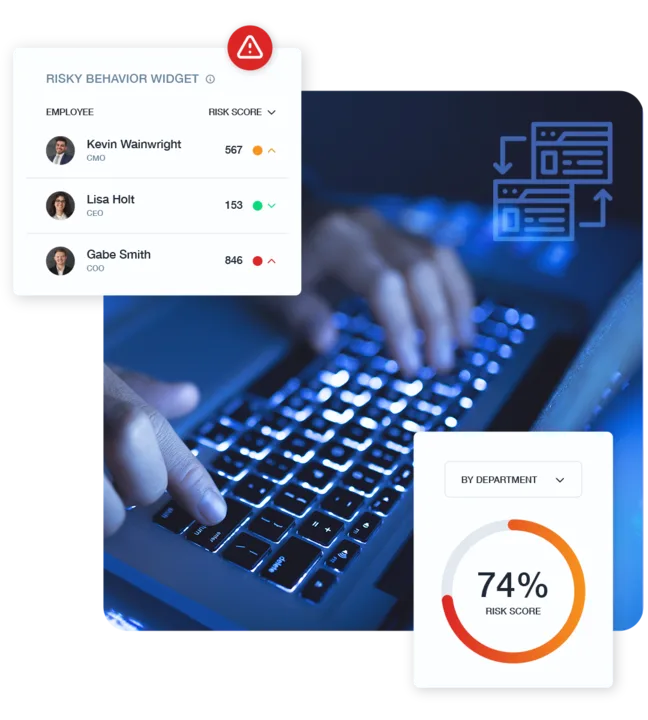
Accelerate triage with automated insider threat detection and instant session reconstruction.
Filter out benign operational noise via context-aware behavioral baselines and anomaly detection.
Capture undeniable, high-definition visual context for every AI policy violation and risk indicator.
How Teramind Provides An AI-Powered Defense
Teramind consolidates user activity monitoring, behavioral analytics, data loss prevention, process mining, and digital forensics into a single platform.
| Feature | Focus / Capabilities | Teramind Advantage |
|---|---|---|
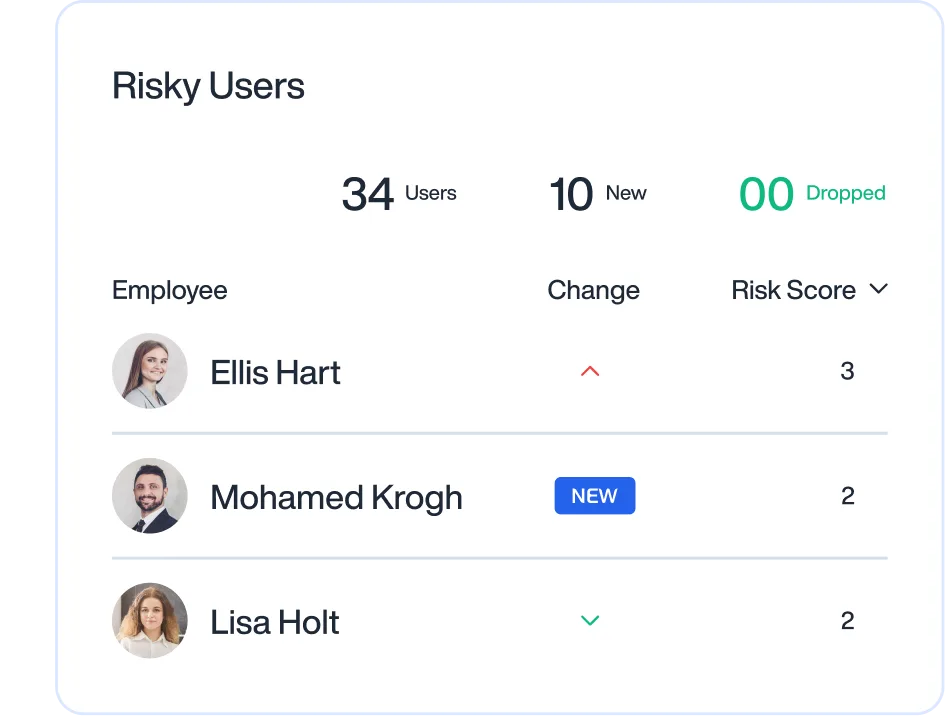
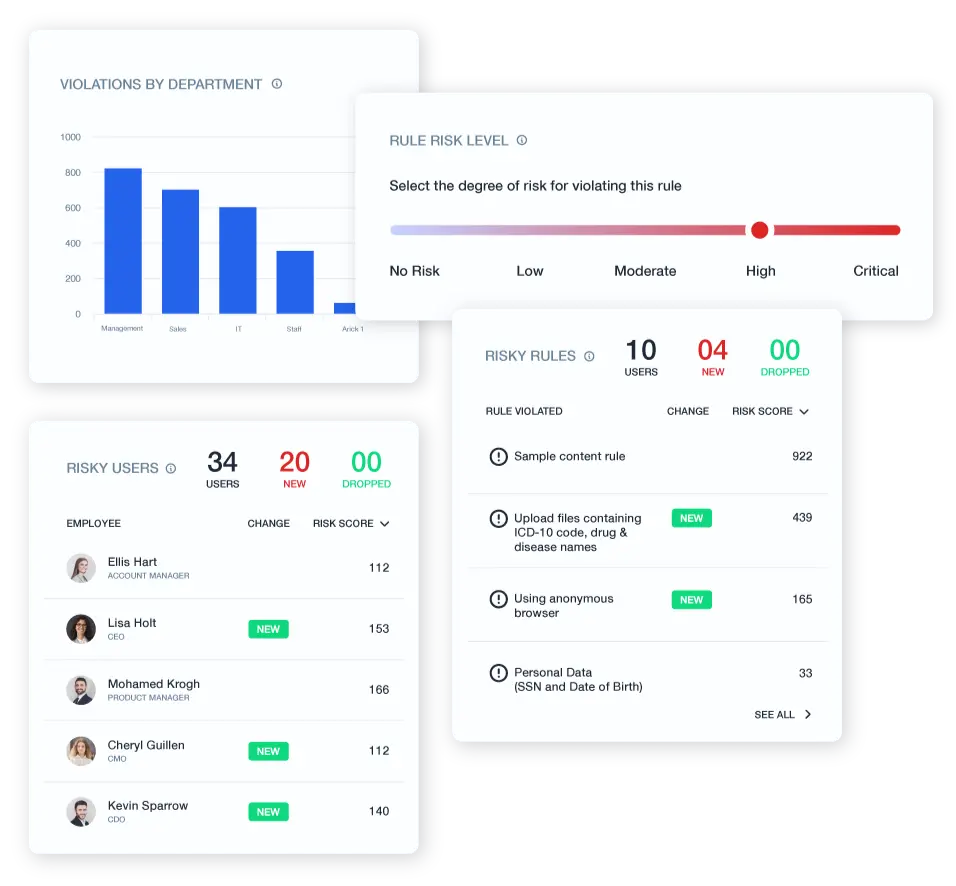
| User & Entity Behavior Analytics (UEBA) | Anomaly detection, dynamic risk scoring, baseline behavior tracking, threat detection | Learns individual & peer baselines to spot anomalous intent early, continuously adjusting risk scores without needing manual tuning |
| Intelligent DLP & Patented OCR | On-screen data tracking, clipboard monitoring, GenAI misuse prevention, sensitive data discovery | Powered by a patented real-time OCR engine that extracts, indexes, and searches text embedded inside live screens, video streams, images, and unencrypted file attachments |
| Agentic AI & GenAI Governance | Autonomous agent oversight, LLM prompt inspection, account guardrails, terminal shell governance | Delivers dedicated oversight for autonomous AI agents (e.g., OpenClaw, Claude Code), tracking command execution, detecting velocity anomalies, and attributing machine actions to human users |
| In-App Field Parsing & Process Mining | Form-field level tracking, SOP compliance auditing, workflow sequence mapping, friction analysis | Captures telemetry at the individual field level across enterprise software to map process sequences, identify operational bottlenecks, and detect policy workarounds |
| Forensic Session Playback | Video audit trails, incident reconstruction, SOC investigation, immutable log generation | Provides full-context, frame-by-frame video recording of high-risk actions before, during, and after a policy triggers |
| Autonomous Risk Mitigation | Real-time policy enforcement, session termination, access revocation, step-up authentication | Executes automated, rule-based actions that prevent data exfiltration instantly while protecting operational workflows |
How Teramind Mitigates Enterprise Internal Threats
Teramind addresses enterprise operational challenges with tailored security policies and behavioral monitoring for human and non-human identities.
IP & Data Exfiltration Protection
Protect your intellectual property, source code, trade secrets, and customer records across 15+ channels.
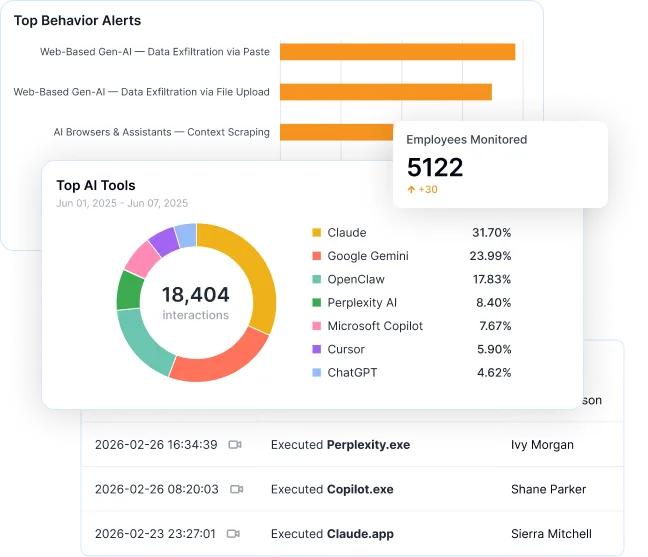
Generative AI Control: Prevent data exposure by controlling what employees upload or paste into web-based Large Language Models (LLMs).
Agentic AI Monitoring: Track and secure autonomous AI agents running in terminal shells, capture command transcripts, and detect superhuman execution speeds.
Patented Visual Data Inspection: Leverage patented real-time Optical Character Recognition (OCR) to scan live user displays and block exfiltration attempts occurring inside unencrypted files, images, or remote desktop sessions.
High-Risk Employee & Offboarding Monitoring
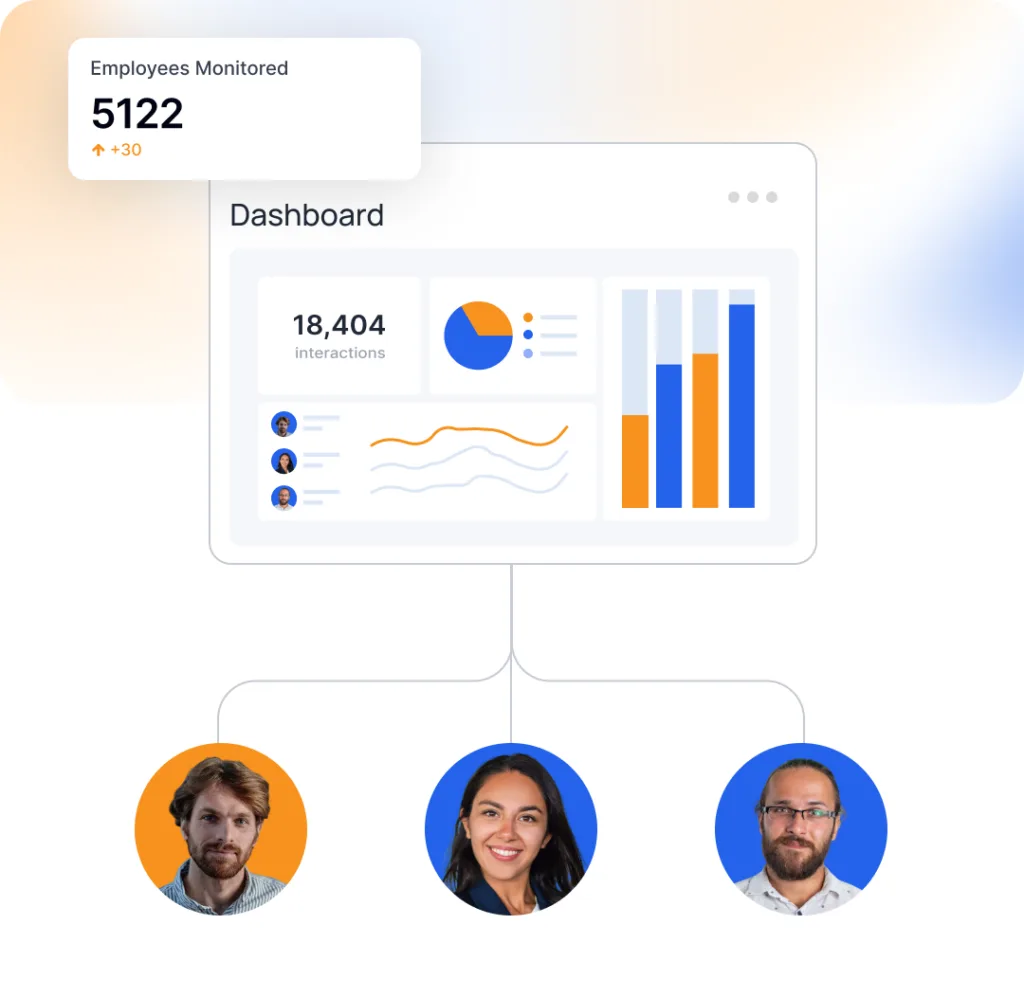
Defend your organization against AI data theft incidents caused by employees who have resigned, received notice of termination, or are undergoing formal performance management.
Flight-Risk Behavioral Indicators: Track precursor indicators such as sudden spikes in file downloads, late-night system logins, mass cloud directory exports, or active job hunting on company assets.
Offboarding Guardrails: Automatically transition departing staff into elevated monitoring profiles 30 to 90 days before their departure date, restricting personal cloud connections and bulk file exports.
Post-Departure Audit Reporting: Generate complete data handling reports for departing personnel to verify that no proprietary assets were retained on personal hardware or cloud storage.
Privileged & Third-Party Access Misuse
Prevent disruption caused by the misused or compromised accounts of your system administrators, third-party vendors, contractors, and managed service providers (MSPs).
Vendor and Contractor Oversight: Apply targeted monitoring to external accounts without installing intrusive infrastructure on non-owned endpoints.
Privileged Abuse Prevention: Monitor administrative console access, database queries, registry changes, and system configuration modifications to ensure strict adherence to least-privilege standards.
Third-Party Session Auditing: Maintain unambiguous, time-stamped visual audit logs of external vendor maintenance windows to ensure strict compliance with service level agreements (SLAs).
Accidental & Unintentional Policy Abuse
Mitigate the organizational damage caused by negligent practices, intentional workarounds, and accidental employee oversights.
In-App Field Parsing & Process Mining: Audit standard operating procedure (SOP) compliance by capturing inputs at the individual form-field level. Identify overly complex security workflows that push well-meaning employees toward unauthorized “Shadow IT” workarounds.
Differentiating Intent from Ignorance: Use behavioral machine learning to distinguish between an inadvertent copy-paste error and an insider intentionally exfiltrating database records.
Real-Time Nudge Notifications: Deliver inline micro-training alerts when users perform risky operations, such as sharing sensitive cloud documents via unrestricted public links.
Why Choose Teramind Over Legacy IRM Tools
Traditional DLP and legacy Insider Risk Management (IRM) solutions rely heavily on static, rule-based policies and regex matching. These legacy tools flood security teams with false positives while providing zero visibility into real user intent.
Teramind fuses behavioral analytics with immutable video evidence, accelerating threat detection and enabling rapid investigation.
| Operational Capability | Legacy DLP & Traditional IRM | Teramind AI Insider Risk Management |
|---|---|---|
| Detection Methodology | Static keyword lists, regex rules, rigid IP policies | Dynamic machine learning, UEBA, behavioral baselines |
| GenAI Visibility | Basic domain blocking or binary URL filtering | Real-time prompt inspection, clipboard OCR, payload blocking |
| Autonomous AI Oversight | Limited to basic web URL filtering for known AI sites | Agentic AI monitoring tracks headless scripts, terminal commands, and attributes machine actions to human accounts |
| False Positive Rate | Extremely high; creates severe SOC alert fatigue | Minimal; refined by contextual behavioral score analysis |
| Investigation Evidence | Cryptic text log files, IP timestamps, system events | High-definition video replay with searchable OCR text overlay |
| Text Extraction Capabilities | Blind to visual on-screen text, images, and video streams | Patented real-time OCR extracts and indexes text directly from live screens and recordings |
| Response Capability | Manual triage or slow policy synchronization delays | Autonomous real-time blocking, session locking, process termination |
| Deployment Overhead | Months of rule tuning, complex server footprints | Rapid cloud, hybrid, or on-premises deployment architecture |
How Teramind Manages Compliance, Privacy, and Trust
Teramind is trusted by government agencies, financial institutions, healthcare providers, and enterprise security leaders worldwide to protect critical digital assets while adhering to global privacy mandates.
Comprehensive Regulatory Compliance Mapping
Teramind features pre-configured compliance dashboards, automated policy templates, and audit-ready reporting frameworks aligned with international security standards.
NIST SP 800-53 / 800-171: Meets technical controls for continuous user monitoring, access control, audit logging, and insider threat program management.
ISO/IEC 27001: Validates organizational controls surrounding asset management, human resource security, access control, and operational security.
HIPAA / HITECH: Safeguards Electronic Protected Health Information (ePHI) through granular access tracking, OCR content scanning, and encrypted session logs.
GDPR & CCPA: Supports European and regional data privacy requirements through customizable data anonymization and explicit user notification controls.
SOC 2 Type II: Provides verifiable operational evidence of continuous security monitoring, processing integrity, and data confidentiality.
Privacy-First Architecture By Design
Teramind provides granular privacy controls that safeguard employee personal data while maintaining essential security coverage.
PII and Sensitive Data Masking: Automatically blur sensitive personal information, banking details, personal webmail credentials, or medical data on employee screens during video recording.
Role-Based Access Control (RBAC): Restrict access to monitoring data based on administrator roles, requiring multi-party authorization protocols to view unmasked video logs.
Selective Monitoring Schedules: Define precise monitoring parameters based on working hours, geo-fencing location, IP ranges, or corporate network connection status to ensure off-hours personal privacy.
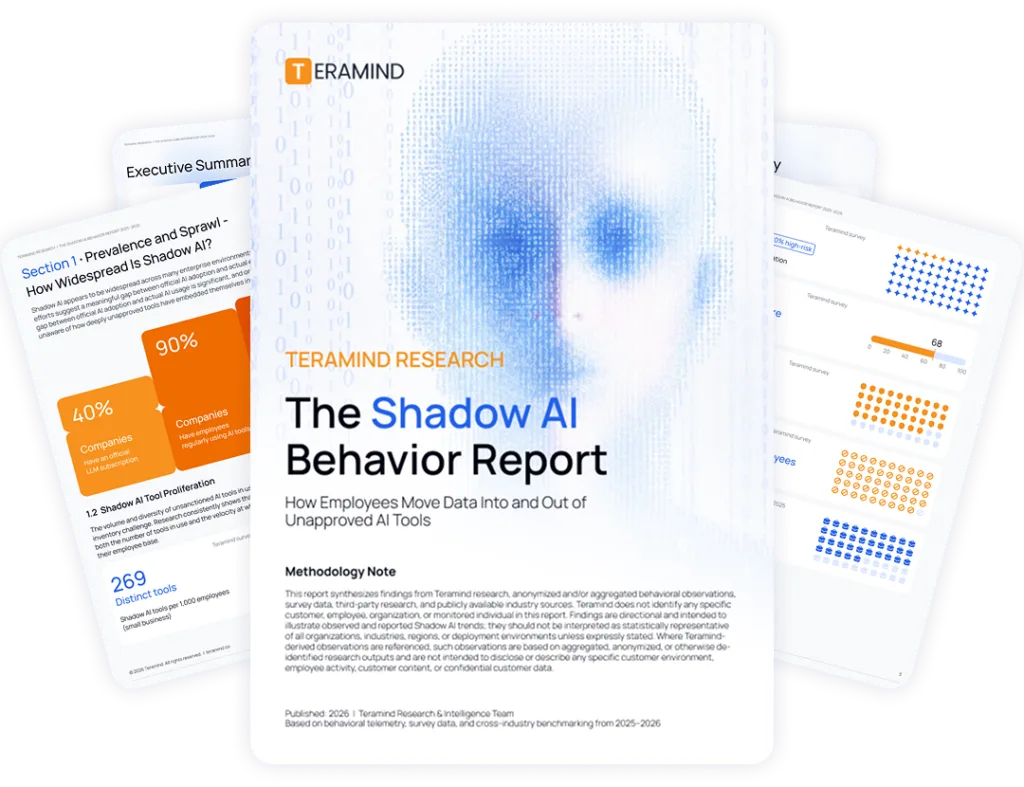
Download Teramind’s Shadow AI Behavior Report
Uncover how 89% of workplace AI activity escapes legacy governance through approved enterprise tools.
Gain critical research into data movement risks — including prompt data leakage, source code uploads, and unvetted plugins — and get a pragmatic 4-step blueprint (Discover, Assess, Govern, Enable) to secure AI adoption without slowing innovation.
Try Platform
With a Live Demo
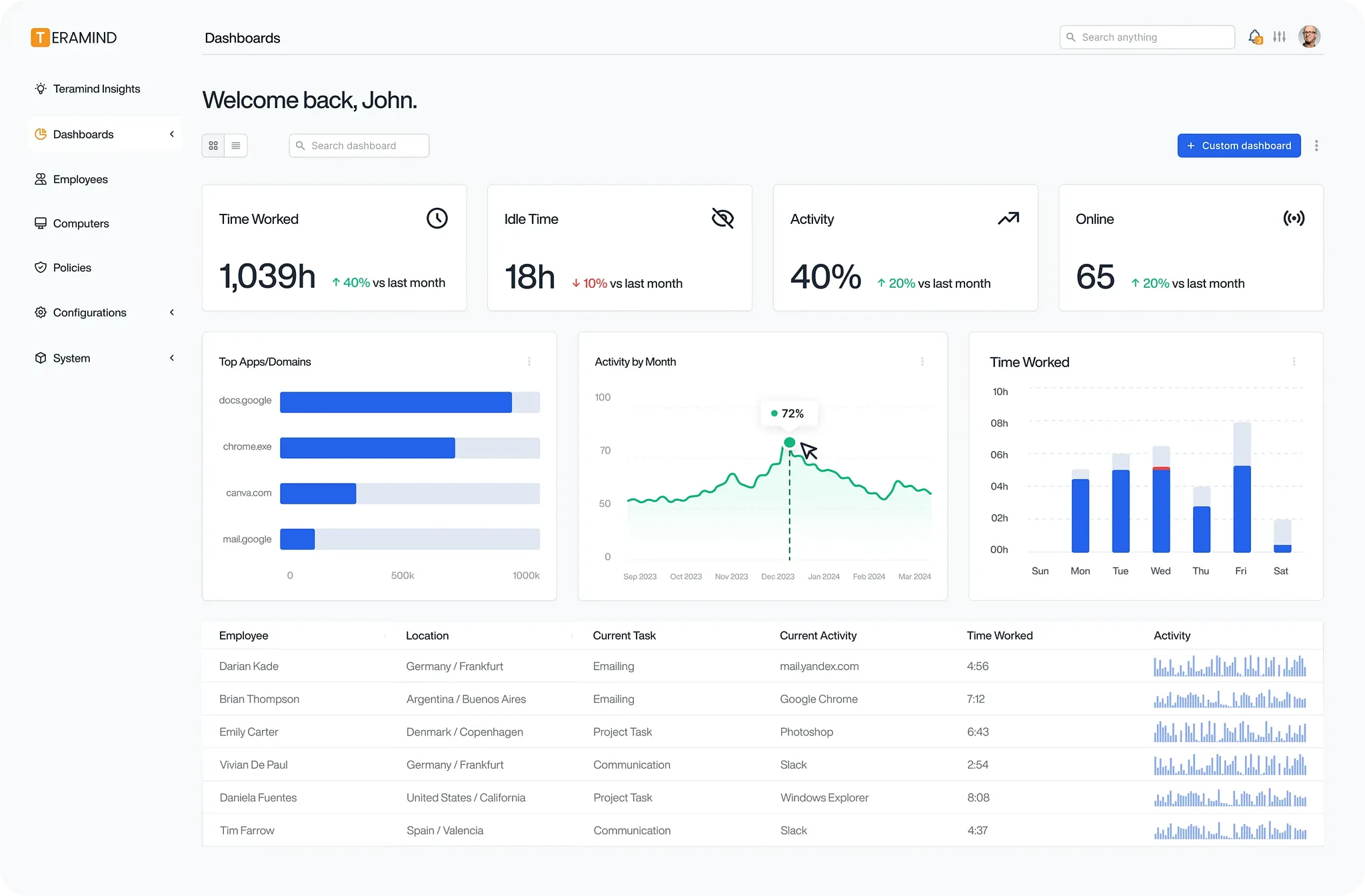
Interact with a live deployment of Teramind to see how it works.
FAQs
What is AI insider risk management?
AI insider risk management is a proactive cybersecurity discipline that combines Machine Learning (ML), User and Entity Behavior Analytics (UEBA), and automated response controls to detect, evaluate, and mitigate internal security risks — such as data exfiltration, privilege abuse, and AI policy violations — before damage occurs.
AI insider risk management leverages continuous machine learning models to analyze multi-channel telemetry — including keystrokes, application usage, cloud file synchronization, and network traffic.
By evaluating individual and peer behavioral baselines in real-time, security teams gain immediate visibility into high-risk deviations. This enables security operations center (SOC) analysts to intercept security incidents before intellectual property or sensitive corporate data leaves the enterprise boundary.
Who is AI insider risk management for?
AI insider risk management is best suited for mid-market companies, large enterprises, and public sector agencies operating across hybrid, remote, and on-premises environments.
The solution serves key enterprise leadership roles and regulated industry sectors:
CISOs & Security Operations Teams: Security leaders who need to detect complex internal threats, prevent data exfiltration, mitigate non-human identity risks, and automate real-time incident containment across digital endpoints.
Compliance, Risk & Privacy Officers: Risk managers in highly regulated sectors (e.g., Financial Services, Healthcare, and Government) requiring audit-ready telemetry, pre-configured policy templates, and evidence packages aligned with HIPAA, GDPR, PCI DSS, SOC 2, and NIST mandates.
IT & System Administrators: IT teams seeking centralized, multi-channel system visibility, streamlined software governance, and granular role-based access controls (RBAC) across Windows, macOS, Linux, and virtual desktop infrastructure (VDI).
HR, Legal & People Operations: HR professionals and legal investigators who rely on forensic video session replay and objective behavioral telemetry to resolve workplace policy violations, mitigate insider fraud, and conduct fair, defensible investigations.
What is the difference between User Activity Monitoring (UAM) and AI IRM?
Traditional User Activity Monitoring (UAM) focuses primarily on capturing broad operational data like active time vs. idle time, keystrokes, and software usage for productivity tracking.
AI Insider Risk Management (AI IRM) focuses on security threat evaluation and risk containment. AI IRM ingests continuous user activity telemetry into predictive machine learning models to:
Detect subtle behavioral anomalies.
Dynamically score threat severity.
Identify risk patterns across peer cohorts.
Execute automated response protocols to prevent security breaches and intellectual property exfiltration.
What types of insider threats does Teramind detect?
Teramind leverages User and Entity Behavior Analytics (UEBA), machine learning algorithms, and multi-channel endpoint monitoring to detect both intentional malicious attacks and unintentional policy breaches across human users, non-human identities, and autonomous AI agents.
The platform continuously evaluates workstation activity signals to identify six primary categories of insider threats:
Data Exfiltration & Intellectual Property Theft: Detects unauthorized transfers of sensitive source code, customer records, trade secrets, and financial data via USB drives, web uploads, cloud storage services, email attachments, clipboard copying, and physical document printing.
Shadow AI & Generative AI Data Exposure: Identifies and blocks unsanctioned generative AI tools, prompt data leakage, unvetted browser extensions, and restricted file or code uploads into public LLMs like ChatGPT, Claude, Copilot, and Gemini.
Non-Human Identity & Agentic AI Risks: Monitors autonomous AI agents (such as OpenClaw or Claude Code) and service accounts by analyzing terminal command velocity (PowerShell, CMD) to catch hidden automated scripts and superhuman execution speeds.
Privileged Access Misuse & Credential Abuse: Tracks anomalous system access, off-hours login activity, unauthorized privilege escalation, and suspicious behavior originating from compromised employee accounts or elevated admin profiles.
Insider Fraud & Financial Data Tampering: Uncovers unauthorized account access, form-field-level manipulation in SaaS/ERP tools, timecard fraud, and unauthorized customer account views.
Negligent Behavior & Policy Violations: Flags unintentional employee mistakes before data breaches occur, including unencrypted data sharing, accidental PHI/PII exposure, and non-compliance with HIPAA, GDPR, PCI DSS, and SOC 2 frameworks.
How does Teramind monitor GenAI tools and autonomous AI agents?
Teramind provides endpoint-centric AI governance across web chatbots, desktop apps, AI assistants, and command-line AI tools.
Through its agentic AI monitoring, Teramind inspects prompt inputs, clipboard pastes, and terminal commands executed by autonomous agents (such as OpenClaw or Claude Code). It uses patented OCR and behavioral velocity detection to halt unauthorized data transfers instantly.
How does Teramind AI insider risk management detect exfiltration in GenAI applications?
Teramind monitors generative AI platforms, such as ChatGPT, Claude, and internal LLM deployments, through a combination of browser content inspection, clipboard tracking, and real-time Optical Character Recognition (OCR).
When a user attempts to paste, upload, or prompt confidential source code, trade secrets, or customer PII into an AI web application, Teramind’s machine learning engine evaluates the text content and context against organizational data policies.
The system can immediately obscure sensitive input fields, display real-time warning notifications, or completely block the network transmission before the data reaches external AI cloud servers.
How does Teramind balance employee privacy with threat protection?
Teramind is built with a privacy-first framework.
Organizations can configure strict role-based access controls (RBAC) to limit who can access employee activity logs. Features such as dynamic PII masking automatically obscure sensitive personal data (e.g., passwords, credit card numbers, healthcare records) on screen capture recordings.
Furthermore, monitoring can be limited to active business hours or specific corporate networks; this ensures that personal activities on personal devices or off-hours work remain completely private and unmonitored.
Can Teramind deploy on-premises, in the cloud, or as a hybrid solution?
Yes. Teramind offers flexible deployment architectures tailored to meet diverse enterprise security and infrastructure requirements.
Teramind can be:
Deployed as a fully managed SaaS cloud instance (AWS/Azure).
Hosted in private cloud environments.
Installed completely on-premises within air-gapped network infrastructure.
Configured as a hybrid deployment.
All deployment options retain full access to Teramind’s core capabilities, including behavioral analytics, OCR detection, session recording, and automated risk response engines.