As artificial intelligence becomes deeply woven into daily workflows, employees are adopting unapproved AI apps at an unprecedented pace.
According to Teramind’s Shadow AI Behavior Report, a staggering 89% of workplace AI usage occurs outside enterprise-governed channels, leaving 86% of organizations blind as to how corporate data flows in and out of these tools.
From pasting confidential source code into public chatbots to uploading sensitive customer records through personal accounts, unsanctioned software creates severe security, compliance, and IP exposure risks.
To regain control and protect sensitive corporate data, security teams need specialized Shadow AI detection tools. Below, we evaluate the top 10 solutions designed to discover, monitor, and govern unmanaged AI activity across your enterprise.
How Did We Select the Top Shadow AI Detection Tools?
Evaluating enterprise Shadow AI detection software requires looking beyond high-level web traffic monitoring to see how platforms handle complex data movement, local models, and agentic workflows.
We assessed each solution against six technical and operational criteria:
- Multi-Surface AI Discovery: We evaluated each platform’s ability to uncover unsanctioned generative AI usage across web browsers, native desktop software, browser extensions, developer CLIs, and background SaaS-to-SaaS API connections.
- AI Data Loss Prevention and Prompt Inspection: We prioritized tools capable of inspecting text prompts, file attachments, and clipboard copy-paste actions in real-time to prevent sensitive corporate IP, customer PII, and source code from leaking into external models.
- Agentic AI and Infrastructure Coverage: We assessed support for monitoring autonomous AI agents, IDE-integrated coding assistants, local LLM frameworks, and Model Context Protocol (MCP) server traffic.
- Proactive AI Policy Enforcement: We focused on direct intervention capabilities — such as inline user coaching, automated prompt blocking, session termination, or automated behavioral nudges — rather than passive post-incident alerting.
- Identity and Contextual Telemetry: We chose solutions that can map AI interactions directly to specific human users, non-human identities, or departmental cost centers by correlating SSO, identity provider, and finance data.
- Enterprise Deployability and Compliance: We looked for enterprise-grade scalability, audit-ready forensic logging, and flexible deployment architecture across endpoint agents, network proxies, or cloud-native ecosystems.
How Do the Best Shadow AI Detection Tools Compare?
| Tool | Primary Detection Layer | CLI & Endpoint Agentic AI Tracking | Full Prompt & Response Logging | Real-Time Intervention | Live On-Screen OCR | 360° Multi-Channel Endpoint DLP | On-Premises / Private Cloud Parity |
|---|---|---|---|---|---|---|---|
| Teramind | Endpoint Agent & User Activity Monitoring | Full (Desktop apps, extensions, & CLI agents) | Yes (Full transcripts & session playback) | Yes (Automated block, warn, or session lock) | Yes (Patented real-time OCR engine) | Yes (15+ system channels & USB/print) | Yes (Cloud, On-Prem, AWS/Azure) |
| Cyberhaven | Endpoint Data Lineage Graph | Full (IDEs, CLIs, local models, MCP) | Yes (Contextual execution lifecycle) | Yes (Runtime block, warn, or redact) | No (Focuses on file & string lineage) | Partial (Lineage-based data movement) | No (Cloud-native platform) |
| Akamai Workforce Protector | Native Browser Session Extension | Partial (Browser & desktop web apps) | Yes (In-session prompts & text inputs) | Yes (Inline block, warn, or redact) | No | Partial (In-session clipboard & uploads) | No (Cloud browser extension) |
| Netskope One | Cloud SASE/SSE Gateway | Partial (MCP Agentic Broker & cloud traffic) | Partial (Inline network traffic inspection) | Yes (Inline network block & coaching) | No (Cloud DLP file/image inspection) | Partial (Optional module available) | No (NewEdge private security cloud) |
| CloudEagle.ai | Identity, Spend & SaaS Integration | No (Focuses on SSO, browser & finance logs) | No (Focuses on token & model cost metrics) | Partial (App access approval & blocking) | No | No (SaaS & FinOps focused) | No (Cloud SaaS) |
| Reco | Identity Graph & OAuth Governance | No (Monitors SaaS APIs & non-human identities) | No | Partial (OAuth revocation & access workflows) | No | No (Identity & API focused) | No (Cloud SaaS) |
| Harmonic Security | Browser Extension & Local SLMs | Yes (Workstation agents & browser tools) | Yes (Prompt & intent logging) | Yes (Local SLM prompt redaction & warning) | No | Partial (Interaction layer focused) | No (Cloud SaaS) |
| Nudge Security | Identity & Email Discovery | No (Discovers accounts via identity & workspace) | No | No (Uses automated “nudge” employee prompts) | No | No (Identity & SaaS focused) | No (Cloud SaaS) |
| Microsoft Purview | M365 Ecosystem & Cloud DSPM | Partial (Microsoft 365 Copilots & M365 Agents) | Yes (Copilot & M365 interaction logs) | Yes (Sensitivity labels & M365 DLP) | Yes (Purview OCR engine) | Partial (Windows & M365 endpoint scope) | No (Hosted on Azure/M365) |
| Proofpoint AI Security | Agentic Workspace & MCP Gateway | Full (IDEs, Ollama, local models, MCP) | Yes (Interaction & agent transaction logs) | Yes (Runtime block, redact, & moderate) | No | Partial (Agentic & prompt interaction scope) | No (Cloud/Hybrid) |
What Are the Top Shadow AI Discovery Tools?
1. Teramind
Teramind is a unified workforce activity monitoring, insider risk management, and data loss prevention (DLP) platform that provides complete visibility into human and non-human identities on endpoint devices.
It tracks user actions across SaaS environments, desktop software, file uploads, and system channels to detect policy violations and prevent AI data leakage in real-time. Security and IT teams leverage its continuous behavioral baselining, OCR indexing, and session playback to defend corporate data assets.
Key Differentiator
Teramind delivers endpoint-centric governance for generative AI tools and AI agents, including ChatGPT, Claude, Copilot, and Gemini.
The platform extends visibility beyond web browsers into desktop AI apps, browser extensions, and AI coding assistants. It provides forensic audit trails via prompt-and-response recording and PowerShell/CMD transcript capturing. It uses behavioral velocity detection to flag automated scripts and can block sensitive data from being pasted into unapproved AI tools.
Additionally, Teramind ships with 11 pre-configured AI behavioral rules for instant out-of-the-box enforcement.
Best For
CISOs, IT security leaders, and compliance officers in heavily regulated mid-market to enterprise organizations, particularly across financial services, healthcare, and the public sector.
2. Cyberhaven
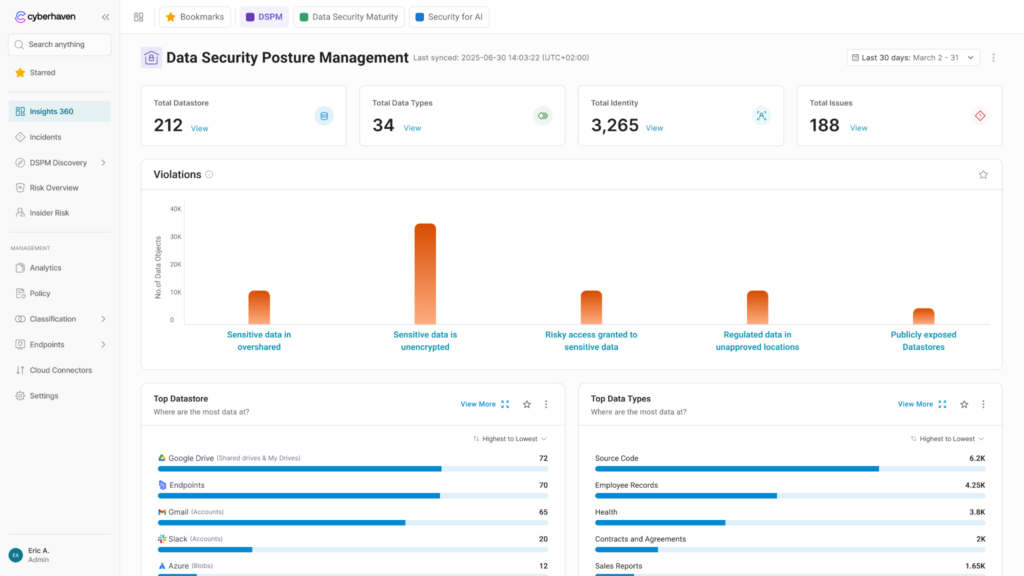
Cyberhaven is an AI-native data security platform that provides real-time visibility into authorized and unauthorized applications, coding assistants, and AI agents across SaaS ecosystems, endpoints, and developer environments.
The platform monitors employee AI usage, including prompt interactions, file access, and background process executions. It can enforce context-aware controls such as blocking, warning, or redacting sensitive data. It inventories Shadow AI surfaces across the enterprise, including command-line interfaces (CLIs), IDEs, and Model Context Protocol (MCP) servers.
Key Differentiator
Cyberhaven uses a specialized data lineage graph to trace sensitive data from its point of origin through multi-turn agent interactions, local models, and MCP servers. It can then reconstruct full execution lifecycles to enforce data-level guardrails at machine speed.
Best For
Enterprise security teams, CISOs, and IT leaders governing developer-heavy workflows and complex digital infrastructures across SaaS, financial services, healthcare, and manufacturing.
3. Akamai Workforce Protector (formerly LayerX)
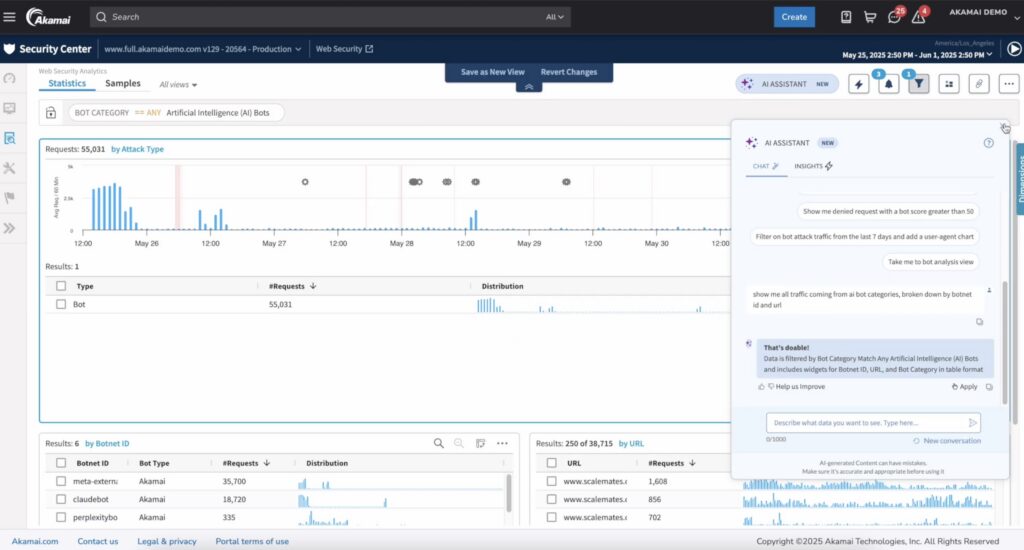
Akamai Workforce Protector is an interaction-layer cybersecurity solution that secures AI, SaaS, and web applications directly inside native browser sessions.
Key Differentiator
Delivered via a lightweight browser extension, it monitors prompts, responses, file transfers, and user inputs without requiring network monitoring, traffic redirection, or specialized browsers.
Best For
Akamai Workforce Protector operates at the browser session layer across managed and BYOD devices. It delivers real-time visibility, redaction, and policy enforcement for file-less AI actions (e.g., text inputs, copy-pasting, and agentic browser interactions) before data reaches public LLMs.
CISOs, IT security teams, and risk officers managing remote, hybrid, or contractor (BYOD) workforces across sectors like financial services, healthcare, retail, and the public sector.
4. Netskope One
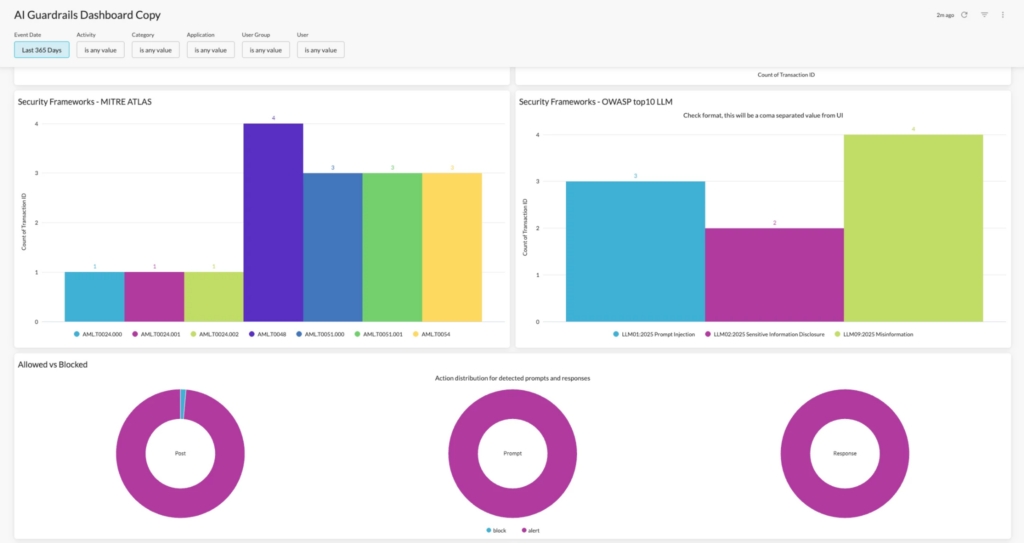
Netskope One is a cloud-native platform that unifies SASE, data security, and AI governance into a single engine and global network architecture.
Powered by its proprietary NewEdge private security cloud, it provides real-time inline traffic inspection to discover unsanctioned cloud and AI app usage across the enterprise. The platform decodes encrypted data flows and applies context-aware DLP policies to prevent sensitive corporate data from leaking into public LLMs.
Key Differentiator
Netskope One features specialized AI security controls that decode and govern Model Context Protocol (MCP) traffic between autonomous AI agents and enterprise data sources, while providing real-time defenses against prompt injection, jailbreaking, and LLM content risks.
Best For
CISOs, global network security architects, and IT leaders in large corporations managing complex multi-cloud deployments and hybrid workforces.
5. CloudEagle.ai
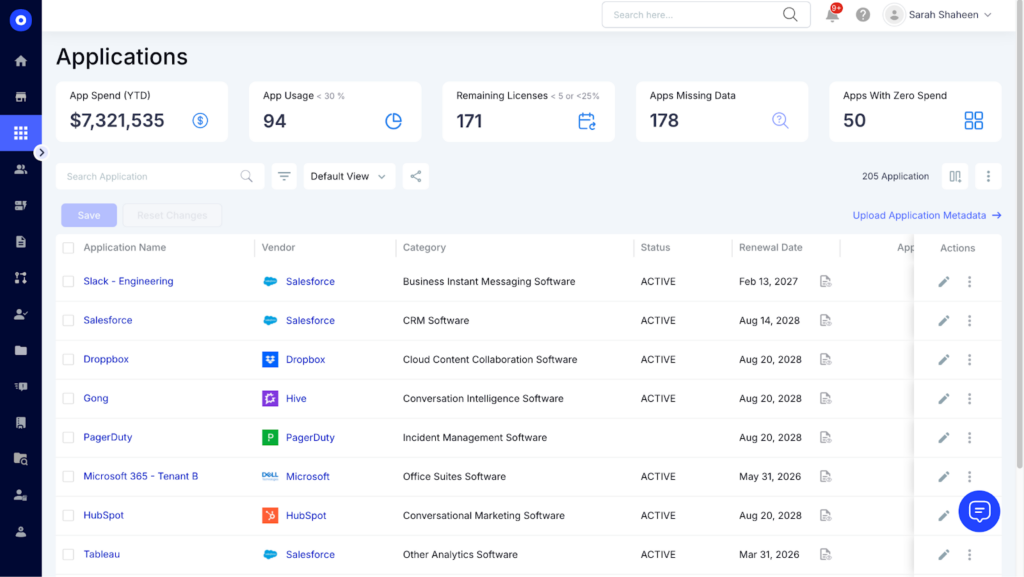
CloudEagle.ai is an AI usage control and SaaS discovery platform that monitors unauthorized applications and Shadow AI by correlating signals across SSO, endpoint security tools, browser activity, and financial records.
It uncovers embedded AI features within SaaS platforms, unapproved desktop tools, free trials, and personal account logins across the enterprise. Security, IT, and finance teams leverage the platform to eliminate duplicate software, mitigate compliance risks, and enforce enterprise AI policies.
Key Differentiator
CloudEagle.ai tracks AI consumption beyond high-level user logins down to exact pay-as-you-go tokens, specific LLM models, API keys, and autonomous agents. This enables precise departmental chargebacks and cost optimization.
Best For
CISOs, IT operations leaders, procurement managers, and FinOps/finance teams in mid-market to enterprise organizations seeking governance over workplace AI risks and corporate spend.
6. Reco
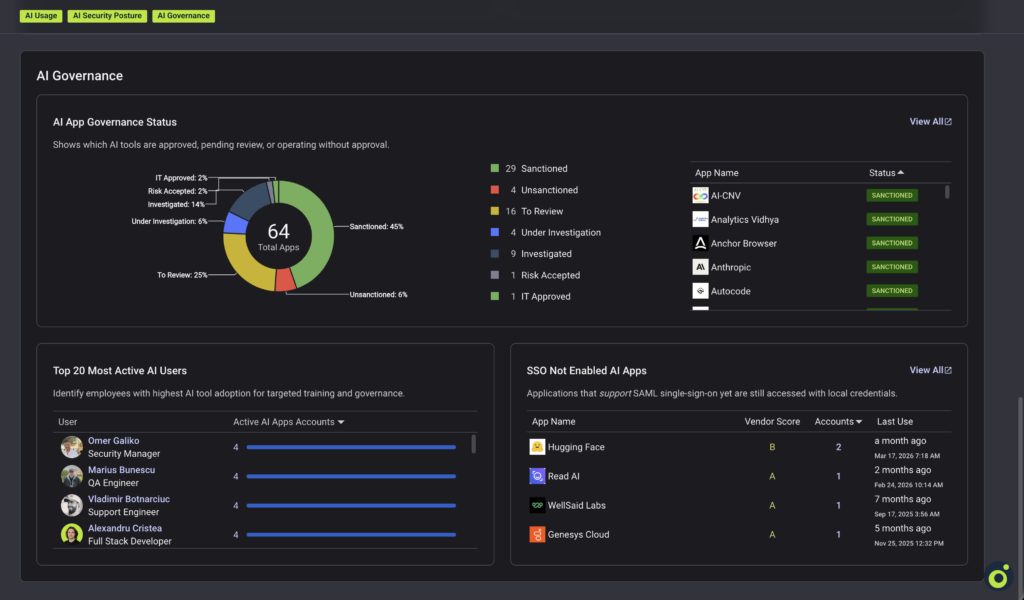
Reco is an identity-centric SaaS and AI security platform that delivers full visibility into sanctioned and Shadow AI applications, embedded GenAI capabilities, and AI agents. It continuously monitors non-human identities, OAuth grants, and SaaS-to-SaaS API integrations to prevent data leakage.
By combining app discovery, access governance, and threat detection, Reco ensures AI automation remains compliant and secure.
Key Differentiator
Reco deploys a proprietary engine to visually map every AI agent and third-party GenAI connection to its human owner, permission set, and data exposure paths, instantly flagging over-permissioned or orphaned AI identities.
Best For
CISOs, Security Operations (SecOps) teams, and IT risk managers in Fortune 500 and high-growth enterprises across financial services, healthcare, legal, and retail.
7. Harmonic Security
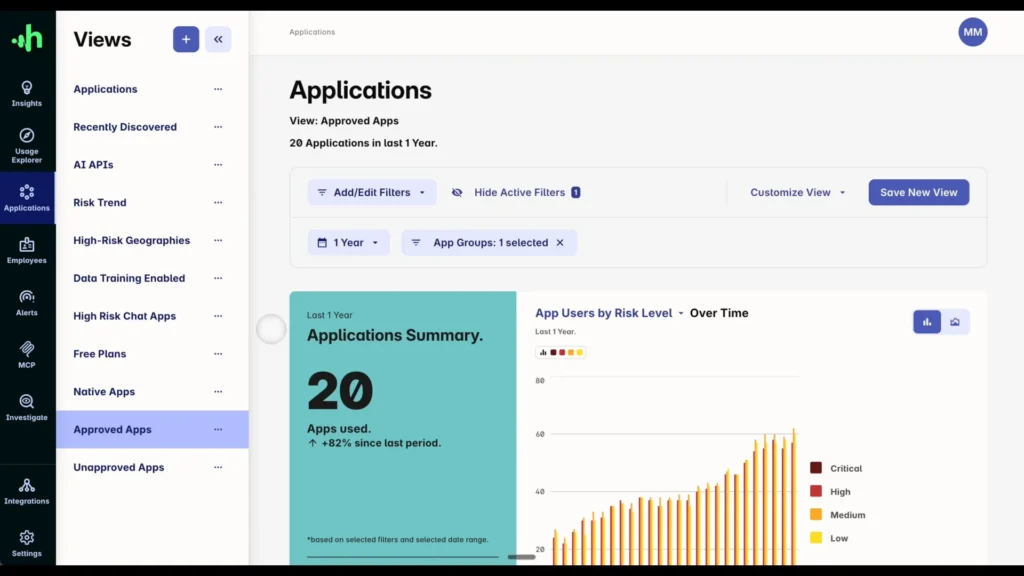
Harmonic Security is an AI Governance and Control (AIGC) platform that provides real-time visibility into Shadow AI across web, desktop, and agentic workflows.
It continuously discovers unapproved AI tools, evaluates model privacy risks, and enforces contextual DLP controls to stop prompt data leaks.
Key Differentiator
Harmonic Security utilizes purpose-built SLMs directly on the endpoint to analyze user intent and prompt context in real-time, enabling precise inline redaction and coaching where traditional, static regex DLP fails.
Best For
CISOs, security architects, and compliance officers in heavily regulated or IP-sensitive industries such as technology, legal, insurance, and healthcare.
8. Nudge Security
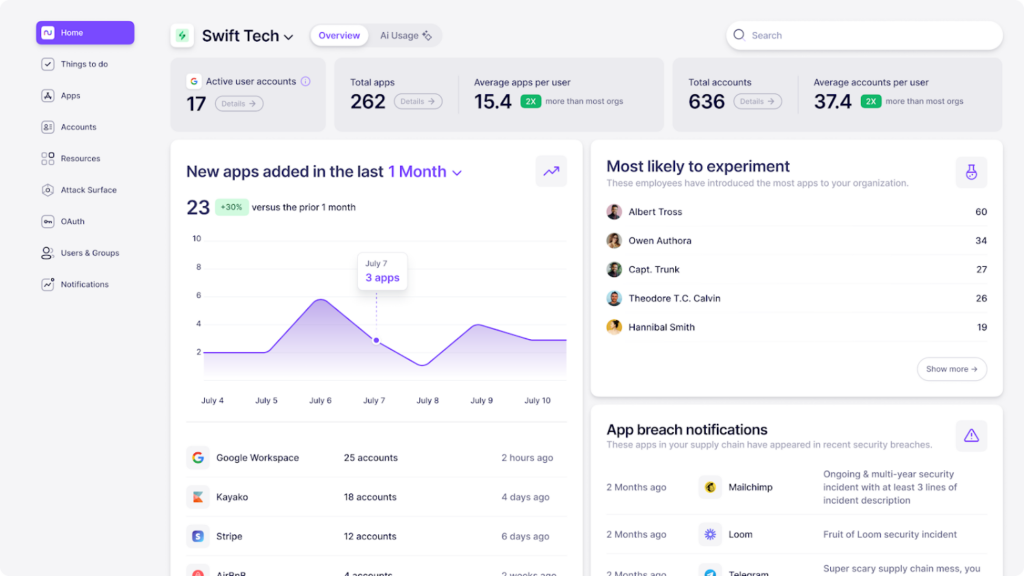
Nudge Security is a SaaS and AI security platform that provides perimeterless discovery of Shadow IT applications, cloud accounts, and third-party integrations. It correlates identity provider logs, browser extension telemetry, and workspace data to maintain a complete system of record for how employees adopt AI tools.
Instead of relying on hard network blocks that employees bypass, it uses automated behavioral cues to guide workforce behavior toward compliant AI usage.
Key Differentiator
Nudge Security sends automated, plain-English “nudges” to employees to remediate unsanctioned GenAI sign-ups, revoke overly permissive AI OAuth grants, and guide users away from pasting sensitive data into unvetted tools.
Best For
CISOs, IT security leaders, and workforce productivity managers in fast-scaling enterprises looking to curb Shadow AI sprawl through collaborative employee engagement rather than rigid network blocking.
9. Microsoft Purview (DSPM for AI)
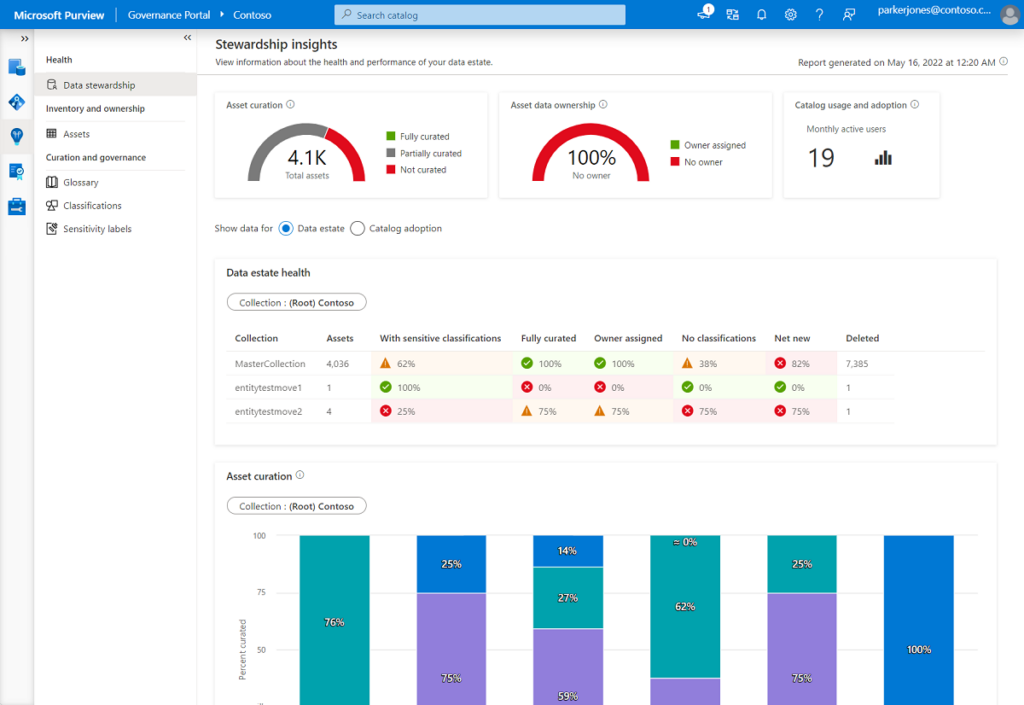
Microsoft Purview is an integrated data security and IT governance solution that delivers end-to-end visibility and risk management across an organization’s entire digital estate, including Microsoft Copilot, custom-built AI models, and public GenAI applications.
It continuously assesses data security posture, automatically detects sensitive corporate data inside AI prompts, and enforces adaptive protection policies across multicloud and SaaS environments.
Key Differentiator
Purview treats first-party Copilots, custom AI agents, and third-party AI apps as first-class entities within Microsoft 365 E5. It utilizes AI-powered Data Security Posture Agents to analyze contextual intent and enforce data classification and DLP policies inside Copilot workflows.
Best For
CISOs, data security administrators, and compliance officers in large enterprises with existing Microsoft 365 E5 deployments, particularly in regulated industries managing large volumes of classified, unstructured data.
10. Proofpoint AI Security (formerly Acuvity)
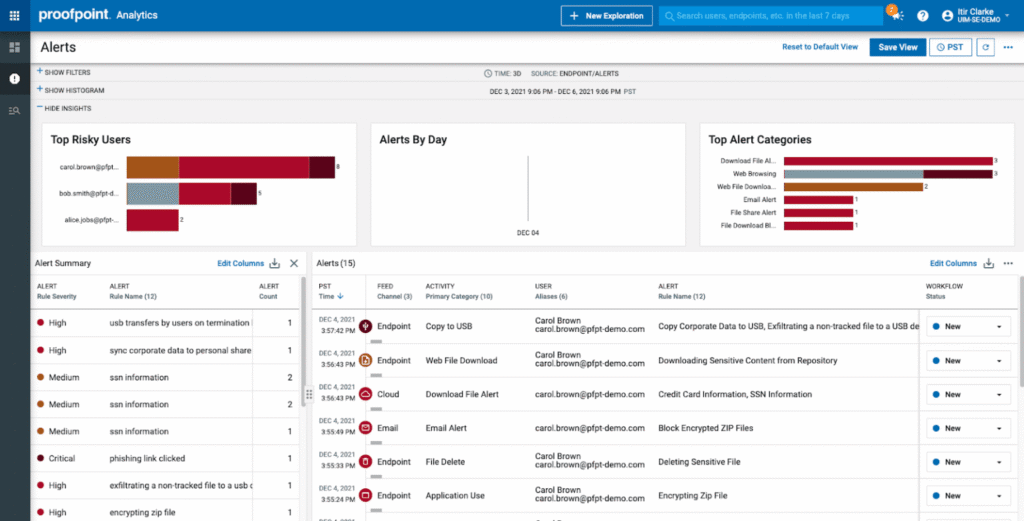
Proofpoint AI Security (formerly Acuvity) is an enterprise governance platform that delivers real-time visibility and runtime protection across human and autonomous AI agent workflows. It continuously discovers unsanctioned AI applications across web browsers, endpoints, local AI models (such as Ollama), and Model Context Protocol (MCP) infrastructure.
The platform inspects prompts, moderates outputs, and reconstructs multi-step agent transactions to prevent sensitive data exposure.
Key Differentiator
Proofpoint evaluates AI intent in real-time across autonomous agent interactions. It enforces content inspection directly at the Model Context Protocol (MCP) boundary to distinguish legitimate actions from prompt injections, model manipulation, and unauthorized cross-system access.
Best For
CISOs, CIOs, and security operations leaders in enterprise organizations managing complex AI agent ecosystems, software development teams, and hybrid collaboration environments.
How Do You Choose the Best Tool for Detecting Unauthorized AI Usage?
Selecting a Shadow AI detection tool requires looking beyond basic network proxies to ensure your team can inspect, govern, and remediate risky AI interactions across every layer.
When evaluating potential vendors, security leaders should benchmark capabilities against the following essential technical criteria:
- Endpoint-Centric AI and Agent Governance: Verify that the tool inspects desktop AI applications, browser extensions, and command-line interface (CLI) agents. It must also be able to capture full prompt-and-response transcripts.
- Proactive Real-Time Intervention: Prioritize solutions that take automated, instant action upon policy violation — such as inline user coaching warnings, prompt blocking, or session termination — rather than relying solely on post-incident passive alerts.
- 360-Degree Multi-Channel Visibility: Ensure the platform monitors activity across all endpoint interaction vectors, including clipboard copy-pasting, desktop screens, file transfers, instant messaging, and USB drives.
- Real-Time Optical Character Recognition (OCR): Assess whether the technology can extract and index text from live screens, video recordings, and images in real-time to enforce DLP rules on visual on-screen data.
- Unified Agent Architecture: Look for platforms that integrate user activity monitoring, insider threat detection, and DLP into a single endpoint agent, avoiding software clutter and operational fragmentation.
- User and Entity Behavior Analytics (UEBA): Choose tools that establish individual behavioral baselines to detect real anomalies — such as unusual command execution velocity or gradual data exfiltration — while keeping false positives low.
- Forensic-Grade Evidentiary Recording: Confirm that the system captures tamper-proof activity logs and screen playback that serve as defensible, chain-of-custody evidence for legal and HR investigations.
- Deployment Parity and Privacy Safeguards: Ensure the vendor offers full feature parity across cloud, on-premises, and private cloud hosting, alongside dynamic PII masking and flexible monitoring schedules to comply with regional privacy standards.
Shadow AI Detection Tools: What’s the Verdict?
Shadow AI isn’t a single technical vulnerability; it spans web browsers, desktop applications, developer terminals, and background cloud APIs.
Because of this, there is no universal “one-size-fits-all” tool. The ideal platform depends entirely on your existing security stack, compliance mandates, and primary risk vectors.
- For Identity, Spend, and OAuth Governance: If your primary goal is tracking unauthorized SaaS sign-ups, managing token consumption, or revoking risky OAuth grants, identity-centric solutions like CloudEagle.ai, Reco, or Nudge Security provide frictionless visibility.
- For Browser and Network-Layer Controls: If you want lightweight browser inline guardrails or Secure Service Edge traffic inspection, Akamai Workforce Protector, Harmonic Security, or Netskope One offer effective web-based prompt filtering.
- For Complex Agentic and Developer Ecosystems: If your teams actively build with autonomous coding assistants, local LLMs, or terminal scripts, platforms like Teramind, Cyberhaven, Proofpoint AI Security, or Microsoft Purview deliver specialized shell and agentic governance.
Why is Teramind an Ideal Choice for Shadow AI Governance?
See Teramind’s Shadow AI detection tool in action → Take a self-guided product tour
Teramind stands out because it addresses Shadow AI where risk originates: directly at the endpoint.
By unifying User Activity Monitoring (UAM), User and Entity Behavior Analytics (UEBA), and Data Loss Prevention (DLP) into a single agent, Teramind captures full prompt-and-response transcripts (including live visual content via patented OCR technology) and CLI terminal executions across 15+ system channels. It ships with 11 pre-configured AI enforcement rules, so organizations can secure high-speed developer workflows and stop data leaks immediately on deployment.
With feature parity across Cloud, On-Premises, and Private Cloud environments, Teramind delivers the forensic proof, real-time intervention, and multi-channel coverage required to eliminate Shadow AI blind spots.
Start your free Teramind trial today.
FAQs
How Do Shadow AI Detection Tools Identify Unapproved Usage Across Web and Desktop Applications?
Shadow AI detection tools monitor endpoint activity, browser sessions, identity provider logs, and network traffic to identify unsanctioned software.
While network proxies only inspect web traffic to known URLs, endpoint solutions like Teramind capture real-time prompt-and-response text, CLI operations, and desktop application activity. This ensures complete visibility even when employees use desktop apps, browser extensions, AI agents like Claude, or search platforms like Perplexity.
How Do Shadow AI Monitoring Tools Support Compliance With Regulations Like GDPR and HIPAA?
Unsanctioned AI tools frequently store user prompts for model training, creating severe regulatory exposure under the GDPR and HIPAA when employees upload personal or medical data.
Detection tools enforce automated DLP policies that detect and redact Protected Health Information (PHI) and Personally Identifiable Information (PII) before it reaches public models.
Teramind supports regulatory compliance by generating court-admissible forensic logs, dynamically masking sensitive visual on-screen data, and offering customizable tracking schedules.
How Does Automated Risk Scoring Help Security Teams Manage Shadow AI Sprawl?
Automated risk scoring evaluates user and entity behavior against established baseline activity to rank threats dynamically.
Rather than forcing security analysts to manually sift through thousands of daily prompts, risk scoring algorithms highlight AI data exfiltration, attempts to bypass network blocks, or repeated uploads of sensitive source code to unapproved LLMs.
Does Endpoint Monitoring for Shadow AI Create Employee Privacy or Surveillance Concerns?
Enterprise AI governance platforms are engineered to protect sensitive corporate data, not invade employee privacy.
Teramind mitigates privacy concerns through configurable guardrails:
- Limiting monitoring strictly to business hours or company-owned devices.
- Automatically redacting sensitive personal fields on screen playback.
- Enforcing Role-Based Access Controls (RBAC) so only authorized compliance officers can review session recordings.
Why Aren’t Traditional Network Firewalls and CASBs Enough to Block Shadow AI?
Traditional network proxies and CASBs inspect web traffic sent to known domains, but they remain blind to fileless endpoint actions like clipboard copy-pasting, local LLM execution, desktop AI applications, and encrypted terminal scripts.
Furthermore, when employees encounter hard network blocks, nearly half find workarounds or switch to unmonitored personal accounts. Endpoint-centric AI governance provides the visual and interaction-level visibility required to secure on-device activity as it happens.
