Your business needs the right combination of talent and skills to fulfill its goals. Strategic workforce planning is essential for predicting future talent needs, eliminating talent gaps, and driving long-term business performance.
However, traditional headcount planning often relies on static spreadsheets, historical staffing numbers, and vague estimates that fail to capture ground-level operational realities.
Modern workforce planning analytics bridges the gap between executive targets and operational execution. By connecting disparate data sources (combining behavioral telemetry, financial limits, and workforce data), organizations can forecast workload demand, eliminate workflow bottlenecks, and optimize resource allocation.
Integrating HR analytics and people analytics into your broader workforce analytics strategy gives HR leaders and executives the actionable insights required to enhance data-driven decision-making and align day-to-day execution with overall HR strategy.
How do you balance workload demand against available capacity?
At the heart of effective workforce analytics is the ability to balance two dynamic variables: workload demand and available productive capacity.
- Workload demand: The actual volume of work required to satisfy strategic goals, customer requirements, or service level agreements (SLAs). In financial services, for instance, demand may be dictated by quarterly loan application volumes, loan origination targets, or compliance audit deadlines.
- Available capacity: The real labor output your existing team can produce.
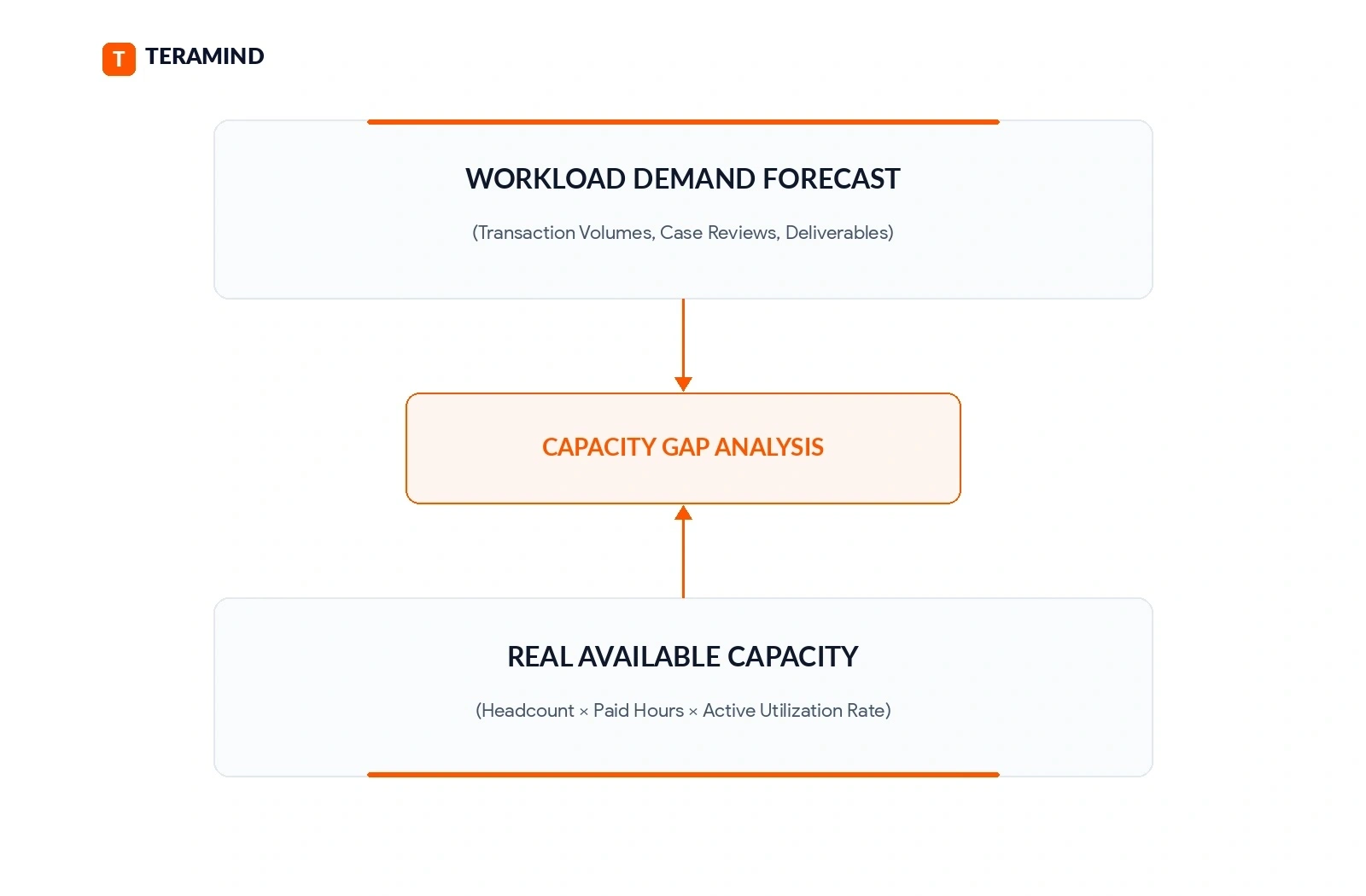
Calculating capacity based purely on standard scheduled working hours (e.g., 40 hours per week per employee) leads to chronic understaffing or overhiring.
True available capacity must factor in paid time off (PTO), administrative overhead, mandatory training, and actual active work patterns, as well as operational factors like the absenteeism rate.
Evaluating historical data establishes true baseline capacity before committing capital to new requisitions, ensuring teams hit their key operational KPIs.
What data comes from Teramind vs. HR or finance systems?
Comprehensive workforce planning requires aggregating metrics across multiple administrative and operational platforms.
Understanding where specific data originates ensures that HR professionals and business leaders ground their decisions on reliable performance metrics.
| System category | Data inputs collected | Role in strategic workforce planning |
|---|---|---|
| Teramind (Workforce behavioral analytics) | Active vs. idle time, application and website usage, task duration, workflow bottlenecks, and remote/hybrid performance trends. | Establishes realized productive capacity, highlights process drag, identifies workflow friction, and flags burnout risks to safeguard employee retention. |
| HRIS, HCM & ATS | Total staffing numbers, tenure, employee turnover, time-to-hire, cost per hire, skills inventories, and leave records. | Defines baseline workforce supply, records historical attrition, supports talent acquisition, and powers enterprise human capital management (HCM). |
| Finance & ERP (Financial management) | Fully loaded FTE labor costs, departmental budget allocations, revenue targets, and operating expense constraints. | Provides budgetary guardrails, financial limits, and return-on-investment (ROI) criteria for talent expansion. |
Should you hire, redistribute work, or improve processes?
When operational evaluation reveals that workload demand exceeds available productive hours, recruiting new personnel isn't always the most effective response.
Strategic leaders apply a three-tiered decision framework to protect the employee experience, maintain high employee productivity, and control escalating labor costs.
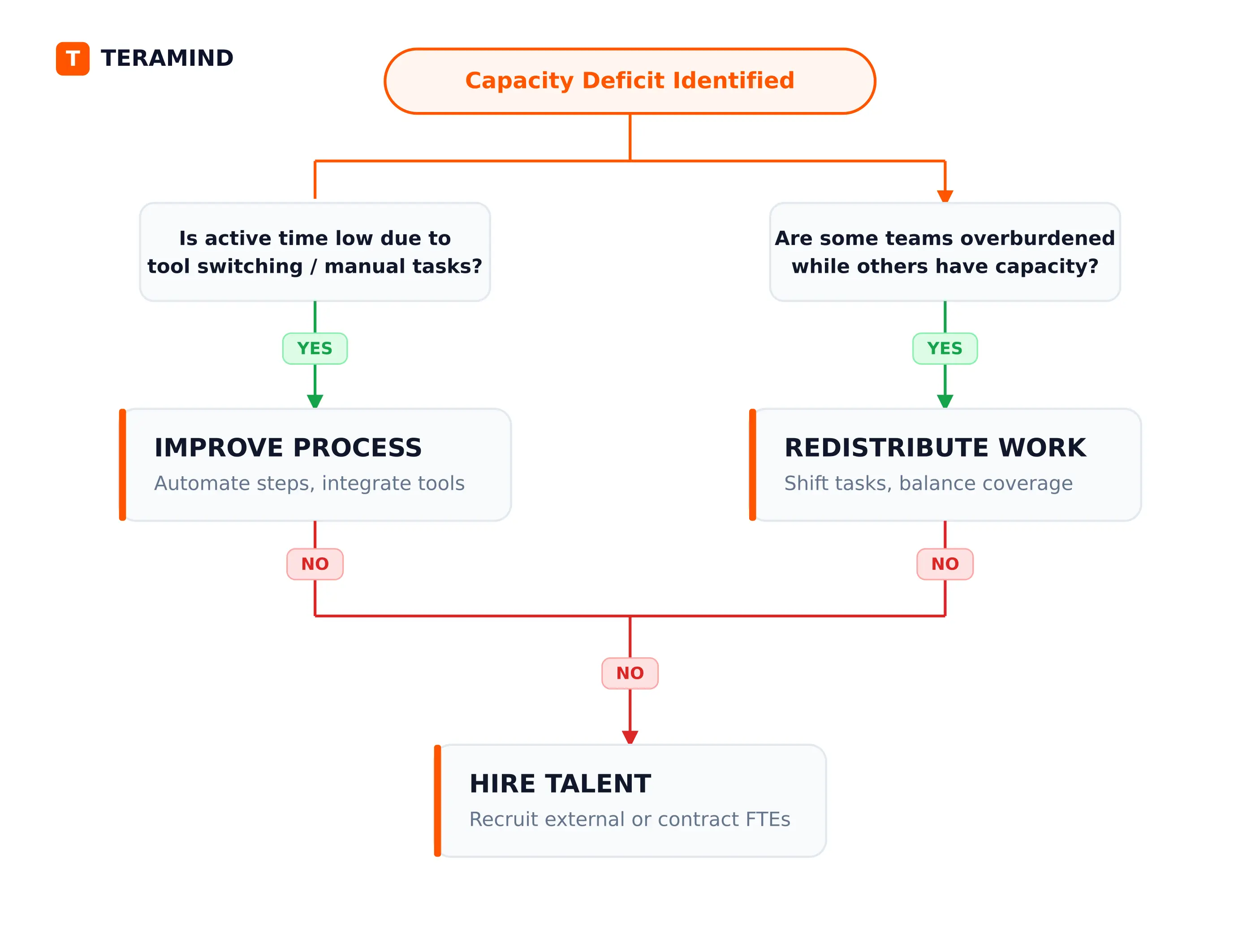
Tier 1: Improve the process
- When to act: Behavioral data shows that employees spend significant active working hours on repetitive data entry, application toggling, or redundant software steps.
- Action: Streamline workflows and integrate software tools to reclaim unproductive hours without increasing headcount.
Tier 2: Redistribute the workload
- When to act: Behavioral metrics indicate a distribution imbalance across regional offices, shifts, or hybrid teams, where some employees face burnout while others have spare capacity.
- Action: Reallocate task assignments, adjust coverage schedules, and upskill cross-functional team members to close localized skills gaps and maintain high employee engagement.
Tier 3: Hire new talent
- When to act: Capacity utilization is fully optimized, processes are streamlined, and demand still exceeds total productive output amid persistent skills shortages.
- Action: Authorize targeted requisitions for full-time employees or contractors with clear, data-backed ROI justification.
How does workforce planning analytics work in practice? A financial services scenario
To understand how workforce analytics prevents unnecessary hiring costs, consider a financial services institution managing Anti-Money Laundering (AML) compliance investigations.
Baseline operational assumptions
- Projected quarterly demand: 15,000 compliance review cases.
- Standard case handling time: 1.2 hours per review.
Total labor demand = 15,000 × 1.2 = 18,000 productive hours required per quarter
- Standard FTE contract: 480 gross working hours per analyst per quarter (12 weeks at 40 hours/week).
- Baseline active capacity (Teramind telemetry): Analysts display an active productivity rate of 70% (30% of paid time is lost to administrative overhead, system latency, and manual data copy-pasting across core banking tools).
Effective capacity per FTE = 480 gross hours × 0.70 = 336 productive hours/quarter
- Current staffing: 40 full-time compliance analysts.
Step-by-step calculations and capacity evaluation
Calculate current available capacity
Total available capacity = 40 analysts × 336 productive hours = 13,440 productive hours
Calculate initial capacity deficit
Capacity deficit = 18,000 required hours − 13,440 available hours = 4,560 productive hours
Traditional hiring reaction (without analytics optimization)
New hires needed = 4,560 deficit hours ÷ 336 productive hours/FTE ≈ 13.57 → 14 new analysts
At a fully loaded cost of $85,000 per analyst, hiring 14 new employees adds $1,190,000 in annual recurring expense.
Analytics-driven optimization with Teramind
Teramind goes beyond surface-level active versus idle time, utilizing in-app field parsing and business process mining alongside patented, real-time Optical Character Recognition (OCR).
This process mining telemetry reveals that compliance analysts spend an average of 72 minutes per day manually cross-referencing customer IDs between legacy mainframe databases and modern risk dashboards.
By deploying API integrations and automating data lookups, the organization eliminates this software friction, raising the average active productivity rate from 70% to 82% while enhancing overall employee performance.
Recalculated capacity and revised hiring needs
Optimized capacity per FTE = 480 gross hours × 0.82 = 393.6 productive hours/quarter
New capacity of existing 40 analysts = 40 × 393.6 = 15,744 productive hours
Revised capacity deficit = 18,000 − 15,744 = 2,256 productive hours
Revised new hires needed = 2,256 deficit hours ÷ 393.6 productive hours/FTE ≈ 5.73 → 6 new analysts
Financial and operational impact
By pinpointing operational bottlenecks via Teramind's granular process mining, the organization met its compliance targets by adding 6 analysts instead of 14.
This saved 8 FTE requisitions ($680,000 annually) in payroll expenses while protecting existing team members from overload.
Which core workforce planning metrics should you measure?
To evaluate the health and performance of your capacity plans, measure these critical HR metrics:
- Headcount and Full-Time Equivalent (FTE): Quantifies total staffing volume converted into standard full-time labor units to simplify capacity modeling.
- Active utilization rate: Measures the proportion of working hours dedicated to core job functions versus non-productive or administrative tasks.
- Turnover and attrition rate: Measures voluntary and involuntary separations to forecast upcoming talent loss and mitigate high employee turnover.
- Absenteeism rate: Measures unscheduled absences to assess overall workforce availability and workplace health.
- Time-to-hire and cost per hire: Evaluates the efficiency and financial resources required for talent acquisition.
- Skills inventory and gap index: Audits team capabilities to identify skills gaps and align training programs.
For detailed calculation formulas, benchmarks, and step-by-step implementation strategies, consult Teramind's guide to workforce planning metrics.
What are the primary types of workforce analytics?
A comprehensive workforce management strategy should incorporate four primary types of analytics:
- Descriptive analytics: Summarizes historical data to explain current operational status (e.g., baseline staffing, average active time, and historic employee turnover).
- Diagnostic analytics: Investigates underlying causes behind operational trends using diagnostic techniques (e.g., identifying why case processing times spiked in a specific department).
- Predictive analytics: Uses predictive models and machine learning to project future outcomes, such as upcoming talent gaps or seasonal demand spikes.
- Prescriptive analytics: Recommends targeted operational steps to support succession planning and address forecasted capacity deficits.
What are the key steps in analytics-driven workforce planning?
To establish an agile workforce productivity framework, HR leaders and operational managers must follow this six-step workflow:
- Align business objectives: Define target operational outputs, service levels, and financial goals with executive stakeholders.
- Aggregate systems data: Connect workforce analytics telemetry from Teramind with talent data from HCM platforms (like Workday) and financial limits from ERP software.
- Assess operational capacity: Evaluate baseline available productive capacity across departments, shifts, and remote working environments.
- Conduct gap analysis: Compare required workload demand against realized active workforce capacity.
- Execute targeted solutions: Apply the three-tiered decision framework to streamline processes, reallocate workloads, or authorize recruitment.
- Monitor and iterate: Leverage people analytics and workforce data to monitor productivity and employee retention. Refine your capacity models as business requirements evolve.
How does Teramind support workforce planning analytics?
Teramind delivers enterprise-grade workforce analytics that remove guesswork from capacity management.
Powered by its unified architecture, Teramind integrates workforce productivity analytics, insider risk management, and endpoint Data Loss Prevention (DLP) into a single lightweight agent.
Key capabilities that set Teramind's workforce analytics apart include:
- 360-degree multi-channel endpoint visibility: Captures detailed operational telemetry across 15+ system channels (including applications, websites, file operations, web uploads, emails, instant messaging, and terminal commands), providing complete context into how work gets done.
- In-app field parsing and business process mining: Examines user interactions down to specific form fields inside enterprise applications. This enables organizations to map actual business process sequences, uncover workflow friction, and verify compliance with standard operating procedures (SOPs).
- Patented real-time Optical Character Recognition (OCR): Automatically extracts, indexes, and searches visual text rendered on employee screens, enabling deep context discovery that standard activity logs miss.
- Workforce behavioral analytics and utilization benchmarks: Differentiates active input from passive or idle time, establishes objective baseline productivity benchmarks, and highlights cross-departmental workload imbalances.
- Hybrid and remote workforce intelligence: Provides consistent operational visibility across remote, hybrid, and on-site teams, ensuring equitable task distribution, optimal process efficiency, and reliable service delivery.
With Teramind, you'll transform your capacity modeling from an intuitive guessing game into a precise, data-backed strategy.
By combining behavioral telemetry with financial and talent metrics, organizations protect operating margins, optimize workflows, and structure their workforce for sustainable growth.
Ready to optimize your workforce capacity with data-driven precision?
